
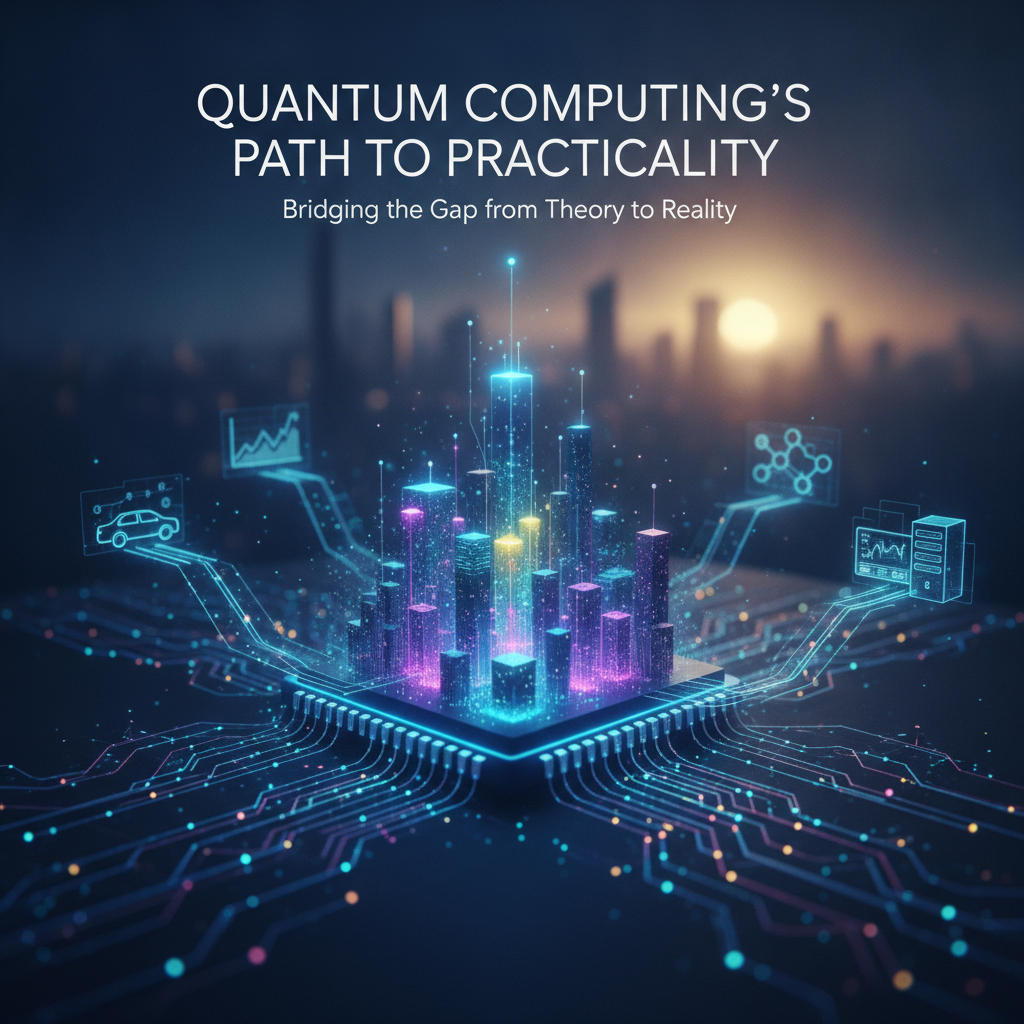
Quantum Computing: Bridging Theory & Reality
Hello Quantum Enthusiasts and Future Thinkers!
Quantum computing has been a hot topic for years, often conjuring images of futuristic breakthroughs and mind-bending physics. While the hype is certainly understandable, many of us are wondering: when will this revolutionary technology move beyond fascinating experiments and become a truly practical tool?
Beyond the Hype: What We’re Aiming For
At its core, quantum computing promises to solve problems currently intractable for even the most powerful supercomputers. This isn’t just about faster calculations; it’s about harnessing quantum phenomena like superposition and entanglement to explore vast computational spaces simultaneously. Imagine simulating new molecules for drug discovery, optimizing complex financial models, or cracking previously unbreakable encryptions – these are the practical dreams fueling quantum research.
The Current Landscape: A “Noisy” Yet Promising Era
We’re currently in the NISQ era – Noisy Intermediate-Scale Quantum. This means our quantum computers have a limited number of qubits (the quantum equivalent of bits) and these qubits are prone to errors due to their delicate nature. Think of it like a very powerful, but also very sensitive and temperamental, prototype. Despite these challenges, researchers are making incredible progress, demonstrating “quantum advantage” in specific, limited tasks, proving the underlying principles work.
Key Hurdles on the Path to Practicality
To truly unlock quantum computing’s potential, several significant hurdles must be overcome:
1. Error Correction and Mitigation
Quantum errors are frequent and difficult to fix. Developing robust quantum error correction codes is paramount. While perfect error correction is still far off, techniques like error mitigation are helping us squeeze more accurate results from current noisy devices.
2. Scaling Up Qubit Counts
Many practical problems will require hundreds, thousands, or even millions of stable, interconnected qubits. Building and controlling such large-scale quantum processors reliably is an engineering marvel in progress.
3. Hardware Stability and Coherence
Qubits need to maintain their quantum state (coherence) long enough to perform meaningful computations. Improving coherence times and reducing interference from the environment are critical areas of research.
4. Algorithmic Innovation and Application Development
We need more quantum algorithms tailored for practical, real-world problems. This involves not only theoretical breakthroughs but also developing user-friendly quantum programming tools and identifying the specific domains where quantum can offer a definitive advantage.
Glimmers of Practicality: Where We’re Headed
Despite the challenges, the path to practicality is becoming clearer:
Hybrid Quantum-Classical Approaches
Current quantum systems are often best used in conjunction with classical computers. Hybrid algorithms leverage the strengths of both, with quantum processors handling the computationally intensive quantum parts and classical computers managing the rest. This approach is showing promise in optimization and machine learning.
Specialized Quantum Simulators
Instead of building universal quantum computers immediately, specialized quantum simulators are being developed to model specific physical systems (like molecules or materials). These could provide early, practical insights in chemistry and materials science.
Advancements in Materials Science and Engineering
New qubit architectures, superconducting materials, and novel control techniques are constantly being explored, promising more stable, scalable, and efficient quantum hardware.
The Future is Quantum-Enhanced, Not Just Quantum
It’s unlikely quantum computers will replace classical computers entirely. Instead, they will serve as powerful accelerators for specific, hard problems. Think of it like GPUs for graphics processing or specialized ASICs for AI – a powerful tool in a larger computational toolkit.
The journey from the theoretical elegance of quantum mechanics to a practical quantum computer is a marathon, not a sprint. We are witnessing an incredible era of scientific and engineering innovation. While universal, fault-tolerant quantum computers are still some years away, the iterative progress, coupled with clever applications of current noisy devices, is steadily paving the way to a future where quantum computing solves some of humanity’s most pressing challenges. Stay tuned – the quantum revolution is unfolding before our eyes!


Leave a Reply