
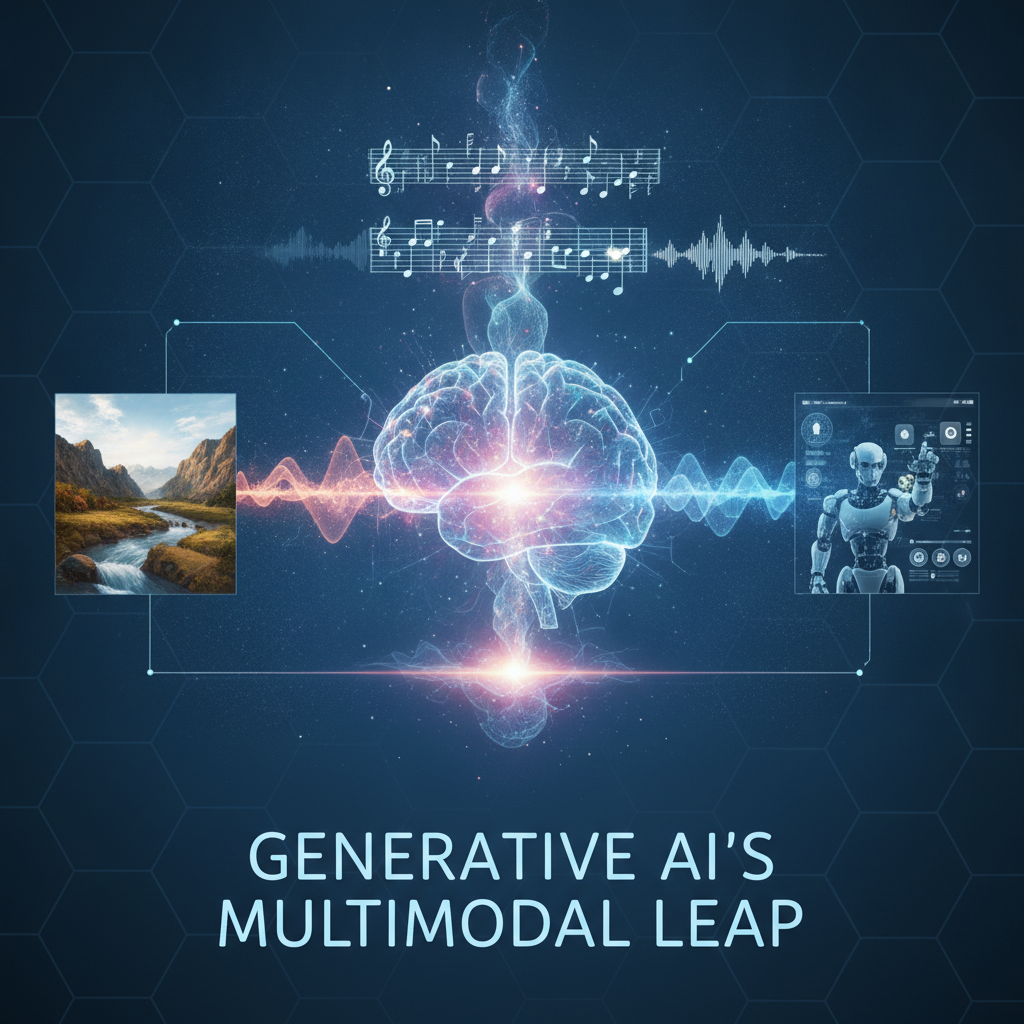
Generative AI has already reshaped how we interact with technology, moving from simple commands to creating intricate texts and stunning images. But what if AI could do more than just read and write? What if it could see, hear, and even understand the connections between these different ways of experiencing the world? That’s precisely the “multimodal leap” we’re witnessing, and it’s set to unlock a new era of AI capabilities.
What Exactly is Multimodal AI?
Traditionally, AI systems often specialized in one data type – think large language models (LLMs) focused solely on text, or computer vision models trained exclusively on images. Multimodal AI breaks down these silos, allowing for a more integrated and holistic understanding of information.
It refers to AI systems capable of processing, understanding, and generating content across multiple modalities simultaneously. Imagine an AI that can seamlessly work with text, images, audio, video, and even 3D models. It’s about AI making sense of the world the way humans do, by integrating diverse sensory information.
Why This is a Game-Changer
The real world isn’t siloed; it’s a rich tapestry of sights, sounds, and words. Multimodal AI allows for a more holistic and human-like understanding, recognizing the subtle relationships between different forms of data that might be missed by single-modality systems.
This integration leads to far more nuanced and contextually aware outputs. Imagine asking an AI to “create a whimsical image of a cat playing a piano in a jazz club, with a melancholic saxophone solo playing in the background.” A purely text-based AI can generate text, and an image AI can generate an image. A multimodal AI can *understand* the interplay and potentially generate both the image and a corresponding audio clip, or even a short video, all from one complex prompt.
This deeper contextual awareness enables AI to perform tasks that were previously impossible or required significant manual effort, opening doors to unprecedented creativity and efficiency.
Exciting Applications We’re Already Seeing
We’ve already been wowed by text-to-image generators like DALL-E, Midjourney, and Stable Diffusion. These are prime examples of multimodal AI in action, translating textual descriptions into breathtaking visual art. This ability to instantly visualize concepts has revolutionized creative industries.
But the applications go much further. Think of AI systems that can accurately describe the contents of a video for visually impaired users, generate realistic speech from text while understanding emotional nuances, or even create short video clips from simple text prompts. The ability to synthesize different content types is incredibly powerful.
From enhancing creative workflows for designers and artists to improving accessibility tools, revolutionizing educational content creation, and even enabling more natural human-computer interaction, the practical implications of multimodal AI are vast and growing daily.
The Road Ahead: An Integrated Future
The multimodal leap signifies a profound shift towards more intelligent, intuitive, and ultimately more useful AI systems. As models become more sophisticated, they will seamlessly integrate our inputs and generate outputs across various formats, truly acting as creative co-pilots or intelligent assistants that understand our intent across multiple dimensions.
Of course, with great power comes great responsibility. Addressing ethical considerations, mitigating bias in training data, and ensuring responsible deployment will be crucial as we navigate this exciting new frontier and continue to push the boundaries of what AI can perceive and create.
Generative AI’s journey from text-only wonders to systems that can see, hear, and create in multiple dimensions marks an extraordinary milestone. The multimodal leap isn’t just an incremental improvement; it’s a fundamental step towards AI that mirrors the richness of human perception and creation. Get ready, because the future of AI is vibrant, dynamic, and incredibly multimodal!
“`


Leave a Reply