
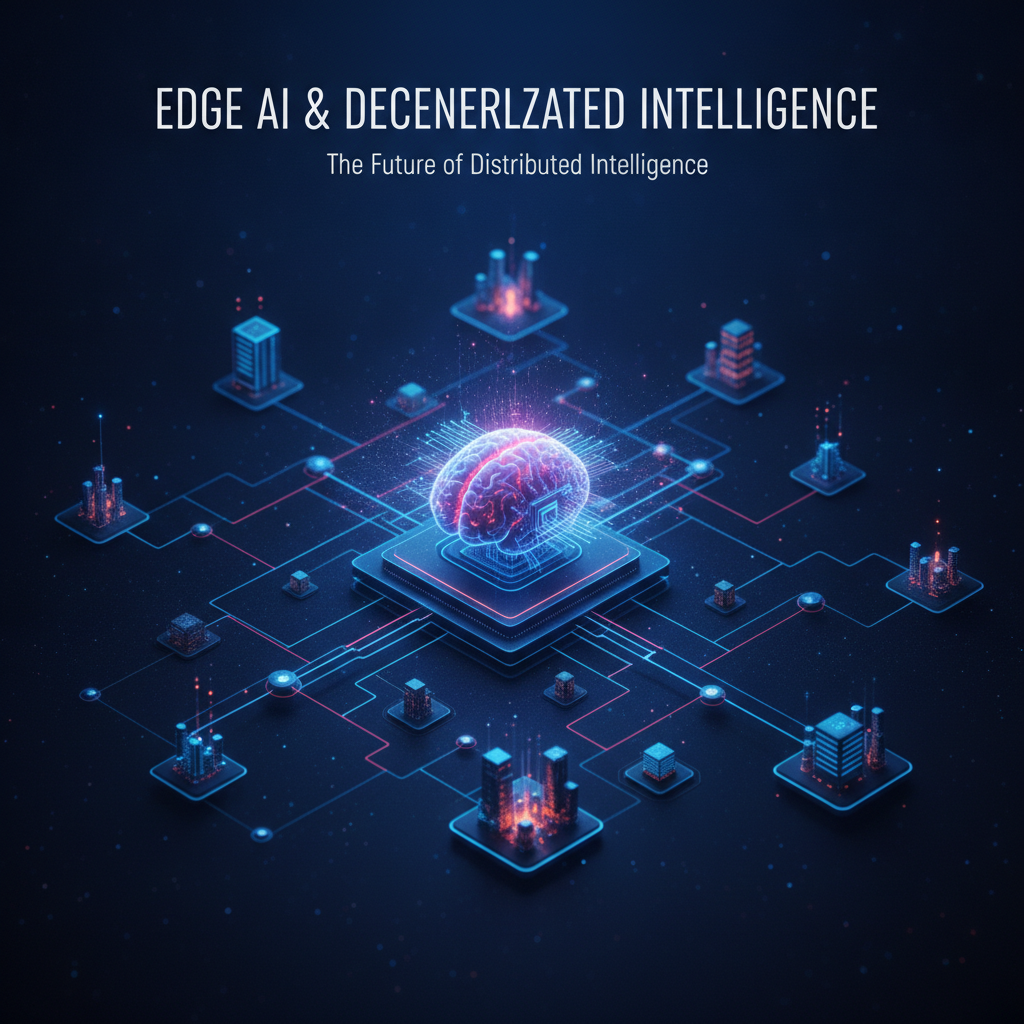
Advancements in Edge AI and Decentralized Intelligence
Welcome to the forefront of innovation! Today, we’re diving into two groundbreaking areas that are rapidly reshaping the landscape of artificial intelligence: Edge AI and Decentralized Intelligence. These powerful concepts aren’t just buzzwords; they represent a fundamental shift in how intelligence is processed, shared, and utilized across countless devices, moving us closer to a truly smart and responsive world.
The traditional model of sending all data to a central cloud for processing is becoming less feasible with the explosion of data generated by IoT devices. This is where Edge AI and Decentralized Intelligence step in, promising lower latency, enhanced privacy, and greater resilience. Let’s explore how these advancements are paving the way for the next generation of intelligent systems.
What is Edge AI? Bringing Intelligence Closer to the Source
Edge AI refers to the deployment of AI algorithms directly on edge devices – physical devices like sensors, cameras, smartphones, and industrial machinery – rather than relying solely on cloud-based servers. Instead of sending raw data to the cloud for analysis, processing happens right where the data is generated. This minimizes the need for constant network connectivity, reduces latency, and significantly cuts down on bandwidth usage.
Imagine a smart security camera that can identify suspicious activity in real-time without having to upload every frame to a remote server. Or an autonomous vehicle that can make immediate decisions based on its surroundings without a millisecond delay waiting for cloud instructions. That’s the power of Edge AI in action!
The Power of Decentralized Intelligence: Collective Brainpower
Decentralized Intelligence takes the concept further by enabling multiple edge devices to collectively learn, share insights, and make decisions without a central authority. This paradigm is about creating a network of intelligent agents that can collaborate, adapt, and evolve. Key concepts within decentralized intelligence include:
- Federated Learning: A machine learning technique where a shared global model is trained across multiple decentralized edge devices, each holding local data samples. This preserves data privacy as raw data never leaves the device.
- Swarm Intelligence: Inspired by the collective behavior of decentralized, self-organized systems (like ant colonies or bird flocks), this involves simple agents interacting locally with their environment and each other, leading to complex global behaviors.
- Multi-Agent Systems: Where multiple intelligent agents interact to achieve common goals, often in dynamic and unpredictable environments.
This distributed approach fosters greater robustness, scalability, and resilience compared to centralized systems. If one device or node fails, the overall system can often continue to function effectively.
Key Benefits and Transformative Applications
The synergy of Edge AI and Decentralized Intelligence unlocks a myriad of benefits and applications across various sectors:
- Reduced Latency: Critical for real-time applications like autonomous vehicles, industrial automation, and remote surgery, where milliseconds matter.
- Enhanced Privacy and Security: Data processing at the edge means sensitive data remains local, reducing the risk of breaches during transmission and meeting stringent privacy regulations.
- Lower Bandwidth Costs: Only processed insights, not raw data, need to be sent to the cloud (if at all), saving significant network resources.
- Increased Reliability: Systems can operate effectively even with intermittent or no internet connectivity, crucial for remote areas or critical infrastructure.
- Scalability: Easily add more intelligent devices to the network without overburdening a central server.
From smart cities monitoring traffic and pollution, to predictive maintenance in factories, to personalized healthcare devices analyzing patient data locally, these advancements are set to redefine how we interact with technology and our environment.
Challenges and The Road Ahead
While the potential is immense, deploying Edge AI and Decentralized Intelligence isn’t without its challenges. Resource constraints on edge devices (power, memory, computational power), ensuring data consistency and synchronization across distributed networks, and robust security measures for scattered intelligence are all areas of active research and development.
However, with rapid advancements in specialized hardware (like AI accelerators for edge devices) and innovative software frameworks, these hurdles are being overcome. The future points towards a highly distributed, interconnected, and intelligent ecosystem where AI is ubiquitous, responsive, and tailored to individual needs.
Embracing a Smarter, More Resilient Future
Edge AI and Decentralized Intelligence are not just incremental improvements; they represent a paradigm shift towards a more efficient, private, and robust future for AI. As these technologies mature, we can expect to see an explosion of innovative applications that empower devices, enrich our lives, and create a truly intelligent world. The journey has just begun, and it promises to be an incredibly exciting one!


Leave a Reply