
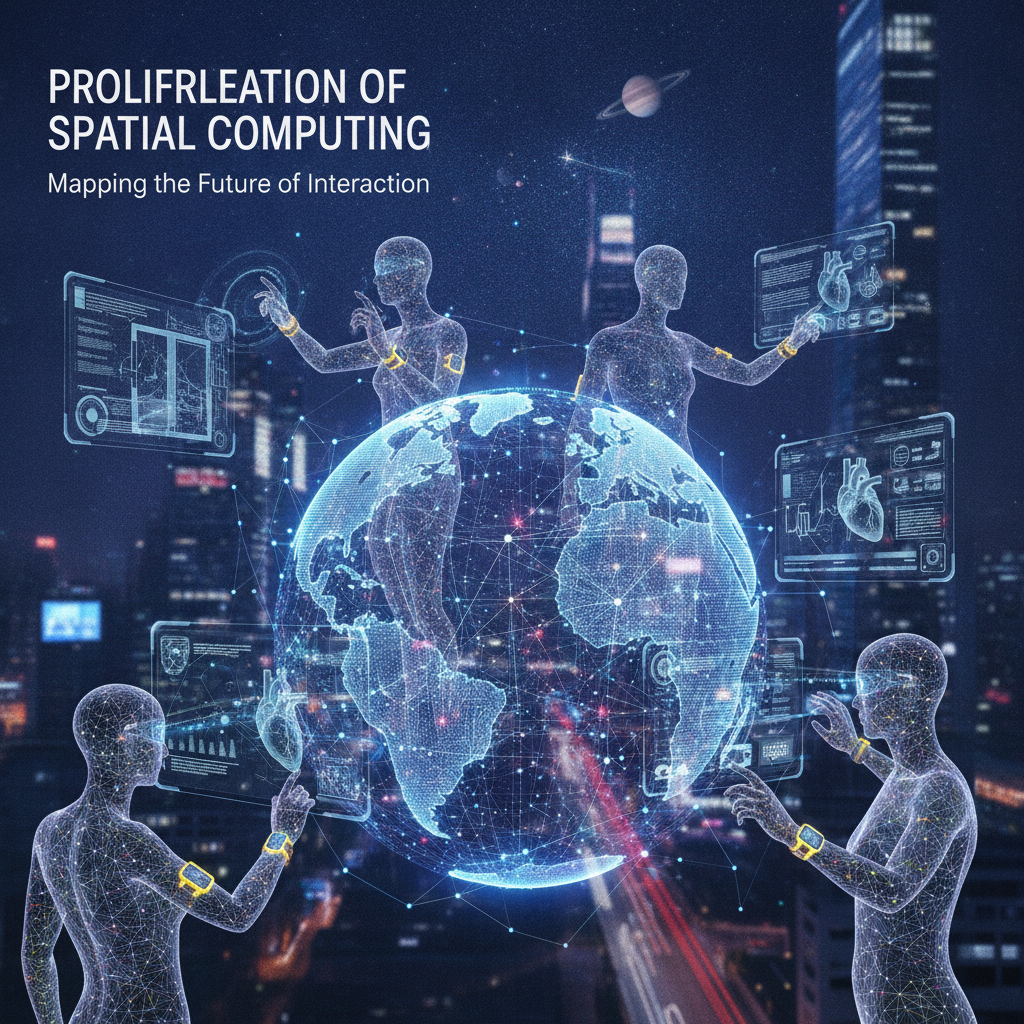
Spatial Computing: Changing Our World
Remember when computers were just boxes on our desks, and then tiny screens in our pockets? Well, get ready for the next leap! Spatial computing is rapidly moving beyond niche tech demos and into our everyday lives, fundamentally reshaping how we interact with information and the world around us. It’s an exciting, transformative journey, and we’re just at the beginning of its widespread proliferation.
What Exactly is Spatial Computing?
At its heart, spatial computing is about blending our digital world with our physical environment. Instead of interacting with flat screens, we’re engaging with digital content that’s anchored in or aware of 3D space. Think of it as computing that understands and operates within your physical surroundings, allowing you to manipulate holograms, immerse yourself in virtual worlds, or overlay digital instructions directly onto real-world objects. It encompasses technologies like Augmented Reality (AR), Virtual Reality (VR), and Mixed Reality (MR), all working together to create a seamless, intuitive experience.
The Accelerating Drivers of Adoption
So, why is spatial computing suddenly everywhere? Several factors are converging to fuel its rapid proliferation:
Hardware Evolution: We’re seeing more powerful, yet increasingly comfortable and accessible, devices. From advanced VR headsets like Meta Quest to groundbreaking mixed reality devices such as Apple Vision Pro, the hardware is becoming sophisticated enough to deliver compelling experiences.
Software & Platform Maturity: Development tools and platforms are becoming more robust, making it easier for creators to build immersive applications. Game engines like Unity and Unreal Engine are powerful enablers, while new operating systems designed for spatial interaction are emerging.
Connectivity & AI: The rollout of 5G networks provides the low latency and high bandwidth needed for complex, real-time spatial interactions. Meanwhile, advancements in Artificial Intelligence (AI) are making these systems smarter, allowing for more natural language processing, object recognition, and context awareness.
Growing Awareness: High-profile product launches and increasing media coverage are bringing spatial computing into the mainstream consciousness, sparking curiosity and demand from both consumers and enterprises.
Where We’re Seeing It Bloom
The impact of spatial computing isn’t confined to a single sector; it’s branching out across various industries:
Enterprise & Industry: Companies are using spatial computing for everything from remote assistance and employee training to designing new products with digital twins and visualizing complex data in 3D. Imagine a surgeon practicing a procedure in VR or an architect walking through a building model before it’s even built!
Entertainment & Gaming: This is perhaps the most familiar application. VR games offer unparalleled immersion, while AR filters and experiences are becoming common on social media, blending our digital identities with reality.
Education: Spatial computing is transforming learning by offering interactive virtual field trips, anatomy lessons in 3D, and engaging simulations that make complex subjects more accessible and memorable.
Healthcare: Beyond training, it’s being used for therapy (e.g., pain management, phobia treatment), surgical planning, and even assisting during operations by overlaying critical patient data.
The Road Ahead: Exciting and Evolving
While the proliferation of spatial computing is undeniable, it’s still a nascent field with immense potential. Challenges like cost, widespread content creation, and user comfort are continually being addressed. However, the trajectory is clear: our future interactions with technology will be increasingly immersive, intuitive, and deeply integrated with our physical surroundings.
The screens around us are beginning to melt away, making way for a world where information and interaction exist fluidly in the space we inhabit. Get ready to step into a new dimension of computing – it’s already here, and it’s rapidly expanding!
“`

Leave a Reply