
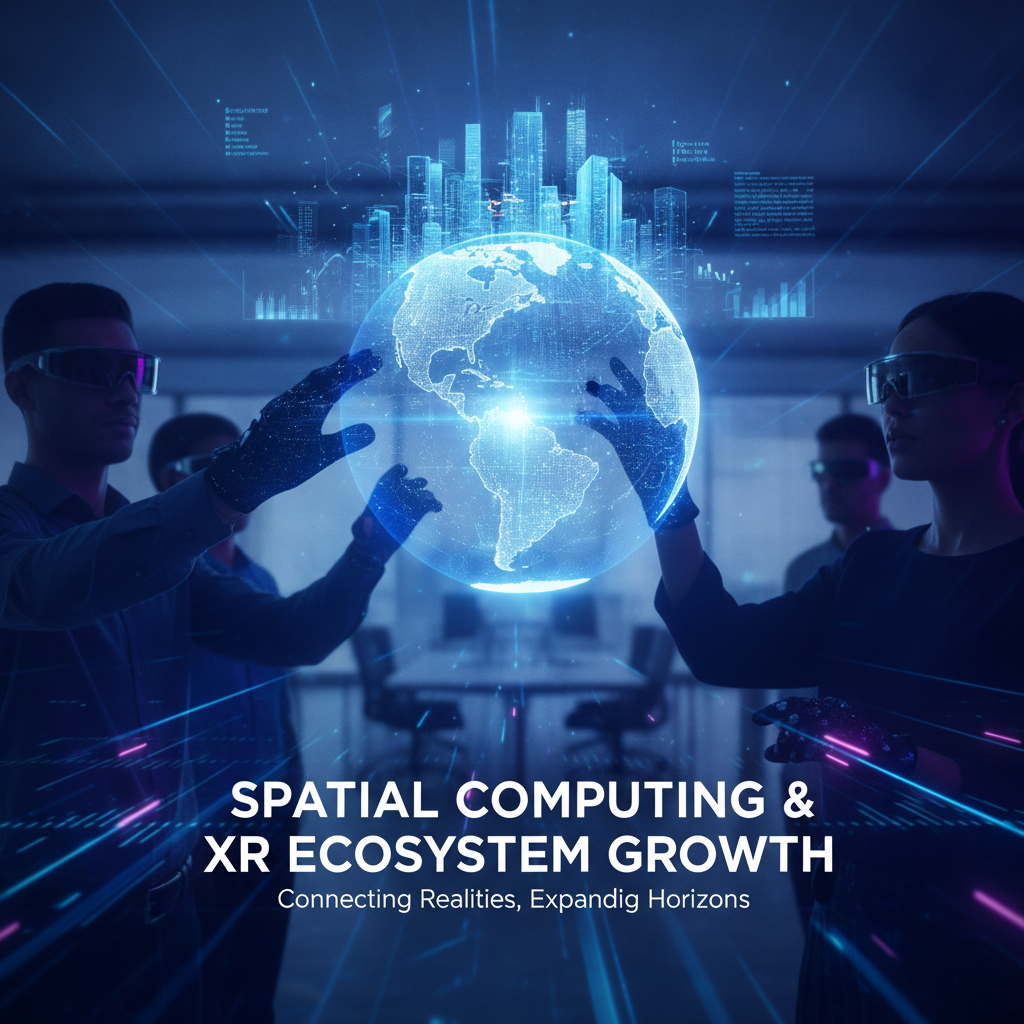
The Future is Spatial: XR Ecosystem Takes Off
Step aside, flat screens! A revolution is brewing that’s set to transform how we interact with technology and the world around us. Spatial computing, powered by Extended Reality (XR), is no longer the stuff of science fiction; it’s here, and its ecosystem is growing at an incredible pace. Get ready to explore a future where digital content seamlessly blends with our physical reality.
What Exactly is Spatial Computing & XR?
At its core, Spatial Computing is about enabling computers to understand and interact with the physical world, much like humans do. It processes information not just as pixels on a screen, but as objects, spaces, and relationships within a 3D environment. Extended Reality (XR) is the umbrella term encompassing Virtual Reality (VR), Augmented Reality (AR), and Mixed Reality (MR) – the technologies that bring spatial computing to life. Think about it: instead of looking at a screen, you’re looking through it, or even within it, as digital information overlays or merges with your real surroundings.
Why Now? The Drivers of Exciting Growth
So, what’s fueling this explosion of interest? A perfect storm of technological advancements is at play. We’re seeing more powerful, yet more compact, hardware (headsets, sensors). Processing power is skyrocketing, AI is becoming incredibly sophisticated, and connectivity (5G) is enabling real-time, high-fidelity experiences. Major tech players are pouring investments into research and development, creating a virtuous cycle of innovation. Developers are flocking to the space, eager to build the next generation of applications, further enriching the ecosystem.
Transforming Industries, One Dimension at a Time
The impact of spatial computing and XR is far-reaching, extending beyond gaming and entertainment.
- Enterprise & Industry: From remote assistance and collaborative design in architecture and manufacturing to virtual training simulations for complex procedures, businesses are leveraging XR to boost efficiency, reduce costs, and enhance safety.
- Healthcare: Surgeons can practice complex operations, therapists can use VR for pain management and phobia treatment, and medical students can explore the human body in immersive 3D.
- Education: Learning becomes experiential, allowing students to virtually visit ancient Rome, dissect a frog, or explore the solar system.
- Retail & Marketing: Imagine trying on clothes virtually or previewing furniture in your living room before buying.
The possibilities are truly endless, fundamentally changing how we work, learn, and live.
The Ecosystem: A Collaborative Frontier
No single company can build this spatial future alone. The growth of the XR ecosystem is a testament to incredible collaboration. It involves hardware manufacturers pushing the boundaries of display and tracking technology, software developers creating intuitive platforms and applications, content creators crafting immersive experiences, and researchers continually exploring new frontiers. Interoperability and open standards are becoming increasingly crucial to ensure a seamless and accessible spatial web for everyone.
Embrace the Spatial Future
The journey into spatial computing is just beginning, and the XR ecosystem is a vibrant, rapidly expanding frontier. It promises not just new ways to consume content, but entirely new paradigms for human interaction, productivity, and creativity. So, keep an eye on this space – better yet, step into it. The future isn’t just digital; it’s spatial, and it’s happening now!
“`


Leave a Reply