
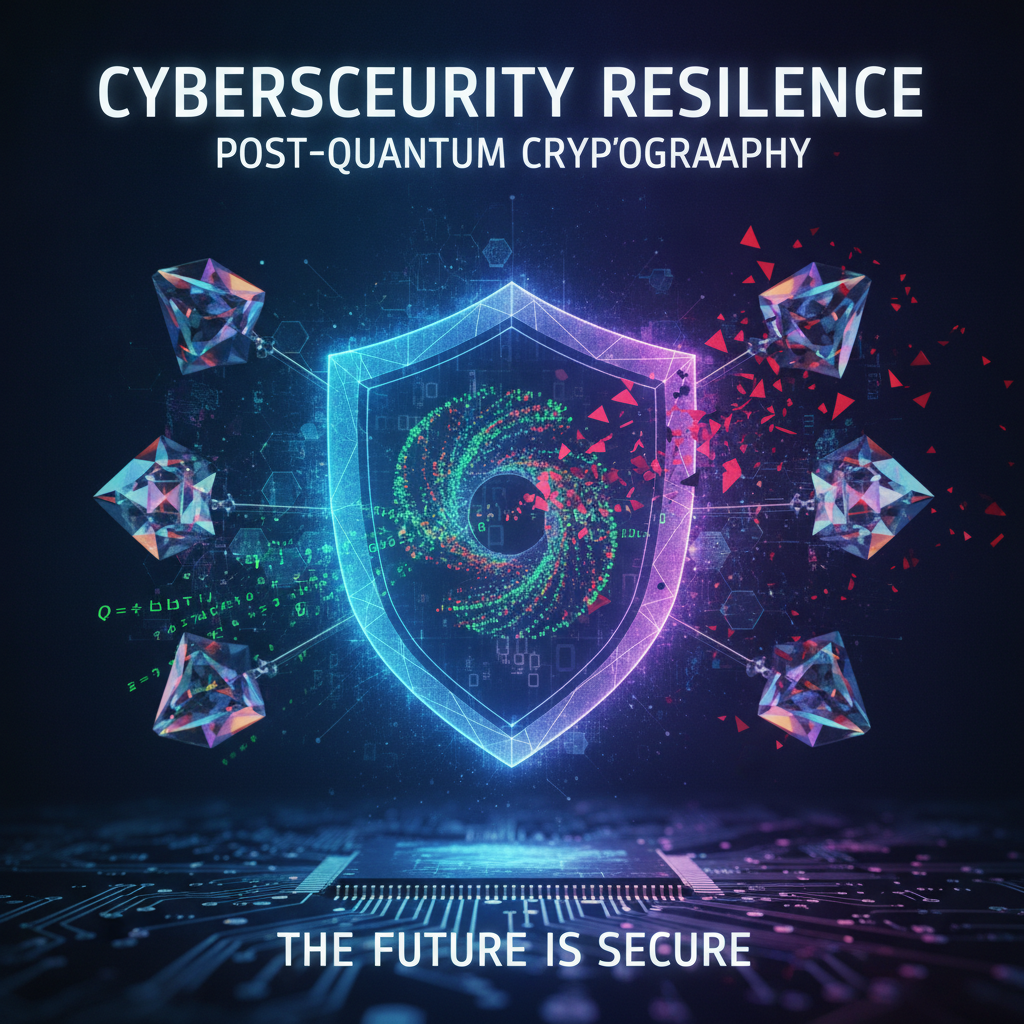
Securing Your Future: Quantum Resilience & Post-Quantum Cryptography
In today’s fast-evolving digital world, cybersecurity isn’t just about building walls; it’s about building a fortress that can withstand attacks and quickly bounce back stronger. This concept is called cybersecurity resilience. But what happens when the very foundations of our digital security, our encryption, face an unprecedented threat? Enter quantum computing. Let’s explore why cybersecurity resilience is more critical than ever, especially with the rise of Post-Quantum Cryptography (PQC).
Building Stronger Defenses: The Essence of Resilience
Cybersecurity resilience goes beyond simply preventing breaches. It’s the ability of an organization to prepare for, respond to, and recover from cyberattacks, minimizing damage and ensuring business continuity. Think of it like a robust immune system for your digital assets. In a world where threats are constantly evolving, being resilient means:
- Proactively identifying vulnerabilities.
- Having robust incident response plans.
- Minimizing recovery time objectives (RTO).
- Adapting and learning from every incident.
It’s about having the flexibility to not just survive a cyber-attack, but to emerge stronger and more secure.
The Quantum Threat: A Cryptographic Wake-Up Call
For decades, our digital world has relied on powerful encryption algorithms like RSA and Elliptic Curve Cryptography (ECC) to secure everything from online banking to classified government communications. These algorithms are based on mathematical problems that are incredibly difficult for even the most powerful supercomputers to solve.
However, quantum computers, still in their early stages, promise to be vastly more powerful for certain types of computations. Specifically, they have the potential to break these widely used public-key encryption standards, rendering much of our current digital security obsolete. This isn’t a distant science fiction scenario; experts predict that cryptographically relevant quantum computers could emerge within the next decade or two, making “harvest now, decrypt later” attacks a real concern.
Post-Quantum Cryptography (PQC): Our Quantum Shield
This is where Post-Quantum Cryptography (PQC) comes in. PQC refers to new cryptographic algorithms that are designed to be resistant to attacks by both classical and quantum computers. These are entirely new mathematical problems that even a powerful quantum computer would find practically impossible to solve.
Organizations like the National Institute of Standards and Technology (NIST) have been leading the charge in standardizing these new PQC algorithms. The goal is to develop a suite of quantum-resistant algorithms that can replace our current vulnerable standards before quantum computers become a widespread threat.
Preparing for the Quantum Future: Steps for Enhanced Resilience
While quantum supremacy might seem far off, the time to prepare for a quantum-safe world is now. Building cybersecurity resilience in the face of quantum threats involves:
- Inventory Your Cryptography: Understand where and how encryption is used across your organization. What systems, data, and communications rely on algorithms vulnerable to quantum attacks?
- Assess Your Quantum Risk: Identify your most critical assets and data that would be catastrophic if compromised by a quantum computer.
- Develop a Migration Strategy: Plan how you will transition your systems to PQC algorithms. This will be a complex, multi-year effort.
- Embrace Crypto-Agility: Design your systems to be flexible, allowing for easier updates and transitions to new cryptographic standards as they evolve.
- Stay Informed: Keep track of PQC standardization efforts and the progress of quantum computing technology.
Proactive planning today will save immense headaches (and potential breaches) tomorrow.
The Road Ahead: A Secure, Resilient Quantum Future
Cybersecurity resilience and Post-Quantum Cryptography are two sides of the same coin when it comes to securing our future. By understanding the quantum threat and strategically implementing PQC, organizations can build stronger, more adaptable digital defenses. It’s not just about surviving the next attack; it’s about thriving in a world where the technological landscape is constantly shifting. Let’s work together to build a secure, resilient digital tomorrow!


Leave a Reply