
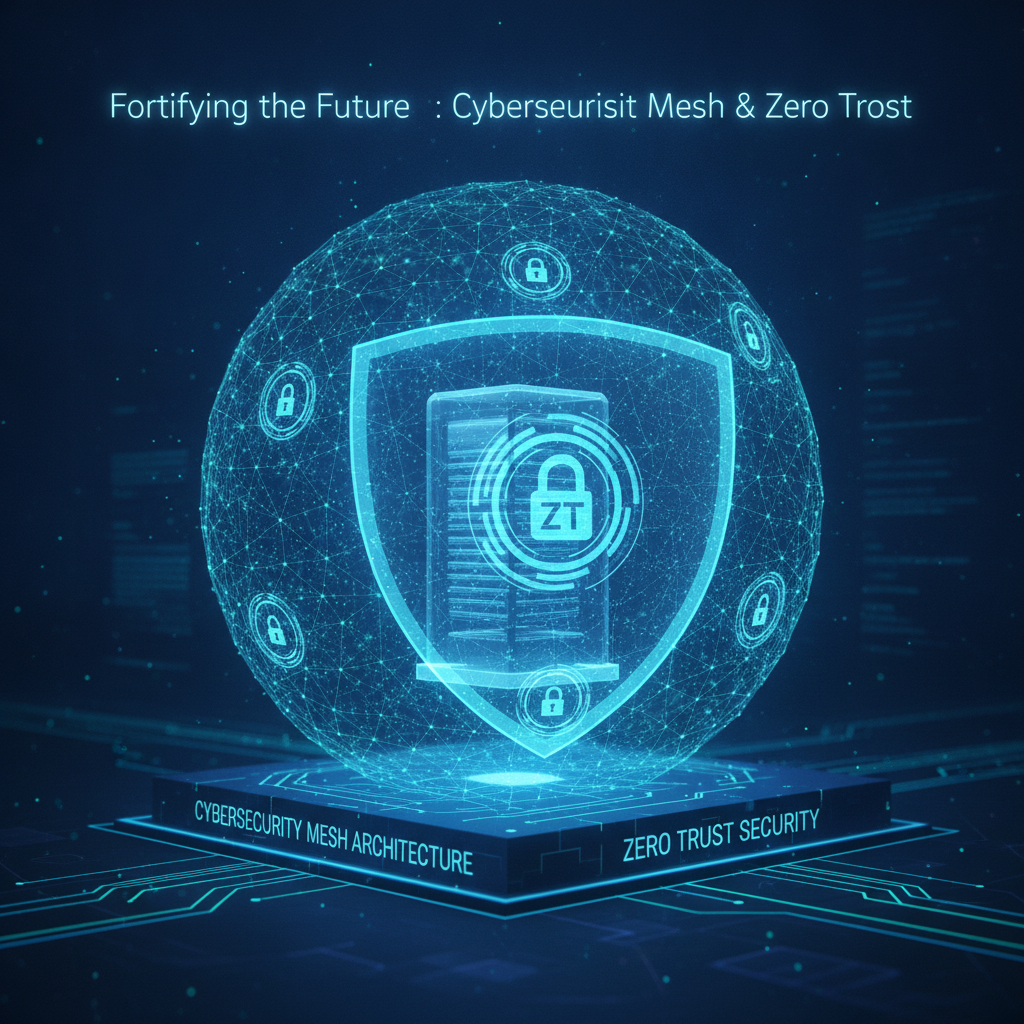
Future-Proofing Your Defenses: Cybersecurity Mesh Architecture and Zero Trust
In today’s interconnected world, traditional perimeter-based security is simply no longer enough. Our data, applications, and users are everywhere – in the cloud, on mobile devices, and scattered across hybrid environments. This distributed landscape demands a more adaptive, resilient, and intelligent approach to cybersecurity. Enter two game-changing concepts: Cybersecurity Mesh Architecture (CSMA) and Zero Trust Security.
Understanding Zero Trust Security: Never Trust, Always Verify
At its heart, Zero Trust is a security model built on the principle that no user, device, or application should be trusted by default, whether inside or outside the network perimeter. Every access request must be verified before being granted, and access is always provisioned with the least privilege necessary. Think of it as a constant state of skepticism, where every interaction is treated as potentially malicious until proven otherwise.
Key tenets of Zero Trust include:
- Verify explicitly: Authenticate and authorize every access request based on all available data points, including user identity, location, device health, and service/data classification.
- Use least privilege access: Grant only the necessary access for a limited time.
- Assume breach: Design systems with the assumption that breaches will occur, and prepare to limit damage.
Introducing Cybersecurity Mesh Architecture (CSMA): Unifying Distributed Security
If Zero Trust is the “what” (the philosophy of security), then Cybersecurity Mesh Architecture (CSMA) is the “how” (the architectural approach that makes it achievable in complex environments). Gartner defines CSMA as a composable and scalable approach to security that enables security services to be deployed, integrated, and managed across disparate IT environments.
Imagine a distributed fabric of security tools and services that can talk to each other, share intelligence, and enforce policies consistently, no matter where they reside. That’s CSMA. It shifts from monolithic security stacks to a modular approach, where individual security tools become interoperable components of a larger, unified security ecosystem.
The Powerful Synergy: How CSMA Elevates Zero Trust
This is where the magic happens! While Zero Trust provides the guiding principles, CSMA provides the technological framework to implement those principles effectively across modern, complex IT landscapes. CSMA makes Zero Trust truly practical and scalable.
Here’s how they work together:
- Distributed Policy Enforcement: Zero Trust policies need to be enforced everywhere – from endpoint to cloud. CSMA provides the mechanism to distribute and enforce these policies consistently across diverse security tools and infrastructures, even as workloads move.
- Enhanced Visibility and Analytics: CSMA integrates various security analytics tools, providing a holistic view of security events and user behavior. This comprehensive visibility is crucial for the “always verify” aspect of Zero Trust, allowing for continuous authentication and authorization based on real-time context.
- Interoperability and Orchestration: Zero Trust requires multiple security controls (identity providers, access management, device posture checks, threat detection) to work in concert. CSMA provides the glue, enabling these disparate tools to communicate, share data, and orchestrate responses seamlessly.
- Simplified Management of Complexity: By offering a centralized management plane over distributed security services, CSMA helps organizations manage the complexity inherent in implementing Zero Trust across multi-cloud and hybrid environments without sacrificing granular control.
Key Benefits of This Combined Approach
Adopting both CSMA and Zero Trust offers significant advantages:
- Stronger Security Posture: By eliminating implicit trust and verifying every access, organizations drastically reduce their attack surface and mitigate risks from advanced threats.
- Improved Agility and Scalability: The modular nature of CSMA allows security to adapt quickly to new business requirements, cloud adoptions, and remote workforces, while Zero Trust ensures these new elements are secure from day one.
- Better User Experience: Secure, context-aware access from any location or device means users can work efficiently without constant security hurdles.
- Reduced Operational Overhead: While implementation requires effort, the long-term benefit includes more automated and efficient security operations, with better threat detection and response capabilities.
Embracing the Future of Cybersecurity
The convergence of Cybersecurity Mesh Architecture and Zero Trust Security isn’t just a trend; it’s a fundamental shift towards building more resilient, adaptable, and robust defense systems. As our digital perimeters dissolve, moving towards a “never trust, always verify” mindset, backed by an intelligent, integrated security mesh, becomes imperative. It’s time to empower your organization with a security strategy fit for the future.
Are you ready to explore how CSMA and Zero Trust can transform your cybersecurity landscape?
“`



Leave a Reply