
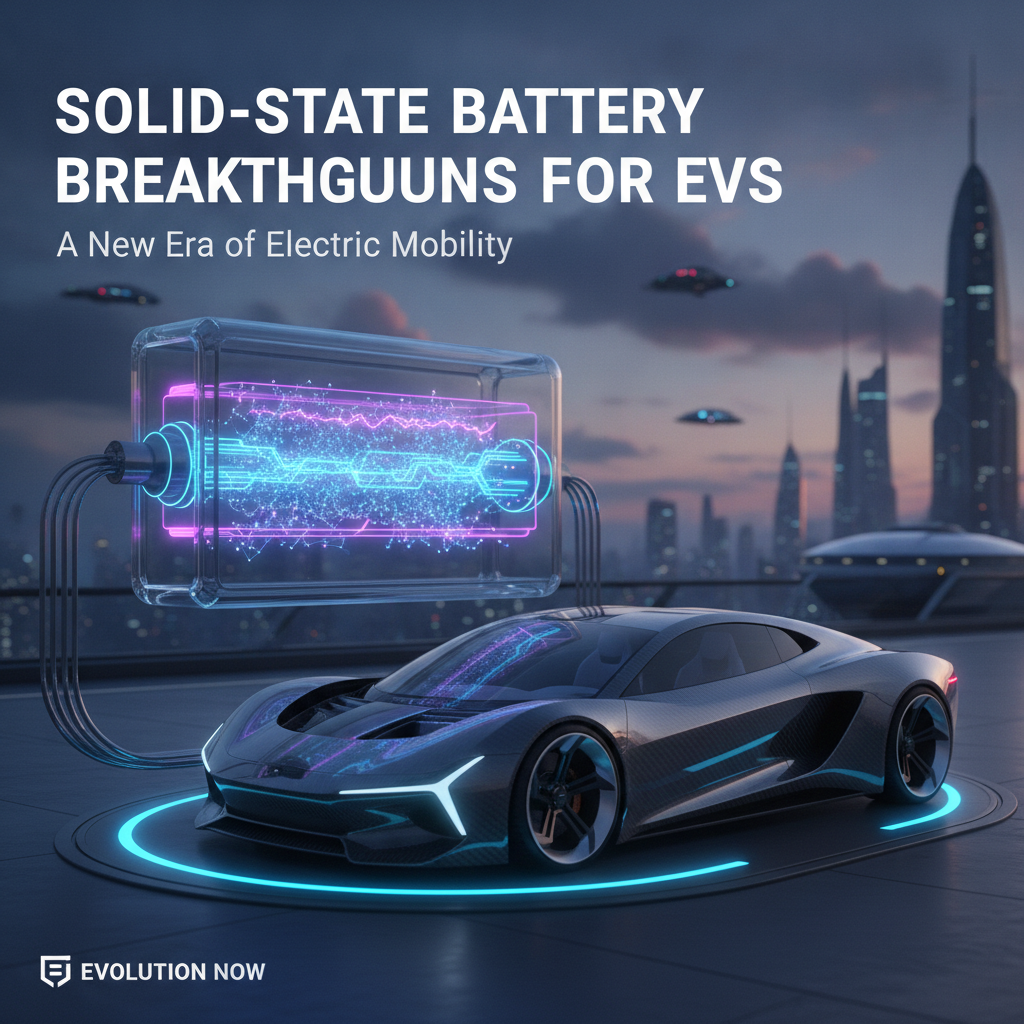
Solid-State Batteries: The EV Game Changer?
Electric Vehicles (EVs) are rapidly changing our world, but their widespread adoption still faces hurdles, primarily related to battery technology. For years, lithium-ion batteries have been the workhorse, powering everything from our phones to our EVs. However, a new era is on the horizon: solid-state batteries. These innovative power sources promise to revolutionize how we drive, offering a future with safer, faster-charging, and longer-range electric cars.
What Are Solid-State Batteries, Anyway?
Traditional lithium-ion batteries use a liquid or gel electrolyte to shuttle ions between the anode and cathode. Solid-state batteries, as their name suggests, replace this flammable liquid with a solid material – it could be ceramic, glass, or a solid polymer. This fundamental shift isn’t just a minor tweak; it’s a game-changer with profound implications.
Imagine a battery that is inherently safer, less prone to overheating, and can pack significantly more energy into a smaller, lighter package. That’s the promise of solid-state technology. They’re also theoretically capable of much faster charging times, slashing the wait at charging stations.
Recent Breakthroughs Paving the Way
For a long time, solid-state batteries felt like a distant dream, confined to research labs. But recent years have seen remarkable breakthroughs that are bringing them closer to commercial reality. Scientists and engineers are tackling challenges in material science, discovering new solid electrolytes that offer high conductivity and stability.
Major automotive manufacturers and battery developers worldwide are investing heavily, with some announcing significant progress in developing prototypes and even pilot production lines. These advancements are crucial for proving that solid-state batteries can perform reliably under real-world conditions and withstand the rigors of automotive use.
Transforming the EV Landscape
The implications of widespread solid-state battery adoption for EVs are enormous. Firstly, it could dramatically increase driving range, effectively eliminating “range anxiety” – the fear of running out of charge. Secondly, faster charging times mean less downtime, making EVs as convenient, if not more so, than gasoline cars for long trips.
Furthermore, their inherent safety and potentially longer lifespan could lead to lower insurance costs and better resale values for EVs. The reduced size and weight of solid-state batteries would also free up design space, allowing for more spacious interiors or more aerodynamic vehicle profiles.
The Road Ahead: Hurdles to Overcome
While the excitement is palpable, it’s important to acknowledge that solid-state batteries aren’t quite ready for prime-time mass production just yet. Significant challenges remain, including scaling up manufacturing processes, reducing production costs to be competitive with lithium-ion, and ensuring long-term durability and cycle life under extreme temperatures and varying driving conditions.
However, the collaborative efforts across industries and continuous innovation suggest that these hurdles are being systematically addressed. We are witnessing a monumental race to bring this technology to the masses.
The Future is Solid: A Glimpse into Tomorrow
Solid-state battery breakthroughs are not just incremental improvements; they represent a fundamental shift that could unlock the full potential of electric vehicles. As research continues and manufacturing techniques mature, we can look forward to a future where EVs offer unparalleled range, lightning-fast charging, and even greater safety. Get ready for an electric revolution that’s built on a solid foundation!
“`



Leave a Reply