
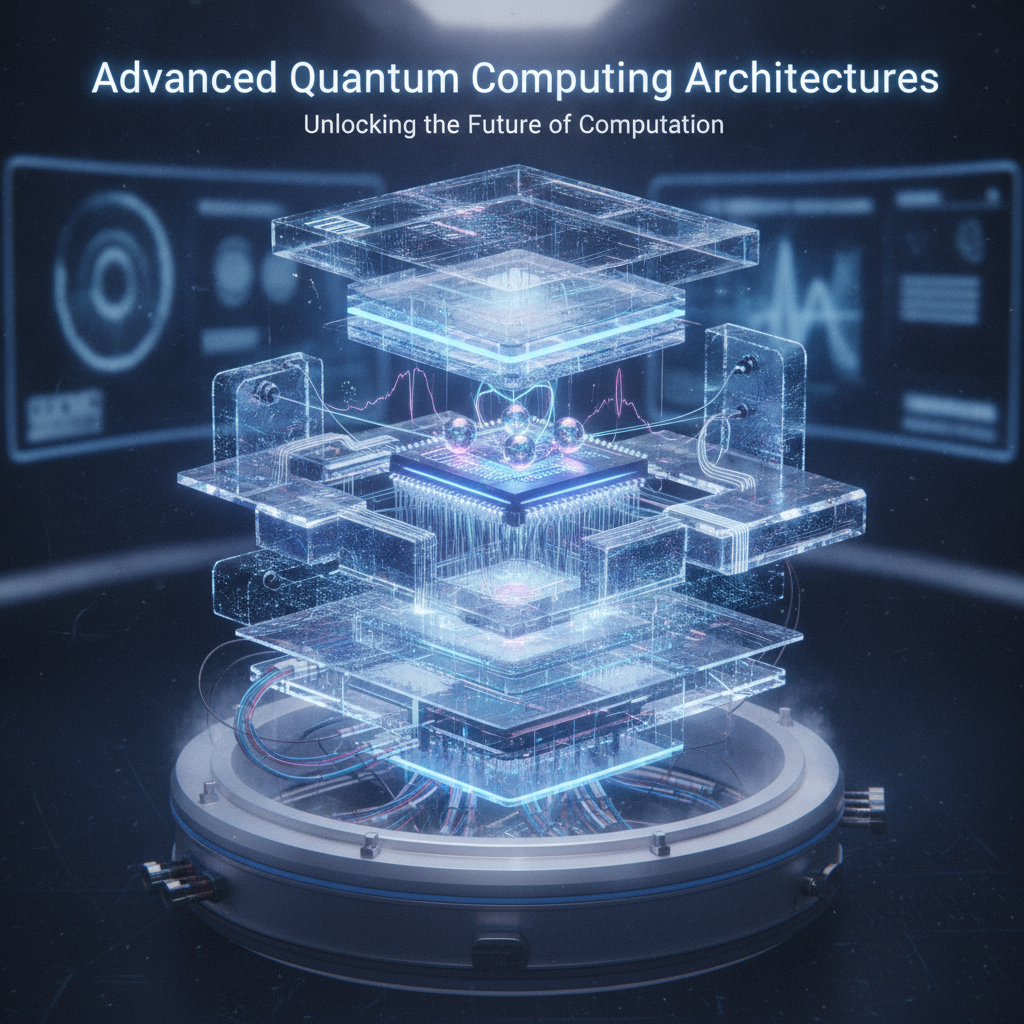
Beyond Qubits: Advanced Quantum Architectures
Quantum computing is rapidly moving from theoretical curiosity to a groundbreaking technological frontier. While much of the early excitement focused on the fundamental concept of qubits, the real power and scalability lie in the sophisticated architectures being developed to harness these quantum phenomena effectively. We’re now entering an era where understanding advanced quantum computing architectures is crucial for appreciating the future potential of this transformative field.
The Imperative for Scalability and Robustness
Current quantum processors, often referred to as Noisy Intermediate-Scale Quantum (NISQ) devices, offer glimpses into quantum advantage but are limited by qubit count, error rates, and coherence times. To unlock the full potential of quantum computing – solving complex problems beyond classical reach, simulating new materials, or breaking current encryption methods – we need far more robust and scalable systems. This drives the innovation in architectural design, aiming for fault-tolerant quantum computing (FTQC).
Diverse Paths: Key Architectural Paradigms
No single approach dominates, and researchers are exploring several promising architectural paradigms, each with unique strengths and challenges:
Superconducting Qubits: Towards 3D Integration
Platforms based on superconducting circuits (like transmons or flux qubits) have shown impressive progress, powering many of today’s leading quantum processors. Advanced architectures in this domain involve increasingly complex 2D layouts and, critically, a push towards 3D integration. Stacking multiple layers of qubits and control wiring allows for higher qubit densities and reduced crosstalk, bringing us closer to millions of qubits required for fault tolerance. Researchers are also exploring multi-chip modules and improved resonator designs for better qubit control and readout.
Trapped Ions: Modular and Interconnected
Trapped ion systems excel in qubit quality, offering long coherence times and high-fidelity gates. The architectural focus here is on modularity. Instead of a single, monolithic trap, designs are emerging that link multiple smaller ion traps via photonic interconnects. Ions can be shuttled between processing zones or entangled with photons that travel to other modules, enabling a distributed quantum computing network. This “quantum internet” approach could scale by connecting many high-quality, smaller processors.
Photonic Quantum Computing: Light-Speed Interactions
Photonic quantum computers use photons as qubits. Their architecture often involves integrated photonic circuits, where light is guided and manipulated on a chip. Key architectural advancements include robust sources of entangled photons, low-loss waveguides, high-efficiency single-photon detectors, and programmable interferometers. The push is towards highly reconfigurable circuits that can perform complex linear optical transformations at room temperature, potentially offering a highly scalable solution once challenges like efficient non-linear interactions are fully overcome.
Neutral Atoms & Rydberg Arrays: Programmable Grids
Neutral atom platforms, particularly those using arrays of Rydberg atoms, are gaining significant traction. Architectures here involve trapping individual atoms in highly configurable optical tweezer arrays. These arrays can be dynamically rearranged, allowing for reconfigurable qubit connectivity. Strong, fast interactions between Rydberg atoms enable high-fidelity gates, and the ability to scale to hundreds of individually addressable qubits within a programmable geometry makes them a strong contender for future large-scale systems.
The Bridge to Practicality: Hybrid and Distributed Approaches
Beyond single-paradigm advancements, hybrid architectures are critical. These involve combining different quantum technologies (e.g., superconducting qubits for processing with photonic links for long-distance communication) or integrating quantum processors more tightly with classical supercomputers. Distributed quantum computing, where several quantum modules work together over a quantum network, represents a powerful scaling strategy, allowing for more complex computations than any single processor could achieve alone.
Challenges and the Path Forward
Despite incredible progress, significant architectural challenges remain. Managing the massive overhead for quantum error correction, minimizing crosstalk in densely packed qubit arrays, engineering robust control electronics at cryogenic temperatures, and developing efficient quantum interconnects are all active areas of research. The future of advanced quantum computing architectures lies in innovative solutions to these problems, pushing the boundaries of materials science, electrical engineering, and quantum physics.
The journey to fault-tolerant, universal quantum computers is a testament to human ingenuity. By continually refining and innovating these complex architectures, we move ever closer to a future where quantum computers unlock scientific discoveries and technological advancements previously confined to the realm of science fiction.
“`


Leave a Reply