
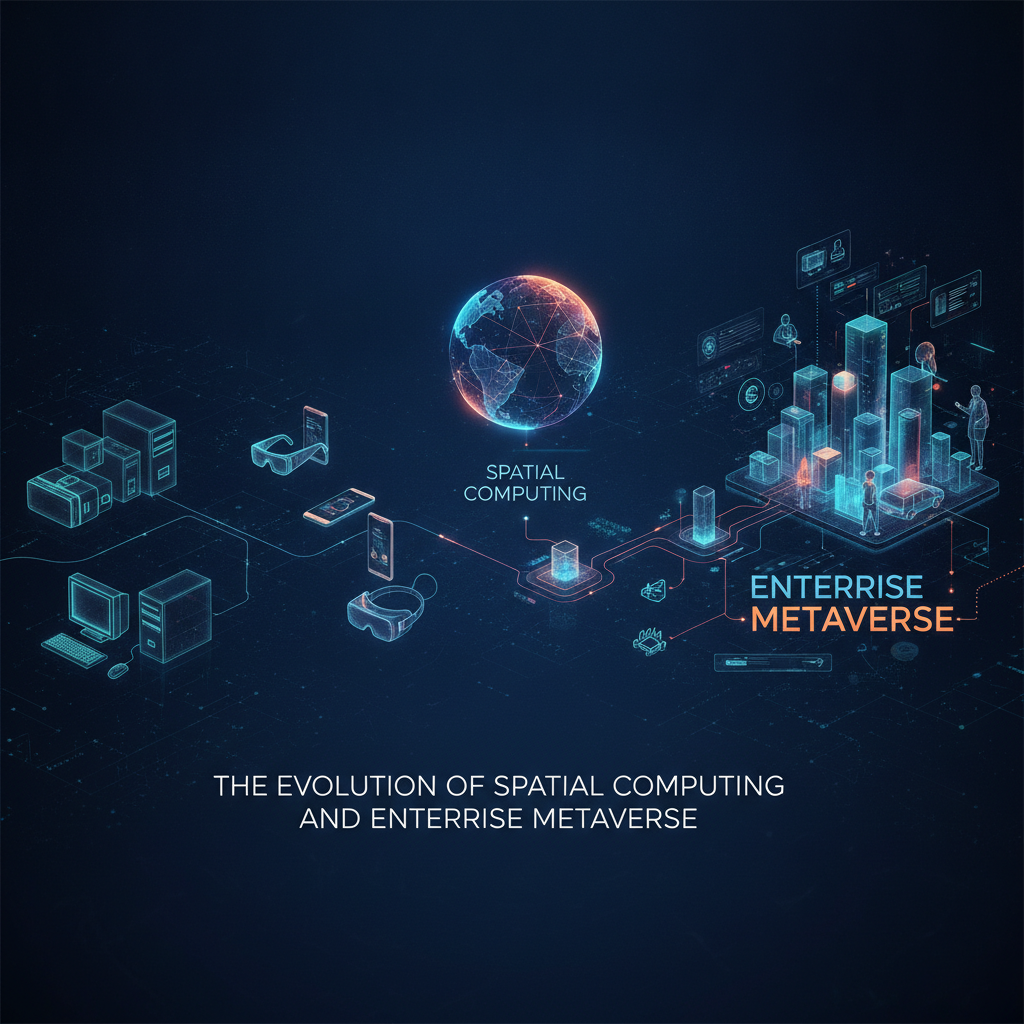
Beyond Screens: The Enterprise Metaverse Arrives
Remember when computing meant a desktop, keyboard, and mouse? We’ve come a long way! Today, we’re on the cusp of a revolutionary shift, moving from flat screens to immersive, interactive 3D environments. This isn’t just about consumer entertainment; it’s the convergence of spatial computing and the enterprise metaverse, poised to redefine how businesses operate, innovate, and connect.
A New Dimension of Interaction
Spatial computing is the technology that allows computers to understand and interact with our physical world, placing digital content within real-world environments and enabling users to interact with it naturally. Think augmented reality (AR) apps that overlay information onto your view, or virtual reality (VR) experiences that transport you to entirely new places. When applied to businesses, this forms the “enterprise metaverse” – a persistent, interconnected network of 3D virtual environments where employees, partners, and customers can collaborate, create, and conduct business in highly immersive ways.
The Tech Powering the Revolution
This transformative leap isn’t happening in a vacuum. It’s fueled by a cocktail of rapidly advancing technologies:
- eXtended Reality (XR): The umbrella term for VR, AR, and Mixed Reality (MR) hardware (headsets, smart glasses) and software, providing the immersive interfaces.
- Artificial Intelligence (AI) & Machine Learning: Essential for processing complex spatial data, creating intelligent virtual assistants, personalizing experiences, and enabling sophisticated real-time interactions.
- Internet of Things (IoT) & Digital Twins: Connecting physical assets to their virtual counterparts, allowing real-time monitoring, simulation, and predictive analysis within the metaverse.
- High-Performance Computing & 5G/6G: Providing the necessary processing power and ultra-low latency connectivity to render complex 3D environments and facilitate seamless interactions.
Transforming Business Operations
The enterprise metaverse isn’t just a futuristic concept; it’s already beginning to deliver tangible value across various sectors:
- Training & Simulation: From intricate medical procedures to complex factory floor operations, employees can train in hyper-realistic, risk-free virtual environments, leading to higher retention and skill mastery.
- Product Design & Prototyping: Engineers and designers can collaborate in shared 3D spaces, iterating on virtual prototypes in real-time, reducing development cycles and material waste.
- Remote Collaboration & Meetings: Beyond video calls, teams can meet as avatars in virtual offices, interact with 3D models, whiteboards, and presentations, fostering a stronger sense of presence and engagement.
- Customer Experience & Sales: Imagine virtual showrooms where customers explore products in 3D, customize items, and even “try on” clothes or furniture virtually before buying.
- Data Visualization: Instead of poring over spreadsheets, executives can walk through immersive 3D representations of complex data, identifying trends and insights more intuitively.
Benefits Beyond Imagination
For businesses willing to embrace this new frontier, the advantages are compelling:
- Increased Efficiency & Productivity: Streamlined workflows, faster decision-making, and optimized processes.
- Cost Savings: Reduced travel expenses, fewer physical prototypes, and more efficient resource utilization.
- Accelerated Innovation: Rapid experimentation, collaborative ideation, and quick market testing.
- Enhanced Collaboration: Breaking down geographical barriers and fostering deeper team connections.
- New Revenue Streams: Opportunities for virtual products, services, and entirely new business models.
Navigating the Future Landscape
While the potential is immense, challenges remain. Issues like interoperability between different platforms, robust security and privacy protocols, massive infrastructure demands, and the need for user-friendly interfaces are all critical areas of development. However, the trajectory is clear: spatial computing and the enterprise metaverse are not just passing fads but foundational shifts that will reshape the future of work.
Ready for the Spatial Era?
The evolution of spatial computing and the enterprise metaverse represents more than just technological advancement; it’s a paradigm shift in how we interact with digital information and each other. Businesses that start exploring and investing in these technologies now will be better positioned to lead in the coming spatial era, unlocking unprecedented levels of productivity, innovation, and engagement. Are you ready to step beyond the screen?



Leave a Reply