
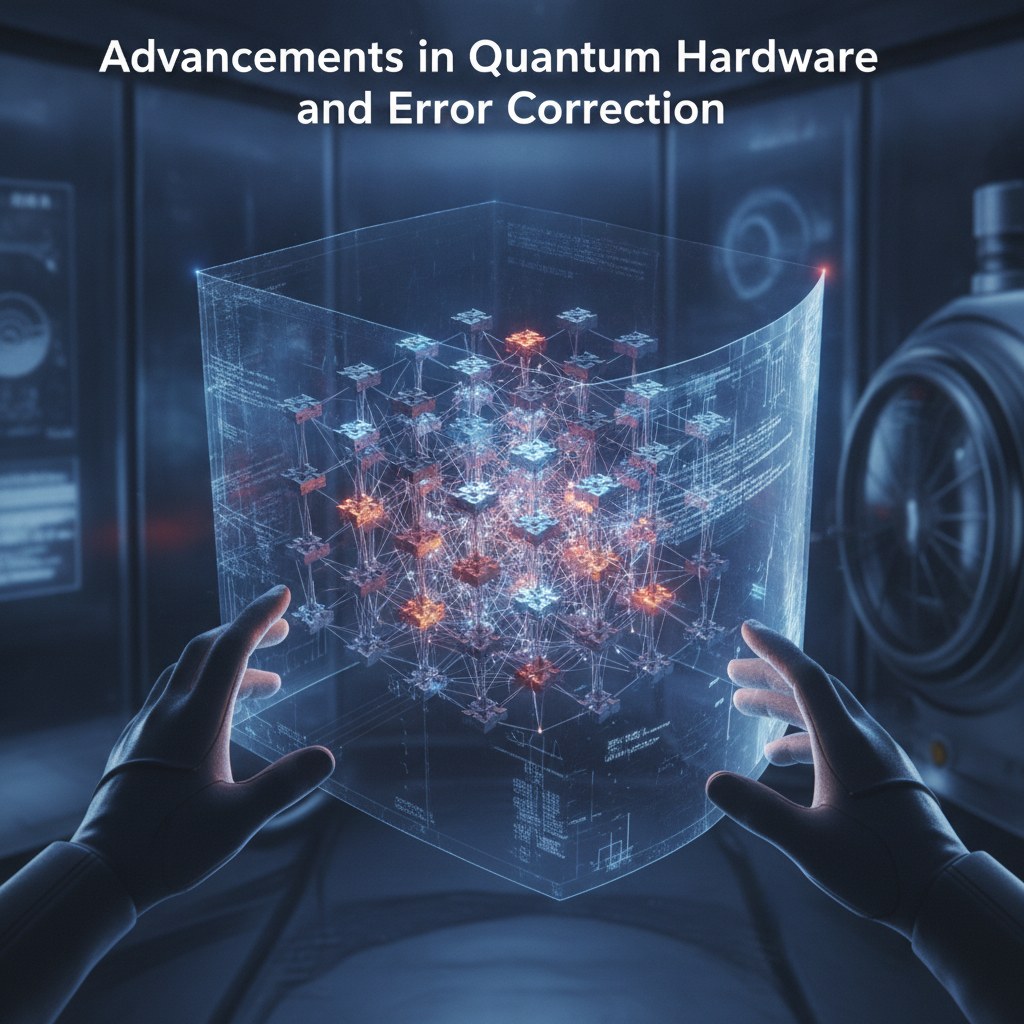
Quantum Leaps: Hardware & Error Correction Evolve
Welcome, quantum enthusiasts! The world of quantum computing is buzzing with incredible progress, constantly pushing the boundaries of what’s possible. Two areas, in particular, are seeing explosive growth and innovation: the development of advanced quantum hardware and the critical quest for effective quantum error correction. Let’s dive into how these twin pillars are bringing us closer to a future shaped by powerful quantum machines.
The Quantum Hardware Renaissance
Building a quantum computer is an engineering marvel, akin to constructing a delicate yet powerful symphony orchestra from individual, highly sensitive instruments. Today, researchers are experimenting with a diverse array of “qubit” technologies, each with its unique strengths and challenges. We’re seeing remarkable advancements in:
- Superconducting Qubits: The workhorses of many current quantum processors, these chilled circuits are increasing in qubit count and connectivity, showing impressive gains in gate fidelity.
- Trapped Ions: Held by electromagnetic fields, individual ions serve as qubits, boasting some of the highest fidelities and long coherence times, making them excellent candidates for universal quantum computing.
- Neutral Atoms: An exciting new frontier, neutral atoms manipulated by lasers offer scalability and strong qubit-qubit interactions, with platforms rapidly growing in size and capability.
- Photonic Qubits: Encoding information in photons, this approach holds promise for quantum networking and communication, with advancements in generating and manipulating entangled photons.
These hardware breakthroughs are not just about more qubits; they’re about better qubits – with longer coherence times (how long they hold quantum information) and higher fidelity (how accurately they perform operations), crucial steps towards robust quantum computation.
Taming the Quantum Beast: Error Correction
Quantum bits are inherently fragile. Unlike classical bits that are either 0 or 1, qubits exist in superpositions and entanglements, making them extremely susceptible to environmental noise and errors (decoherence). This fragility is one of the biggest hurdles to building practical quantum computers. This is where Quantum Error Correction (QEC) comes in.
QEC isn’t about perfectly shielding qubits; it’s about encoding quantum information redundantly across multiple physical qubits to protect a single, more robust “logical qubit.” Recent years have seen groundbreaking progress in:
- Experimental Demonstrations: Researchers are now successfully encoding logical qubits and demonstrating basic error correction capabilities in various hardware platforms, showing that these theoretical constructs can work in practice.
- Code Development: Advancements in quantum codes, such as surface codes, topological codes, and bosonic codes, are offering more efficient ways to protect quantum information with fewer physical qubits per logical qubit.
- Fault-Tolerant Operations: The ultimate goal is fault tolerance – the ability to perform computations even in the presence of errors. Progress is being made in designing fault-tolerant gates for logical qubits, a monumental step towards reliable quantum computing.
The Interplay: Hardware Drives Error Correction
It’s a symbiotic relationship: advancements in quantum hardware directly enable more sophisticated error correction experiments, and the demands of error correction push hardware development towards higher fidelity and greater scalability.
For instance, demonstrating a logical qubit requires multiple highly coherent physical qubits with strong connectivity and precise control. As hardware platforms achieve these benchmarks, the path to implementing more complex QEC schemes, and eventually fault-tolerant quantum computers, becomes clearer. The goal is to cross the “break-even point” where the logical qubit performs better than its constituent physical qubits, a milestone that some experiments are beginning to approach.
Looking Ahead: Towards a Fault-Tolerant Future
The journey towards powerful, fault-tolerant quantum computers is a marathon, not a sprint. However, the rapid advancements in both quantum hardware and error correction are incredibly encouraging. Every new qubit added, every gain in coherence, and every successful demonstration of error detection or correction brings us closer to unlocking the full potential of quantum computing – promising revolutions in medicine, materials science, artificial intelligence, and beyond.
Stay tuned, as the quantum landscape continues to evolve at an astonishing pace!

Leave a Reply