
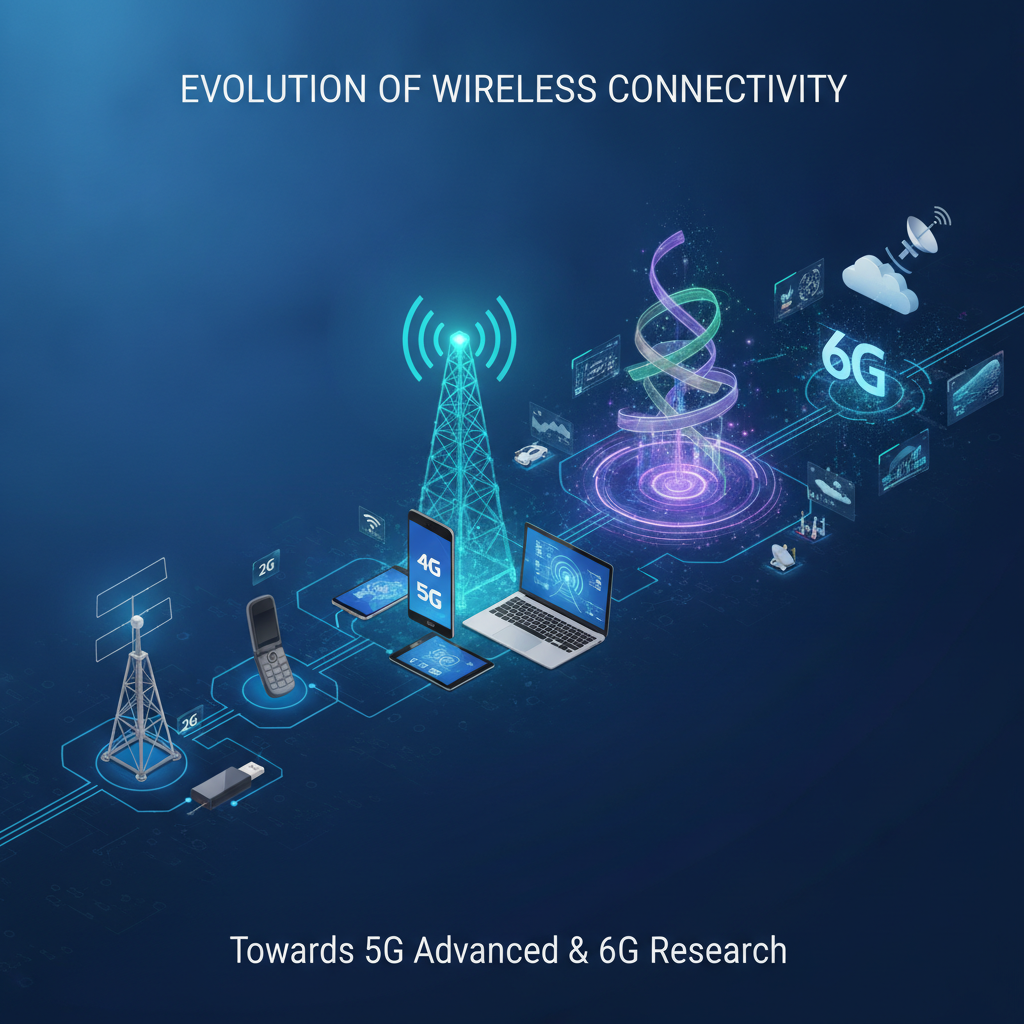
Wireless Future: Beyond 5G, Towards 6G Research
We live in an incredibly connected world, and the pace of wireless innovation shows no signs of slowing down. From the first mobile phone calls to today’s lightning-fast data streams, each generation of wireless technology has reshaped our lives. Now, as 5G continues its global rollout, the visionaries of our industry are already looking ahead: to 5G Advanced and the exciting, uncharted territory of 6G research. Let’s explore this fascinating evolution!
The Journey So Far: A Glimpse at Generations Past
Before we peer into the future, it’s worth appreciating the incredible journey of wireless connectivity. Early generations (1G, 2G) brought us voice calls and SMS. 3G ushered in mobile internet, and 4G LTE made high-speed data and video streaming commonplace. Each step built upon the last, fundamentally changing how we interact with information and each other.
5G, the current generation, is more than just faster internet. It’s designed to connect virtually everything: enhancing mobile broadband (eMBB), enabling ultra-reliable low-latency communication (URLLC) for critical applications, and connecting massive numbers of IoT devices (mMTC). But even 5G isn’t static; it’s a living, evolving standard.
Unpacking 5G Advanced: The Next Evolution of 5G
Just as 4G evolved into 4G LTE-Advanced, 5G is undergoing its own significant enhancements, known as 5G Advanced (defined by 3GPP Release 18 and beyond). This isn’t a completely new generation, but rather a robust upgrade that pushes the boundaries of 5G’s capabilities even further. Think of it as 5.5G!
Key features of 5G Advanced include:
- Enhanced AI/ML Integration: Deeper integration of Artificial Intelligence and Machine Learning into network operations, making networks smarter, more efficient, and self-optimizing.
- Extended XR Capabilities: Better support for Extended Reality (XR) applications, encompassing Virtual Reality (VR), Augmented Reality (AR), and Mixed Reality (MR), promising truly immersive experiences.
- Integrated Sensing and Communication (ISAC): The ability for cellular networks to not just communicate, but also to sense their environment, opening doors for advanced radar-like applications and context awareness.
- Advanced Power Saving: More sophisticated techniques to reduce energy consumption for both devices and network infrastructure, crucial for sustainability.
- Improved Spectrum Utilization: Even more efficient use of available spectrum, including new frequencies, to maximize capacity and performance.
5G Advanced will serve as a critical bridge, refining current technologies while laying essential groundwork for the ambitious goals of 6G.
Peeking into 6G Research: Imagining the Future of Connectivity
While 5G Advanced is just around the corner, researchers worldwide are already deep into exploring the possibilities of 6G, expected to arrive around 2030. 6G isn’t just about “faster” – it’s about fundamentally transforming how we interact with the digital and physical worlds, creating a truly intelligent, ubiquitous, and sustainable connectivity fabric.
Some of the fascinating research areas for 6G include:
- Extreme Performance: Imagine peak data rates in the terabits per second range and sub-millisecond latency, enabling near-instantaneous global interactions.
- AI-Native Networks: Networks where AI is not just an add-on but an intrinsic part of the design, optimizing everything from resource allocation to security.
- Integrated Sensing, Communication, and Computation: Taking ISAC further, 6G networks could provide hyper-accurate localization, environmental mapping, and even gesture recognition, blending communication with ubiquitous intelligence.
- New Frequency Bands: Exploration of Terahertz (THz) spectrum and even Visible Light Communication (VLC) to unlock massive bandwidths and new capabilities.
- Pervasive Intelligence: The vision of intelligent digital twins, holographic communication, and truly immersive multi-sensory experiences becoming commonplace.
- Sustainability as a Core Design Principle: Designing networks from the ground up to be ultra-energy efficient, minimizing environmental impact.
Challenges and Opportunities on the Horizon
The path to 6G is paved with both immense opportunities and significant challenges. On the opportunity side, 6G promises to unlock new industries, revolutionize healthcare, transform urban living with smart cities, and connect remote areas like never before. The societal impact could be profound.
However, challenges abound: developing new hardware for higher frequencies, managing the sheer complexity of integrated AI networks, ensuring global standardization, addressing privacy and security concerns in a hyper-connected world, and powering these advanced systems sustainably will require unprecedented collaboration and innovation from governments, academia, and industry alike.
The Future is Always Connecting!
The evolution of wireless connectivity is a testament to human ingenuity. From the foundational promise of 5G to the refined power of 5G Advanced and the boundless potential of 6G research, we are on an exciting journey towards a future that is more connected, intelligent, and immersive than ever before. Keep an eye on this space – the next breakthroughs are just around the corner!
“`


Leave a Reply