
Quantum Leaps: Milestones in Computing’s Future
Quantum computing, once a futuristic concept confined to scientific fiction, is rapidly becoming a tangible reality. Unlike classical computers that store information as bits (0s or 1s), quantum computers use qubits, leveraging mind-bending quantum phenomena like superposition and entanglement. This allows them to process vast amounts of information simultaneously, promising to revolutionize fields from medicine to finance. Let’s take a friendly stroll through some of the monumental milestones that have brought us to the cusp of a quantum age.
The Seeds of a Revolution: Early Theories
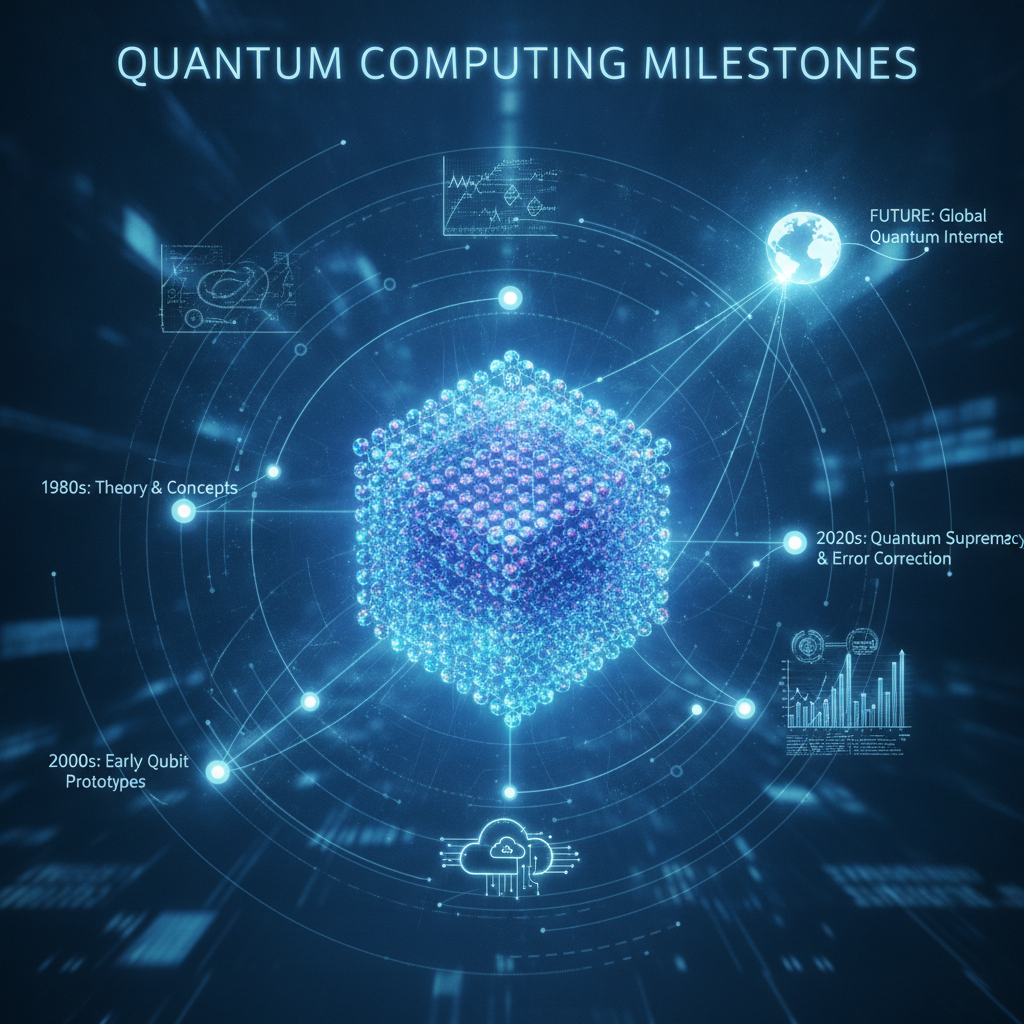
While the first working quantum computers are relatively new, the theoretical groundwork was laid decades ago. Visionaries like Richard Feynman in the early 1980s proposed the idea of using quantum mechanical effects to simulate other quantum systems, realizing that classical computers simply couldn’t handle the complexity. This initial spark highlighted the need for a fundamentally new type of computation.
Algorithmic Breakthroughs: What Can They Do?
The 1990s brought two pivotal algorithmic discoveries that truly ignited the field. In 1994, Peter Shor developed Shor’s algorithm, capable of factoring large numbers exponentially faster than classical algorithms. This has profound implications for modern cryptography, as much of our secure communication relies on the difficulty of factoring large numbers. Just two years later, Lov Grover created Grover’s algorithm, which offers a quadratic speedup for searching unsorted databases. These algorithms demonstrated the immense potential of quantum computation beyond mere theoretical musings.
Building Blocks: From Qubits to Gates
Turning theory into reality required the arduous task of creating stable qubits and designing quantum logic gates. The early 2000s saw significant progress in various qubit technologies, including superconducting circuits, trapped ions, and photonic systems. Researchers learned how to control and manipulate these delicate quantum states, performing basic operations and demonstrating simple quantum gates. This experimental work was crucial in showing that quantum phenomena could indeed be harnessed for computation.
The Era of “Quantum Advantage” and Accessibility
The late 2010s marked a thrilling period. In 2016, IBM made its quantum processors accessible to the public via the cloud with the IBM Q Experience, democratizing access to this cutting-edge technology. Then, in 2019, Google announced it had achieved “quantum advantage” (formerly “quantum supremacy”), claiming its Sycamore processor performed a specific task far beyond the capabilities of the fastest supercomputers. While debated, this event undeniably pushed quantum computing into the mainstream consciousness, demonstrating its potential for specific computational problems.
What’s Next? The Road Ahead
Today, the quantum computing landscape is bustling with innovation. Companies and research institutions worldwide are racing to build more stable qubits, develop better error correction techniques (a significant challenge due to the fragility of quantum states), and discover new algorithms. We are witnessing rapid advancements in areas like quantum machine learning, quantum chemistry simulations, and optimization problems. While practical, large-scale fault-tolerant quantum computers are still some years away, the milestones we’ve achieved so far paint a clear picture: the future of computing is quantum, and it’s arriving faster than many once imagined.


Leave a Reply