
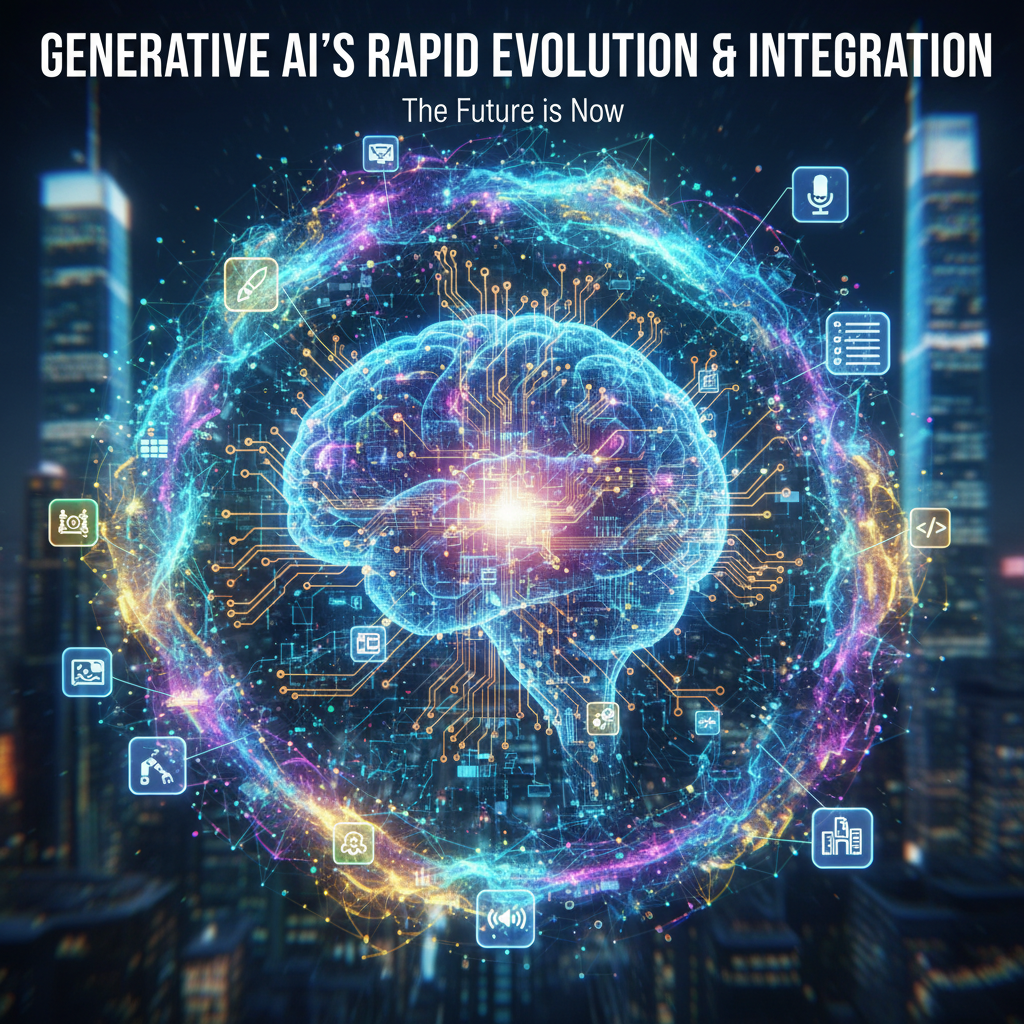
Generative AI: Fast Evolution, Deep Integration
Remember when AI was mostly about playing chess or recognizing faces? Well, buckle up! Generative AI, the branch of artificial intelligence capable of creating new content—from text and images to code and music—is not just evolving; it’s practically sprinting, transforming industries and our daily lives at an astonishing pace.
What’s Fueling This Rapid Ascent?
Several factors contribute to the exhilarating speed of Generative AI’s development. We’re seeing unprecedented advancements in model architectures, particularly with transformer networks, which allow for a deeper understanding of context and nuance. This, coupled with the availability of vast datasets and increasingly powerful computational resources, has enabled models to learn and generate with remarkable sophistication. It’s a virtuous cycle: better models lead to more applications, which in turn drive further research and investment.
Integration: From Niche Tool to Ubiquitous Partner
The beauty of this evolution isn’t just in what these models can *do* in a lab, but how quickly they’re being integrated into real-world applications across virtually every sector. Here’s a glimpse:
- Creative Industries: Artists and designers are using AI to brainstorm ideas, generate unique styles, and even create entire compositions, expanding creative possibilities.
- Software Development: Developers leverage AI for code generation, bug fixing, and automated documentation, significantly boosting productivity.
- Marketing & Content Creation: From crafting engaging ad copy to personalizing customer communications, AI is becoming an indispensable content engine.
- Healthcare & Research: AI assists in drug discovery, data synthesis for simulations, and even generating synthetic data for training other models, accelerating breakthroughs.
It’s moving beyond being a standalone tool and becoming an integrated co-pilot, enhancing human capabilities rather than simply replacing them.
Embracing the Opportunities and Navigating Challenges
This rapid integration brings immense opportunities for innovation, efficiency, and entirely new forms of creativity. Businesses can personalize experiences at scale, researchers can accelerate discoveries, and individuals can unlock new creative potentials.
However, with great power comes great responsibility. The swift evolution also presents challenges we must address thoughtfully: ethical considerations around bias and misinformation, the need for robust security, intellectual property concerns, and the impact on the future of work. Responsible development and deployment, alongside continuous public discourse, are crucial to harnessing its full positive potential.
The Future is Now: What’s Next?
Generative AI isn’t a futuristic concept anymore; it’s a present-day reality that continues to evolve at breakneck speed. As models become even more multimodal—seamlessly blending text, image, and audio generation—and increasingly accessible, their integration will only deepen. We are at the cusp of a truly transformative era, where the line between human and machine creativity blurs, promising a future of unprecedented innovation and problem-solving. Stay curious, stay informed, and get ready for what’s next!

Leave a Reply