
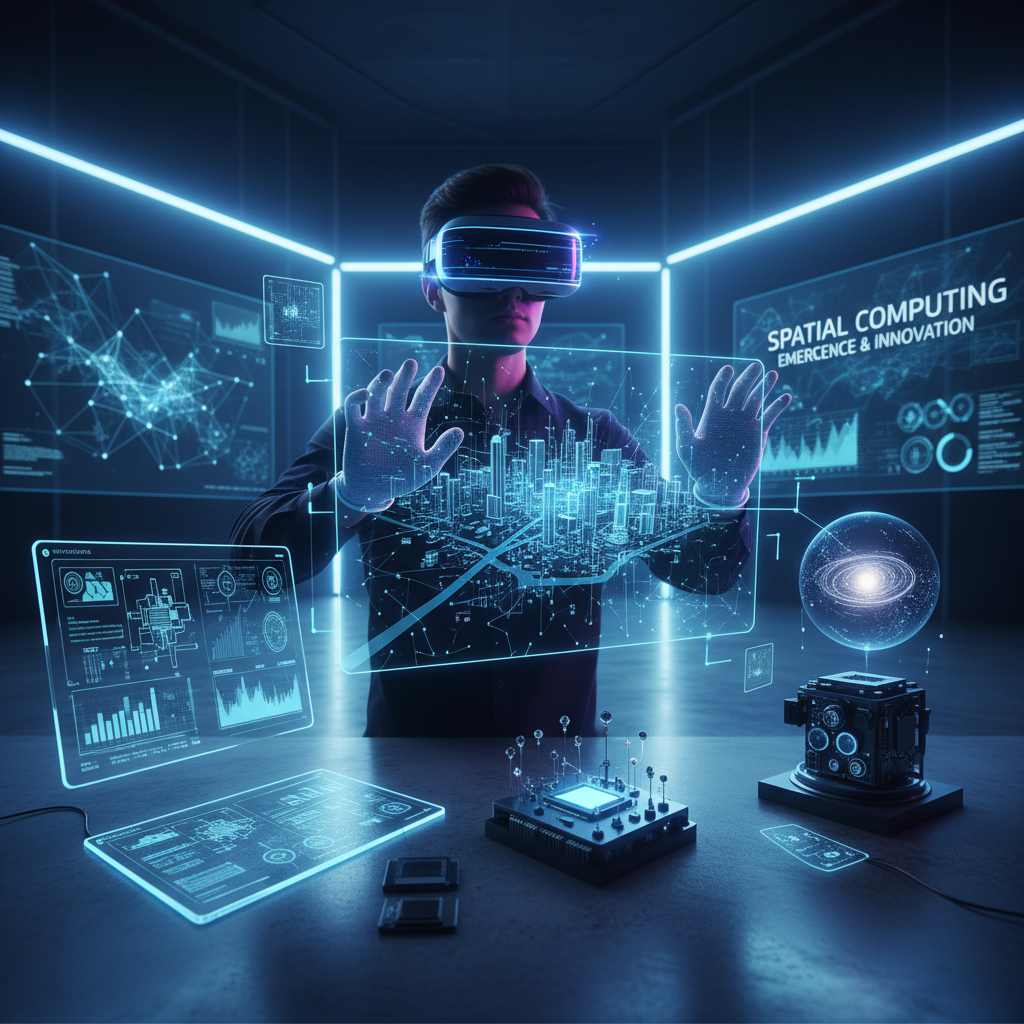
Spatial Computing: Where Innovation Meets Reality
Remember those sci-fi movies where characters interact with holograms and digital interfaces that seamlessly blend into their physical surroundings? Well, those futuristic visions are rapidly becoming today’s reality, thanks to the thrilling emergence of spatial computing. This isn’t just a new gadget; it’s a paradigm shift in how we interact with technology and the world around us.
What Exactly is Spatial Computing?
At its core, spatial computing is about blending our physical environment with digital information, allowing us to interact with virtual content as if it were truly present in our space. Unlike traditional virtual reality (VR), which often completely replaces your view, or augmented reality (AR), which overlays digital information, spatial computing aims for a more integrated and intuitive experience. It understands the physical world, tracks your movements within it, and places digital objects or interfaces appropriately, enabling natural interaction through gaze, gestures, and voice.
The Hardware Revolution Underway
The concept of blending digital and physical worlds isn’t new, but what makes today different is the incredible leap in hardware innovation. For spatial computing to truly flourish, devices need to be powerful, precise, and comfortable enough to disappear into the background. We’re finally seeing these capabilities mature, moving from bulky prototypes to increasingly refined, powerful systems that can deliver on the promise.
Key Innovations Driving the Shift
Several technological advancements are converging to make this dream a reality:
High-Resolution Displays: Forget grainy images. The latest devices feature micro-OLED displays with incredibly high pixel densities and advanced pancake optics, providing crystal-clear visuals that reduce eye strain and enhance immersion, making digital objects look genuinely real.
Advanced Sensor Arrays: This is where the “spatial” magic happens. Sophisticated cameras, LiDAR scanners, and accelerometers work in tandem to accurately map your environment, track your head and hand movements, and even understand your gaze. This real-time spatial awareness is critical for seamless interaction and digital object persistence.
Powerful, Dedicated Processors: Processing the sheer volume of data from multiple sensors, rendering complex 3D environments, and doing it all with minimal latency requires immense computational power. We’re now seeing custom-built chips optimized for spatial computing (like Apple’s R1 chip) that handle these tasks efficiently, preventing motion sickness and enabling truly responsive experiences.
Intuitive Input Methods: The era of cumbersome controllers is fading. Spatial computing emphasizes natural interactions: using your eyes to select, your hands to manipulate virtual objects, and your voice for commands. This makes the technology far more accessible and intuitive for everyone.
Beyond the Screen: A New Era of Interaction
Imagine collaborating with colleagues on a 3D model that floats in your office, or learning about anatomy by dissecting a virtual heart in your living room. From enhancing productivity and offering new ways to learn, to revolutionizing entertainment and social interaction, spatial computing promises to transform nearly every aspect of our lives. It’s about moving beyond flat screens and experiencing digital content in a much more profound, engaging, and spatially aware way.
The Road Ahead
While the excitement is palpable, spatial computing is still in its early days. Challenges remain, including reducing device size and weight, improving battery life, and expanding the ecosystem of compelling applications. However, with major tech players investing heavily and continuous breakthroughs in hardware, the future looks incredibly bright. We are at the cusp of a truly transformative era.
Get ready to step into a world where your digital life seamlessly merges with your physical reality. The future of computing is spatial, and it’s arriving faster than you think!
“`


Leave a Reply