
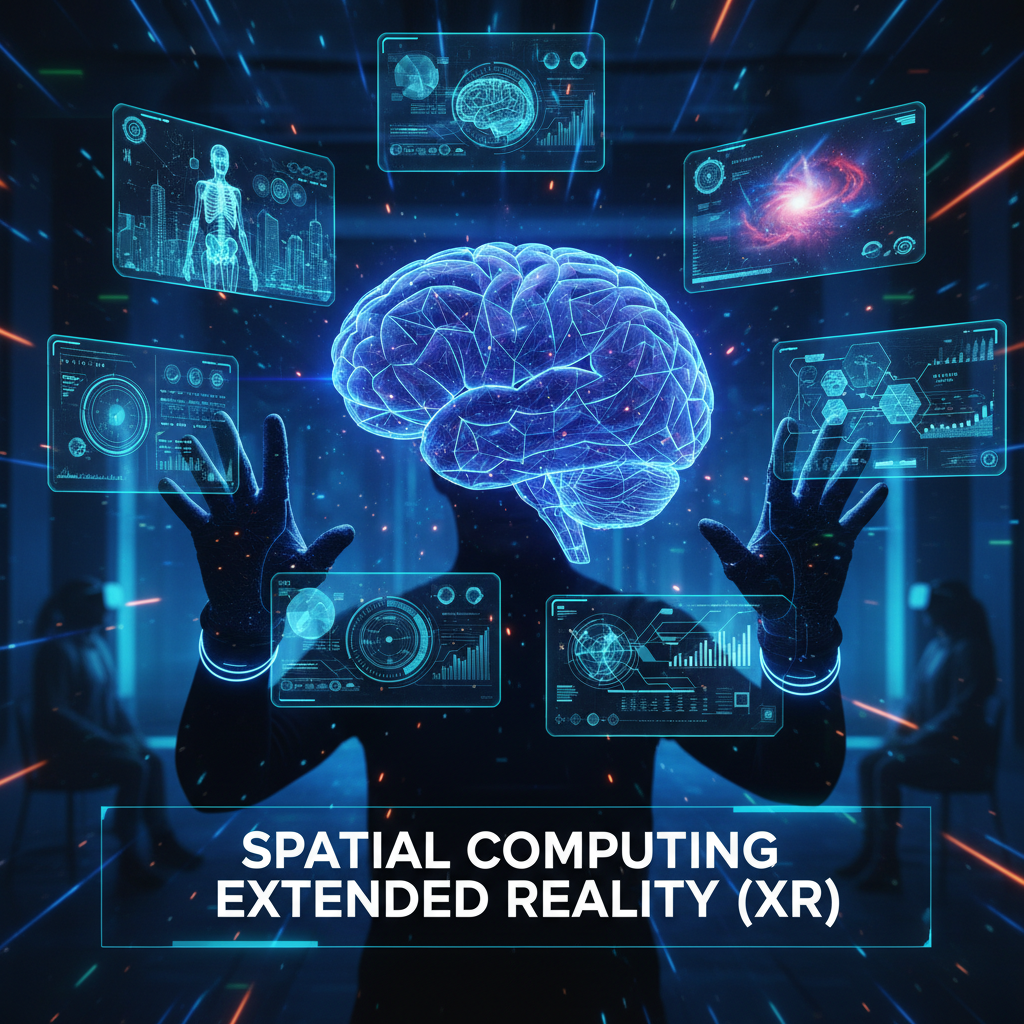
Step into Tomorrow: Spatial Computing & XR
Ever wonder what it would be like if your digital world seamlessly merged with your physical surroundings? Well, get ready, because that future is rapidly unfolding thanks to two interconnected powerhouses: Spatial Computing and Extended Reality (XR). Let’s dive into these fascinating concepts and explore how they’re set to revolutionize our lives!
What is Spatial Computing?
At its heart, Spatial Computing is about enabling computers to understand and interact with the real world in three dimensions, much like we humans do. Imagine a system that not only knows *what* an object is, but also *where* it is, *what its relationship is* to other objects, and *how it moves* within a given physical space. This goes far beyond a flat screen, bringing digital content into our physical environment in a meaningful, contextual way.
Think of an architect virtually walking through a building design placed on their living room floor, or a surgeon practicing a complex procedure on a holographic patient model. Spatial computing provides the underlying framework that allows these digital elements to be “aware” of, and interact with, the actual space around them.
XR Explained: Virtual, Augmented, and Mixed Realities
Extended Reality (XR) is an umbrella term encompassing several immersive technologies that blur the lines between the real and virtual worlds. It’s essentially the interface through which we experience spatial computing.
- Virtual Reality (VR): This is the most immersive form, where users are completely transported to a simulated environment, typically through a headset. Think gaming worlds, virtual tours, or training simulations where you’re fully immersed in a digital space.
- Augmented Reality (AR): AR overlays digital information onto the real world. A classic example is using your phone camera to see Pokémon pop up in your park, or getting directions overlaid on the actual street view. It enhances your view of reality.
- Mixed Reality (MR): MR takes AR a step further. It blends real and virtual worlds to create new environments and visualizations where physical and digital objects coexist and interact in real-time. With MR, a digital object isn’t just floating there; it can be “aware” of real-world obstacles and even interact with them, like a virtual ball bouncing off a real table.
The Symbiosis: How They Work Together
Spatial Computing and XR are two sides of the same coin. Spatial Computing provides the “brain”—the understanding of the physical world and how digital objects can logically exist within it. XR provides the “eyes and hands”—the immersive interface that allows us to see, hear, and interact with those digital elements in a truly three-dimensional, intuitive way.
Without spatial computing, XR experiences would be less convincing, with digital objects appearing disconnected from our physical surroundings. Without XR, spatial computing’s incredible potential to merge worlds would remain largely unseen, trapped within algorithms rather than experienced. Together, they create a powerful synergy that opens doors to unprecedented applications across industries – from collaborative design and remote work to education, entertainment, and healthcare.
The Future is Here (and Now!)
Devices like the Apple Vision Pro and Meta Quest are just the beginning, bringing sophisticated spatial computing capabilities directly to consumers. We’re on the cusp of a profound shift where our interactions with technology will move beyond flat screens to become truly spatial, intuitive, and integrated with our environment.
Imagine collaborative workspaces where colleagues, regardless of their physical location, can interact with 3D models and data as if they’re in the same room. Or personalized learning experiences where historical events unfold holographically right before your eyes. The possibilities are truly boundless.
Spatial Computing and XR are not just buzzwords; they represent a fundamental reimagining of how we perceive and interact with information and each other. The journey into this new frontier is exciting, and we’re only just beginning to unlock its incredible potential. Get ready to step into tomorrow!
“`
Leave a Reply