
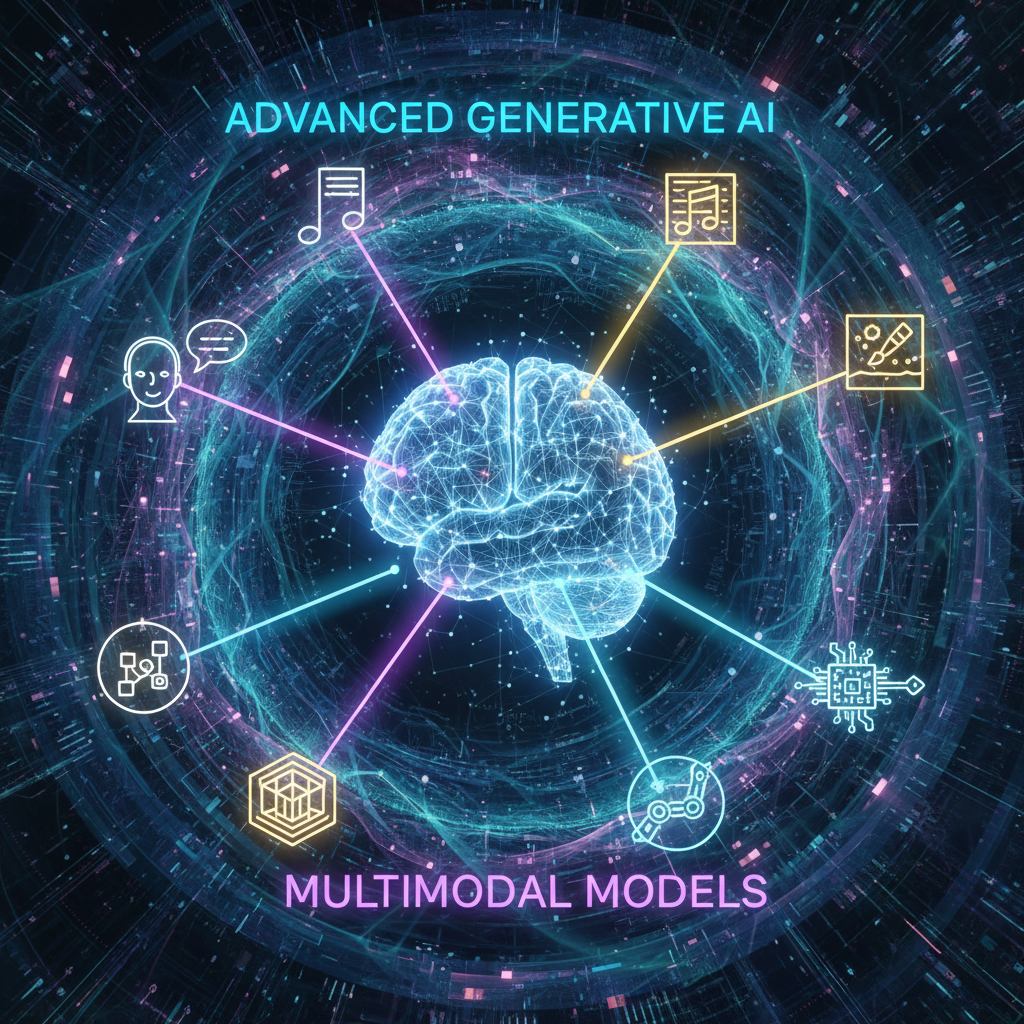
Beyond Text: The Multimodal Revolution in AI
Welcome to the cutting edge of artificial intelligence! For years, generative AI has amazed us with its ability to create realistic text, images, and even code. But what happens when these powerful models learn to speak not just one language, but many – simultaneously? We’re diving deep into the exciting world of Advanced Generative AI and Multimodal Models, where the future of AI is richer, more intuitive, and incredibly transformative.
What are Advanced Generative AI Models?
At its core, generative AI is about creating something new. Moving beyond simple pattern recognition, advanced generative models like sophisticated Transformers and Diffusion Models are trained on vast datasets to understand underlying structures and generate novel outputs. Think of AI that can write a coherent story, compose a unique piece of music, or design an entirely new image from a text prompt. These models don’t just mimic; they innovate.
They excel at tasks that require creativity and understanding of complex relationships. From generating realistic human faces that don’t exist to developing functional code snippets or even predicting protein structures, their capabilities are rapidly expanding across various domains, pushing the boundaries of what machines can produce.
The Power of Multimodal AI
Now, imagine these generative models not just operating in one medium, but seamlessly integrating information from multiple sources – text, images, audio, video, and more. That’s the essence of multimodal AI. It’s about building systems that perceive and interact with the world much like humans do, by combining different sensory inputs to form a holistic understanding.
Multimodal models can understand a picture *and* its caption, generate a video from a text description, or even create a voiceover for an animated character. Instead of isolated processes, these models learn how different data types relate to each other, leading to a much richer and more nuanced comprehension of context.
Why Multimodal is the Next Frontier
The real magic of multimodal AI lies in its potential to unlock unprecedented levels of understanding and interaction. By processing information across modalities, these models can overcome the limitations of single-modality systems, leading to more robust, accurate, and versatile AI applications. They can infer meaning from visual cues when text is ambiguous, or enrich visual content with descriptive narratives.
Consider applications like enhanced accessibility tools that can describe complex visual scenes to the visually impaired, more natural human-computer interfaces that understand both your voice and your gestures, or even advanced diagnostic tools that correlate medical images with patient reports. The ability to “see,” “hear,” and “read” simultaneously is a game-changer for AI’s impact on our daily lives.
Challenges and the Road Ahead
While the promise of advanced generative and multimodal AI is immense, the journey isn’t without its challenges. Integrating and aligning diverse data modalities is computationally intensive and requires innovative architectural designs. Addressing issues like data bias across different modalities, ensuring ethical deployment, and managing the sheer scale of training data are crucial areas of ongoing research and development.
However, with continuous breakthroughs in machine learning algorithms, increasing computational power, and a vibrant global research community, we are consistently overcoming these hurdles. The rapid pace of innovation suggests that multimodal AI will soon move from cutting-edge research to widespread practical applications, reshaping industries and transforming how we interact with technology.
The evolution of advanced generative AI into multimodal systems marks a pivotal moment in artificial intelligence. It’s not just about creating more content; it’s about building AI that understands and generates information in a way that mirrors human cognition, opening up a universe of possibilities. Stay tuned, because the future of AI is truly a feast for all senses!
“`

Leave a Reply