
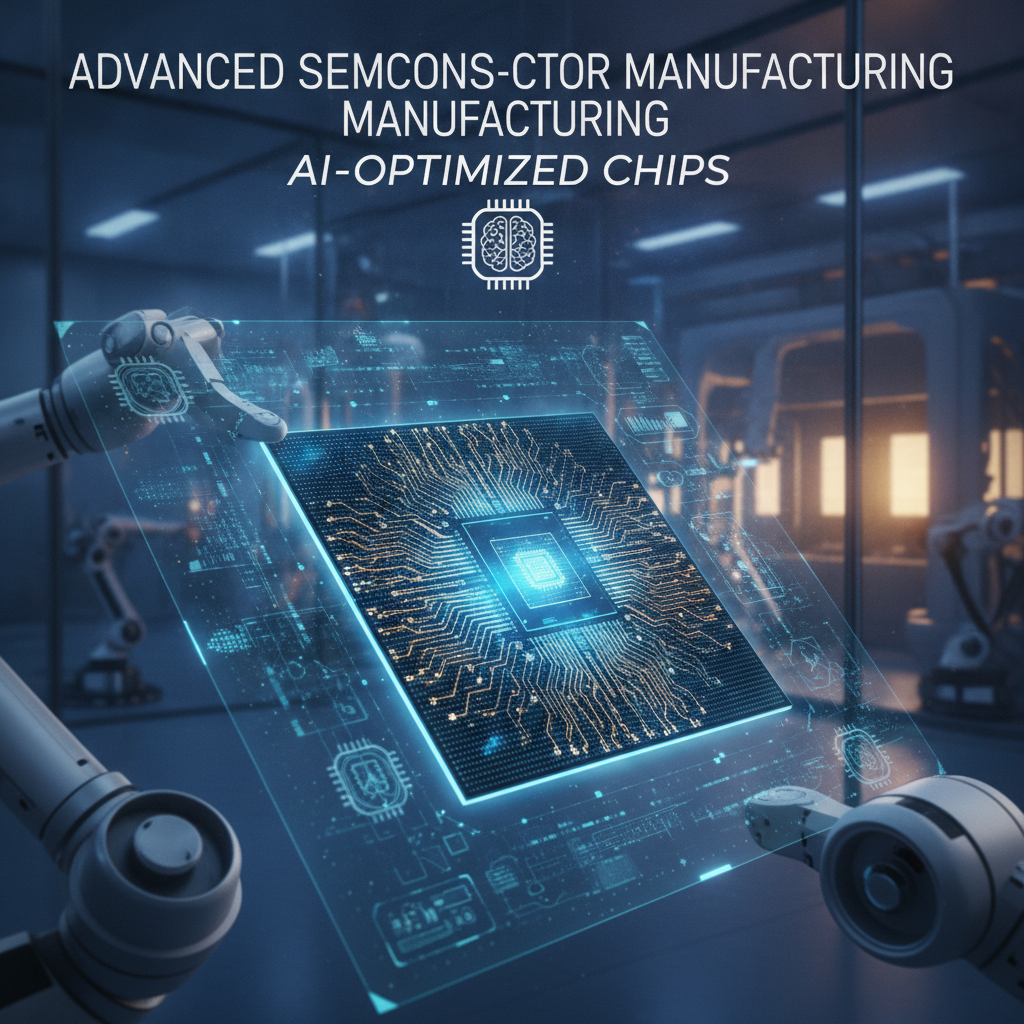
Chips That Think: AI & Next-Gen Manufacturing
Welcome to the forefront of innovation, where the very foundations of our digital world are being reimagined! Semiconductors, the tiny brains powering everything from your smartphone to supercomputers, are undergoing a profound transformation. This isn’t just about making them smaller; it’s about making them smarter, faster, and more efficient, thanks to the incredible synergy between advanced manufacturing techniques and artificial intelligence.
The Microscopic Marvels: A New Era in Manufacturing
For decades, the semiconductor industry has pushed the boundaries of physics, striving to pack ever more transistors onto a single chip. Today, this pursuit has led to mind-boggling advancements. We’re talking about features measured in nanometers, where manufacturing precision is akin to building a skyscraper one atom at a time. Technologies like Extreme Ultraviolet (EUV) lithography are literally using light at the edge of the electromagnetic spectrum to etch impossibly fine patterns. Beyond just shrinking, we’re also seeing innovations like 3D stacking, where different chip components (like memory and processors) are layered on top of each other, creating “chiplets” that communicate at unprecedented speeds, redefining what’s possible in a compact space.
AI as the Architect: Designing Smarter Silicon
It’s fascinating to consider that the very intelligence we’re trying to build into machines is now helping us design those machines. Artificial intelligence is revolutionizing the Electronic Design Automation (EDA) landscape. AI algorithms are now optimizing chip layouts, predicting power consumption, and even identifying potential manufacturing defects long before a physical chip is ever made. This reduces design cycles, cuts costs, and drastically improves yield rates. Imagine an AI sifting through billions of possible configurations in mere hours, identifying the most efficient and powerful design – a task that would be impossible for human engineers alone. AI isn’t just building chips; it’s helping build better chips.
AI-Optimized Chips: Built for Intelligence
But the impact of AI isn’t limited to the manufacturing process; it’s profoundly changing the chips themselves. “AI-optimized chips” are not just general-purpose processors; they are purpose-built marvels engineered specifically to handle the massive, parallel computations required by AI workloads like machine learning training and inference. These include specialized cores like Neural Processing Units (NPUs) and Tensor Processing Units (TPUs), designed to accelerate matrix multiplications and other common AI operations. They boast architectures that minimize data movement, maximize energy efficiency, and are capable of processing vast amounts of information with incredible speed. These chips are the brains that will power the next generation of AI applications, from autonomous vehicles to sophisticated medical diagnostics.
The Symbiotic Future: AI and Chips Intertwined
The relationship between advanced semiconductor manufacturing and AI-optimized chips is truly symbiotic. Advanced manufacturing techniques enable the creation of the complex, highly integrated AI chips we need. In turn, AI helps refine and perfect these manufacturing processes, pushing the boundaries even further. This feedback loop is accelerating innovation at an incredible pace.
The implications are far-reaching. We’re looking at a future with highly intelligent edge devices, breakthroughs in scientific research powered by AI supercomputers, and an unprecedented level of automation across industries. It’s a thrilling time to be involved in technology, and the intersection of advanced manufacturing and AI-optimized chips is undoubtedly where much of that excitement will unfold.
“`


Leave a Reply