
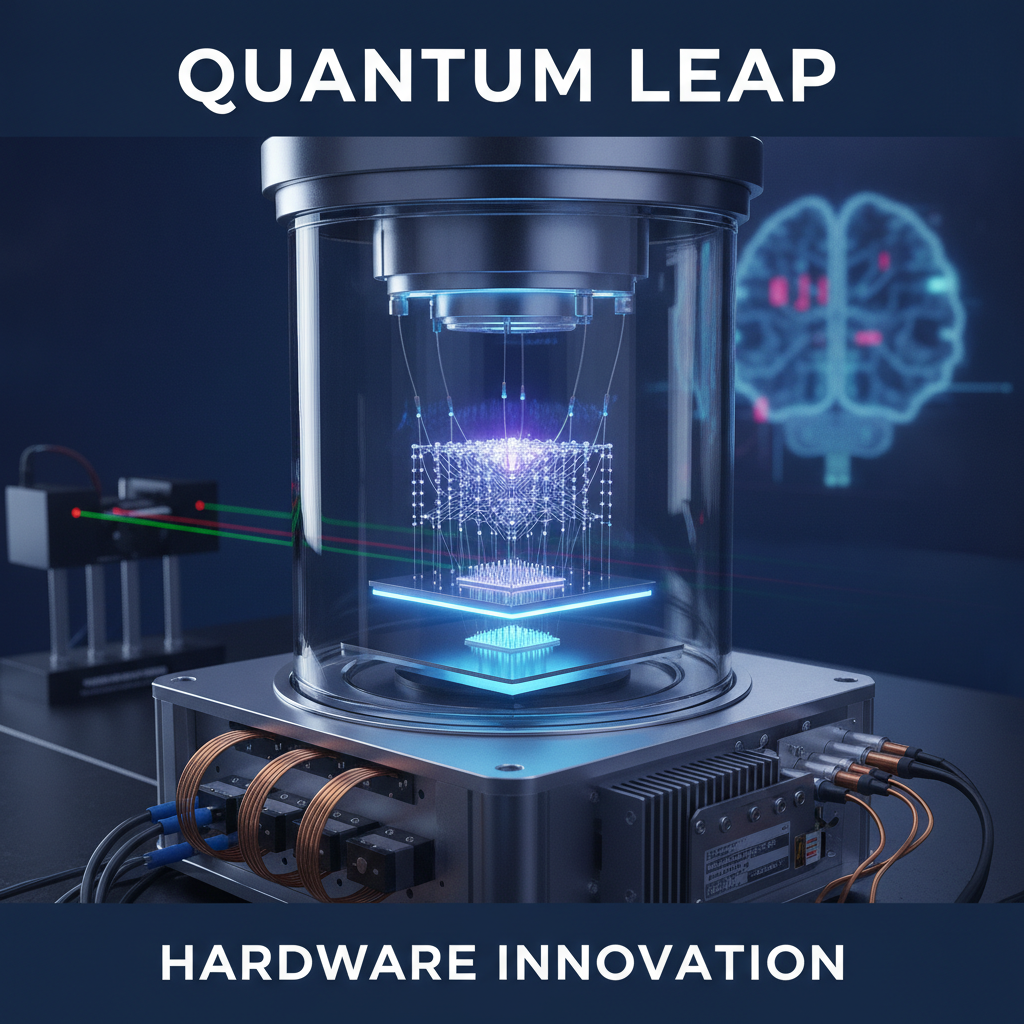
Quantum computing isn’t just a futuristic concept anymore; it’s rapidly moving from theoretical whiteboards to tangible hardware in labs worldwide. While the algorithms and software are crucial, the true engine driving this revolution lies in the incredible advancements happening in quantum computing hardware. Let’s take a friendly dive into the fascinating world of building the machines that will unlock unprecedented computational power.
The Core of It All: Qubits
Unlike classical bits that are either 0 or 1, qubits can exist in a superposition of both states simultaneously, allowing for exponentially more complex calculations. But how do we physically create and control these elusive qubits? The scientific community has explored several ingenious approaches, each with its unique strengths and challenges.
Superconducting Qubits: The Industry Workhorse
Often associated with major players like IBM and Google, superconducting qubits are tiny circuits cooled to extremely low temperatures (near absolute zero). These systems are known for their speed and the relatively mature fabrication techniques. Recent breakthroughs focus on increasing the number of interconnected qubits and improving their coherence times – how long they maintain their quantum state. This platform continues to push boundaries in qubit count and connectivity.
Trapped Ions: Precision and Fidelity
Companies like IonQ and Quantinuum are champions of trapped ion technology. Here, individual atoms are suspended in a vacuum using electromagnetic fields and manipulated with lasers. Trapped ions boast exceptionally high qubit fidelity (low error rates) and long coherence times, making them highly attractive for certain quantum applications. The challenge often lies in scaling these systems efficiently while maintaining their pristine performance.
Neutral Atoms: A Scalability Powerhouse?
A more recent, but rapidly emerging player, is neutral atom quantum computing, spearheaded by companies like Pasqal and QuEra. This approach uses arrays of neutral atoms (not ions, so they don’t repel each other) held in place by optical tweezers. The potential for scalability with thousands of qubits in a single system is very exciting, along with good coherence properties and flexible connectivity. It offers a promising path towards larger quantum processors.
Silicon Spin Qubits: Leveraging Existing Tech
Imagine building quantum processors using technologies similar to what’s in your smartphone! Silicon spin qubits aim to do just that, leveraging the semiconductor industry’s vast infrastructure. Companies like Intel are making strides in this area, offering the promise of highly scalable and manufacturable quantum chips, albeit with ongoing challenges in qubit control, entanglement, and maintaining quantum states at higher temperatures than other platforms.
Overcoming the Quantum Hurdles
Building quantum hardware is an engineering marvel. Scientists and engineers are constantly pushing boundaries to address critical challenges common across platforms:
- Coherence: Keeping qubits stable and in their delicate quantum state for longer periods, crucial for complex computations.
- Scalability: Increasing the number of qubits without sacrificing performance or introducing excessive noise.
- Error Correction: Developing robust methods to detect and correct the inherent fragility and errors of quantum states.
- Cryogenics & Control: Designing sophisticated cooling systems and precise control electronics that operate at extreme conditions, often at millikelvin temperatures.
The Road Ahead
The pace of advancement in quantum hardware is breathtaking. Each qubit platform is evolving rapidly, contributing unique insights and capabilities to the overall quantum ecosystem. While a universal, fault-tolerant quantum computer is still some years away, the continuous breakthroughs in qubit stability, connectivity, and manufacturing are bringing us closer every day.
These hardware innovations are not just theoretical feats; they are the bedrock upon which real-world quantum applications—from drug discovery and materials science to financial modeling and artificial intelligence—will be built. It’s an incredibly exciting time to be witnessing the dawn of a new computing era!


Leave a Reply