
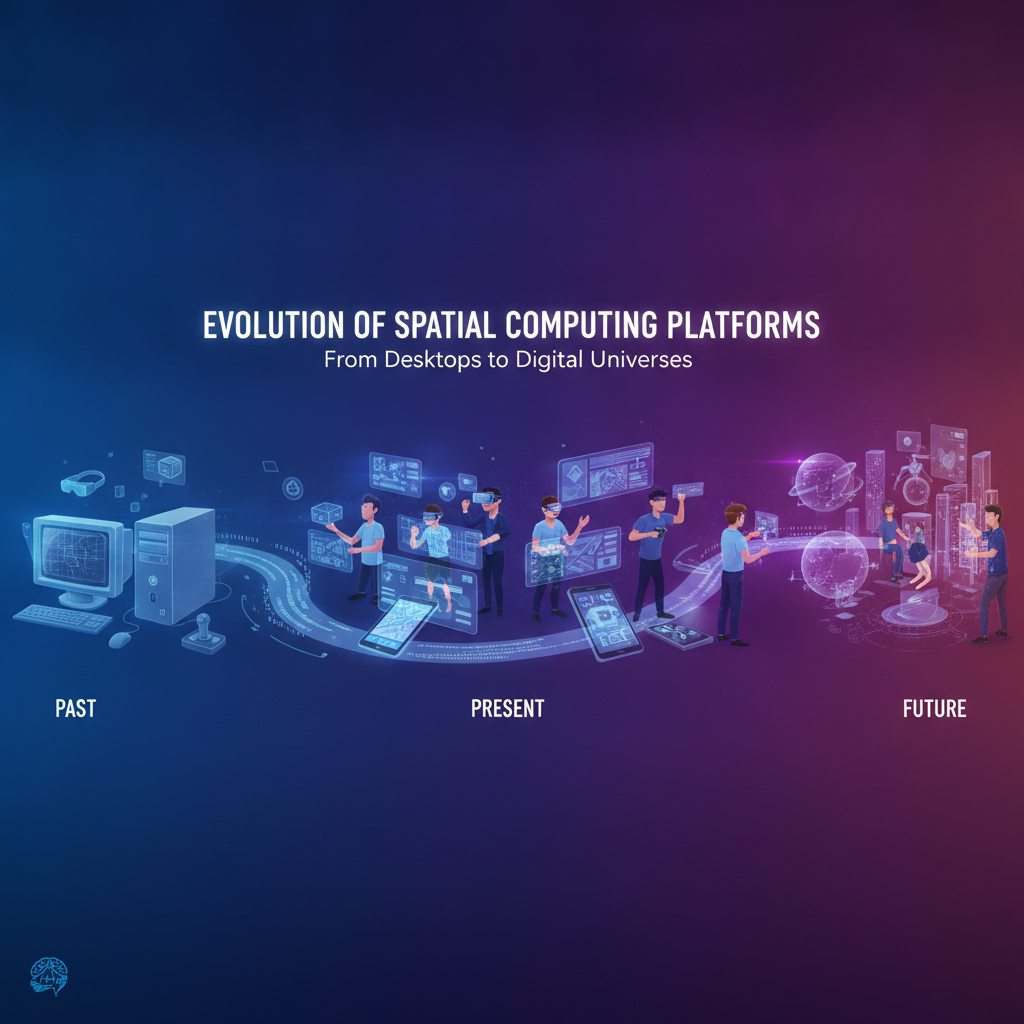
Spatial Computing: A Journey Through Its Evolution
Welcome, fellow tech enthusiasts, to an exploration of one of the most exciting frontiers in technology today: Spatial Computing. It’s more than just a buzzword; it’s a paradigm shift that promises to transform how we interact with digital information and the world around us. Let’s embark on a fascinating journey through its evolution, from nascent ideas to the sophisticated platforms we see emerging today.
Defining the Digital Frontier: What is Spatial Computing?
Before we dive into history, let’s get on the same page. Simply put, spatial computing refers to technology that allows computers to understand and interact with the physical world, and for users to interact with digital content that’s anchored to, and aware of, their physical environment. Think of it as blending the digital and physical realms, creating immersive and intuitive experiences that go beyond flat screens.
This isn’t just about virtual reality (VR) or augmented reality (AR) in isolation; it’s about a broader ecosystem where digital objects persist in space, react to physics, and are accessible through various devices, making our interactions feel more natural and integrated.
The Early Whispers: Foundational Concepts and Visionaries
While “spatial computing” is a more recent term, its roots run deep. The vision for interacting with digital information in a three-dimensional space dates back decades. Pioneers like Ivan Sutherland, with his “Ultimate Display” concept in the 1960s, envisioned a world where computers could create virtual worlds indistinguishable from reality, allowing users to interact directly with digital objects.
Throughout the 1980s and 90s, research institutions and academics explored early forms of VR and AR. From NASA’s virtual environments for astronaut training to early head-mounted displays and academic projects, these efforts laid crucial theoretical and practical groundwork. They grappled with challenges like tracking, rendering, and interaction methods, planting the seeds for what would blossom into today’s platforms.
Breaking Through: The First Wave of Consumer Platforms
The 2010s marked a significant inflection point. The advent of more powerful mobile processors, miniaturized sensors, and high-resolution displays made consumer-grade spatial computing a tangible reality. Companies like Oculus (later acquired by Meta) ignited the modern VR revolution with affordable headsets, promising immersive gaming and experiences.
Simultaneously, augmented reality began to gain traction. Google Glass offered an early, albeit controversial, glimpse into AR eyewear. Microsoft’s HoloLens, released in 2016, showcased a sophisticated mixed-reality experience, projecting holograms into the real world and paving the way for enterprise and industrial applications. These platforms, despite their early limitations, sparked immense excitement and investment, moving spatial computing from labs to living rooms and workplaces.
Beyond the Hype: Maturation and Diverse Applications
Today, the landscape is richer and more diverse than ever. We’ve seen a maturation of both hardware and software. Devices like the Meta Quest line have made VR more accessible and standalone, while companies like Magic Leap continue to push the boundaries of mixed reality with advanced optics and computing power.
The applications have also diversified dramatically. Beyond gaming and entertainment, spatial computing is revolutionizing fields such as:
- Healthcare: Surgical training, therapy, patient education.
- Manufacturing & Design: Prototyping, assembly guidance, remote collaboration.
- Education: Immersive learning environments, virtual field trips.
- Retail: Virtual try-ons, interactive showrooms.
The recent entry of major players, like Apple with its Vision Pro, signals a new era of high-fidelity, integrated spatial experiences, blending productivity, entertainment, and communication in unprecedented ways.
The Horizon: What’s Next for Spatial Computing?
The journey is far from over; in many ways, it’s just beginning. The future of spatial computing promises to be even more transformative. We can anticipate:
- Seamless Integration: Less clunky hardware, eventually leading to lightweight, fashionable glasses or even direct neural interfaces.
- AI-Powered Intelligence: Enhanced understanding of user intent and environment, leading to more intuitive and proactive digital assistants.
- True Persistence: Digital objects that stay exactly where you leave them, accessible across devices and users.
- Ubiquitous Adoption: As platforms mature and become more affordable, spatial computing will integrate into our daily lives as seamlessly as smartphones have.
We’re moving towards a world where digital information isn’t confined to a screen but becomes an integral, interactive layer of our reality, enhancing our perception and capabilities.
Embracing the Spatial Future
From the theoretical musings of visionaries to the sophisticated mixed-reality headsets of today and the seamless spatial experiences of tomorrow, the evolution of spatial computing platforms has been a thrilling ride. It’s a field brimming with innovation, creativity, and the potential to redefine human-computer interaction fundamentally.
So, let’s keep our eyes on this exciting space. The journey from pixels to presence is accelerating, and the future promises to be truly three-dimensional!
“`


Leave a Reply