
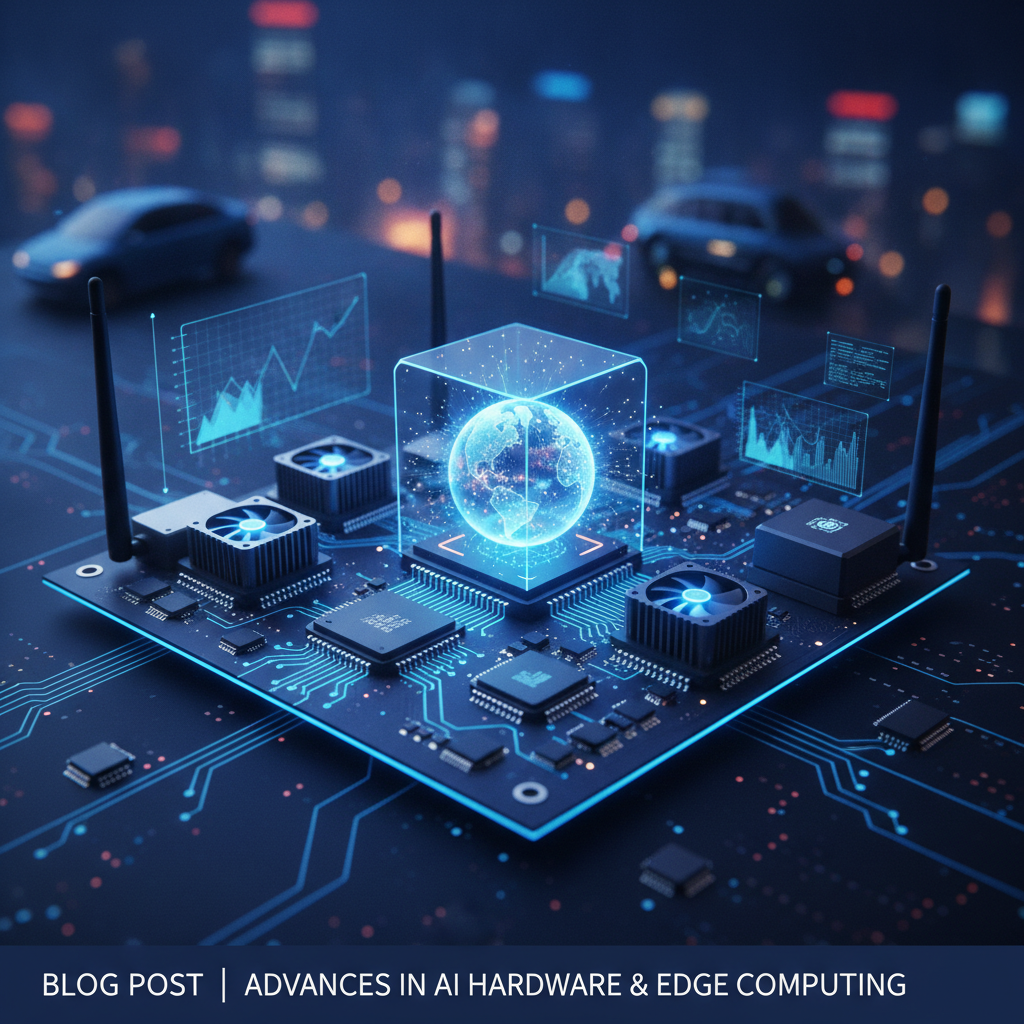
Powering AI: The Revolution in Hardware & Edge
Artificial Intelligence is rapidly transforming industries, societies, and our daily lives. But behind every smart recommendation, autonomous vehicle, or sophisticated medical diagnosis lies a critical foundation: advanced hardware. As AI models become more complex and ubiquitous, the evolution of specialized AI hardware and the rise of edge computing are proving to be game-changers. Let’s dive into this fascinating frontier!
The Need for Specialized AI Hardware
For years, general-purpose CPUs and GPUs have powered AI’s growth. However, modern AI, particularly deep learning, demands immense computational power for tasks like massive matrix multiplications and parallel processing. This led to a crucial realization: to unlock AI’s full potential, we need hardware designed specifically for it.
- ASICs (Application-Specific Integrated Circuits): These chips are custom-built for AI workloads. Google’s TPUs (Tensor Processing Units) are a prime example, offering incredible efficiency for both training and inference tasks in data centers.
- FPGAs (Field-Programmable Gate Arrays): Offering a sweet spot between general-purpose and dedicated ASICs, FPGAs provide flexibility. Developers can reconfigure their hardware logic to optimize for specific AI models, making them adaptable.
- Neuromorphic Chips: Inspired by the human brain, these futuristic chips aim to mimic biological neural networks. They promise ultra-low power consumption and event-driven processing, paving the way for highly efficient, brain-like AI.
Bringing AI Closer: The Edge Revolution
While cloud computing offers vast resources, sending all data to a central cloud isn’t always feasible or desirable for every AI application. This is where edge computing steps in. Edge AI processes data directly on local devices or servers, much closer to where the data is generated, offering distinct advantages:
- Low Latency: Crucial for real-time applications like autonomous vehicles, robotics, or industrial automation where milliseconds matter.
- Enhanced Privacy & Security: Sensitive data can be processed locally without the need to transmit it over networks, reducing exposure risks.
- Reduced Bandwidth Usage: By processing data locally, less information needs to be sent to the cloud, saving bandwidth and costs.
- Improved Reliability: Edge devices can operate independently, even with intermittent or no internet connectivity, ensuring continuous operation.
Innovations Driving Edge AI Hardware
The demand for on-device AI has fueled a new generation of hardware designed for efficiency, compact size, and low power consumption:
- Low-Power AI Accelerators: Products like NVIDIA Jetson series, Google Coral, and Intel Movidius are purpose-built to run complex AI models efficiently at the edge, making AI accessible to a wider range of devices.
- System-on-Chips (SoCs) with Integrated NPUs: Many modern smartphones, smart home devices, and IoT sensors now feature dedicated Neural Processing Units (NPUs) directly embedded within their main chip, enabling sophisticated AI capabilities right on the device.
- TinyML: An exciting subfield focused on deploying machine learning models on incredibly small, low-power microcontrollers. This pushes AI to the very limits of embedded systems, even on devices powered by coin-cell batteries.
The Impact and Future Outlook
These hardware advancements are not just technological feats; they are powering real-world innovation across countless sectors:
- Smart Cities: AI-powered cameras analyzing traffic flow and security footage locally, enhancing public safety and efficiency.
- Healthcare: Wearable devices performing real-time health monitoring and anomaly detection, providing instant insights.
- Industrial IoT: Predictive maintenance on factory floors, with sensors processing data locally to anticipate machinery failures and minimize downtime.
- Autonomous Systems: Vehicles and drones making instantaneous, life-critical decisions without reliance on cloud communication.
The future promises even more powerful, energy-efficient, and ubiquitous AI hardware. We can anticipate deeper integration of AI capabilities into everyday objects, further convergence of hardware and software optimization, and hybrid cloud-edge models that leverage the strengths of both. This continuous innovation ensures that AI will become even smarter, faster, and more responsive.
The journey of Artificial Intelligence is intrinsically linked to the evolution of its underlying hardware. From specialized data center accelerators to compact, power-efficient edge devices, these advancements are not just making AI faster; they’re making it more accessible, secure, and impactful. The revolution in AI hardware and edge computing is laying the groundwork for an incredibly intelligent and interconnected future!
“`


Leave a Reply