
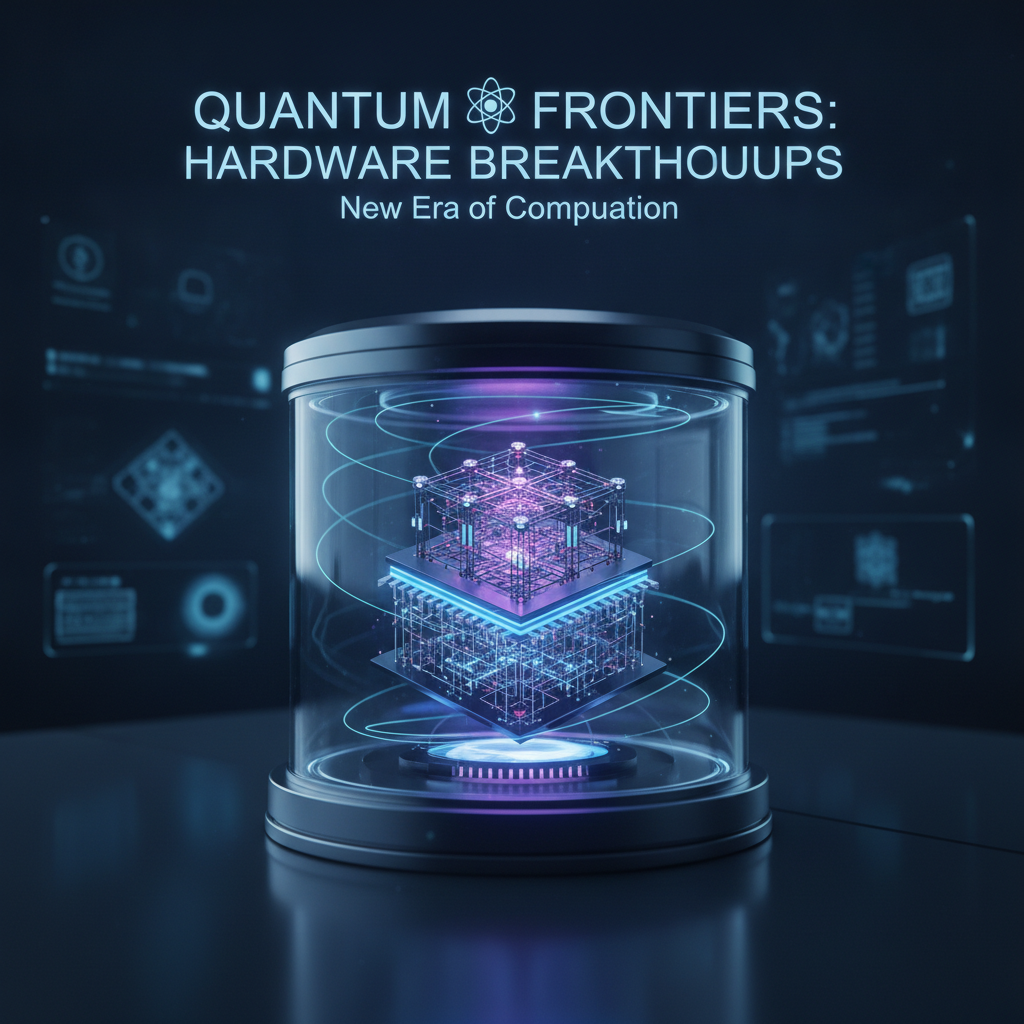
Quantum Hardware: Rapid Progress & Future
Quantum computing isn’t just a futuristic concept anymore; it’s a rapidly evolving field, and at its heart lies the incredible progress in quantum hardware. While the theoretical potential of quantum algorithms has long captivated scientists, the real breakthroughs are happening in labs worldwide, where engineers are building, refining, and scaling the actual quantum processors. Let’s dive into the exciting advances that are shaping the future of computing!
Unlocking the Quantum Realm: Why Hardware Matters
For quantum computers to deliver on their promise – solving problems currently intractable for even the most powerful supercomputers – we need robust, reliable, and scalable hardware. This means creating and maintaining ‘qubits’ (quantum bits) that can store and process information using quantum mechanics. The challenge is immense: qubits are fragile, easily disturbed by their environment, and incredibly difficult to control with precision. Yet, remarkable strides are being made, bringing us closer to practical quantum systems.
Diverse Paths to Powerful Qubits
There isn’t a single ‘best’ way to build a qubit, and researchers are exploring several promising avenues, each with its own advantages and challenges. This diversity is a strength, fostering innovation and competition.
Superconducting Qubits: The Workhorses
Currently, superconducting qubits are at the forefront of quantum processor development, famously used by companies like IBM and Google. These tiny circuits operate at extremely low temperatures, just a fraction of a degree above absolute zero, to minimize thermal noise. Recent advances have focused on increasing the number of qubits on a single chip, improving their coherence times (how long they can maintain quantum states), and reducing error rates. We’re seeing chips with hundreds of qubits, a significant leap from just a few years ago!
Trapped Ions: Precision & Coherence
Another leading technology involves trapped ions. Here, individual atoms are suspended in a vacuum using electromagnetic fields and cooled with lasers. Each ion acts as a qubit, and their quantum states can be manipulated and read out with extraordinary precision. Trapped ion systems boast some of the highest fidelity (lowest error rate) quantum operations and excellent coherence times, making them ideal for exploring complex algorithms and quantum error correction. Researchers are now tackling the challenge of scaling these systems to many more ions.
Silicon Spin Qubits: Leveraging Existing Tech
Imagine building quantum computers using a technology similar to the silicon chips in your smartphone! Silicon spin qubits leverage well-established semiconductor manufacturing techniques, making them highly attractive for future scalability. While still in earlier stages of development compared to superconducting and ion traps, recent breakthroughs in controlling and coupling these qubits are extremely encouraging. Their potential to be integrated into conventional electronics gives them a unique long-term advantage.
Photonic & Topological Approaches: New Horizons
Beyond the leading contenders, exciting research is underway in photonic quantum computing, which uses photons (particles of light) as qubits, and topological quantum computing, which aims to create qubits inherently protected from environmental noise. While these approaches are more nascent, they offer unique pathways to building robust and scalable quantum computers, potentially overcoming some of the limitations of current technologies.
Bigger, Better, Faster: Hardware Breakthroughs
It’s not just about the type of qubit; it’s also about how well they perform. Recent hardware advancements span several critical areas:
- Increased Qubit Count: We’re seeing a rapid increase in the number of qubits on single processors, moving from tens to hundreds, and soon potentially thousands.
- Improved Coherence Times: Qubits are staying quantum for longer, allowing for more complex operations before decoherence sets in.
- Lower Error Rates: The fidelity of quantum operations is steadily improving, meaning fewer errors occur during computations.
- Enhanced Connectivity: Researchers are finding better ways for qubits to interact with each other, which is crucial for running complex algorithms.
- Advanced Control Systems: The electronics and software used to precisely manipulate qubits are becoming more sophisticated and efficient.
What’s Next for Quantum Hardware?
The journey is far from over. The next few years will likely see continued exponential growth in qubit counts and performance metrics. We’ll also witness more sophisticated integration of quantum error correction techniques into hardware, which is vital for building fault-tolerant quantum computers capable of solving truly impactful problems. The focus will shift towards creating modular systems that can connect multiple smaller quantum processors, paving the way for a quantum internet and distributed quantum computing.
A Quantum Leap in the Making
The rapid advances in quantum computing hardware are nothing short of astounding. What was once considered science fiction is steadily becoming a tangible reality, driven by brilliant minds pushing the boundaries of physics and engineering. While a fully universal, fault-tolerant quantum computer is still some years away, the progress being made today is laying the essential groundwork, promising a future where quantum technology could revolutionize fields from medicine and materials science to finance and artificial intelligence. It’s an exciting time to witness the dawn of a new era in computation!


Leave a Reply