
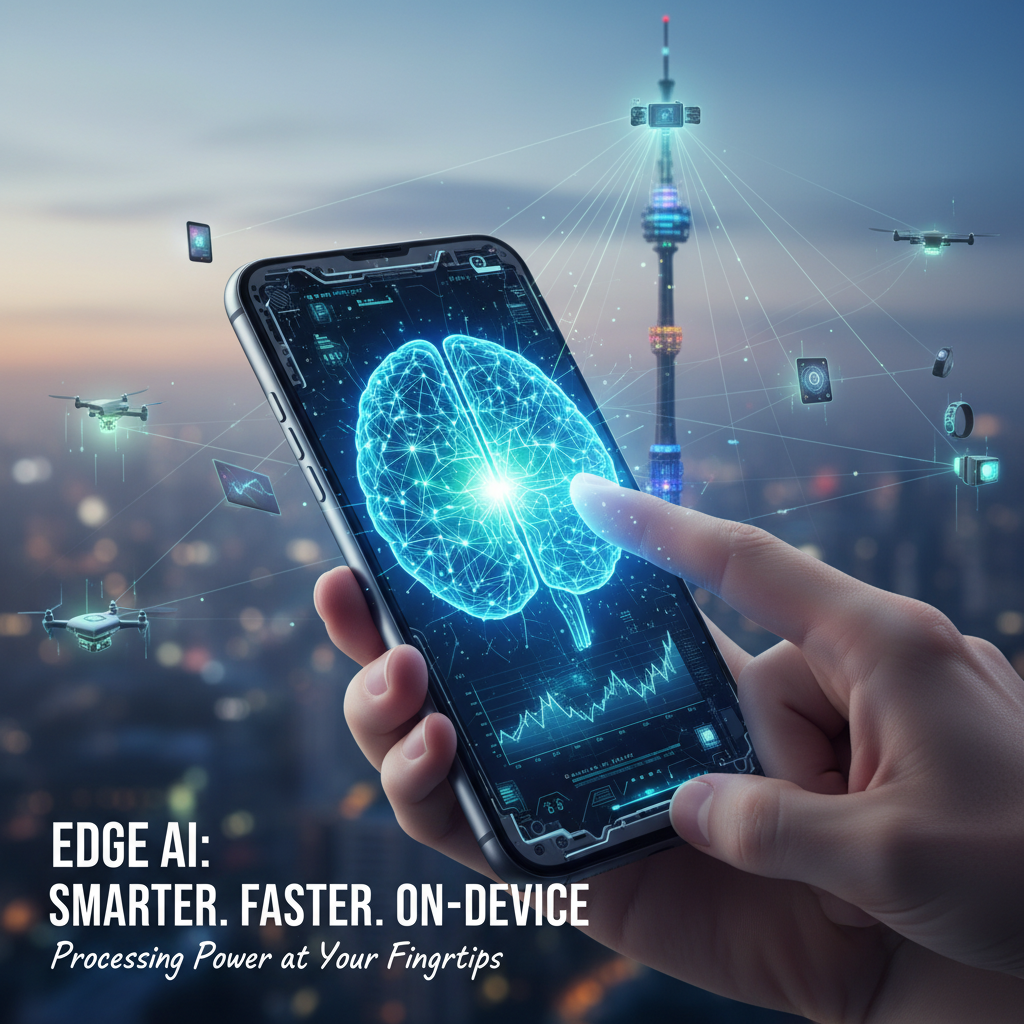
Artificial Intelligence has become a cornerstone of modern technology, powering everything from personalized recommendations to complex industrial automation. Traditionally, much of this AI magic happened in the cloud, with data traveling vast distances to powerful servers for processing. But what if the intelligence could reside right where the action is – on your device itself? Welcome to the world of Edge AI and On-Device Processing!
What is Edge AI Anyway?
At its core, Edge AI refers to the practice of running AI algorithms and machine learning models directly on local hardware (the “edge” of the network), rather than sending all data to a central cloud server. Think of your smartphone, a smart camera, an industrial sensor, or even a self-driving car – these are all examples of “edge devices.”
On-device processing means that the computation happens locally, reducing the reliance on constant internet connectivity and remote data centers. Instead of uploading a video to the cloud for object recognition, an edge-enabled camera can identify a person or a package right then and there.
Why Go Local? The Benefits of On-Device Processing
The shift towards edge AI isn’t just a tech trend; it’s driven by a host of practical advantages that are reshaping how we interact with AI:
- Lightning-Fast Responses (Low Latency): For applications like autonomous vehicles or real-time industrial control, every millisecond counts. Processing data locally eliminates network delays, enabling instant decision-making.
- Enhanced Privacy and Security: When data is processed on the device, it doesn’t need to leave your local network. This significantly reduces the risk of data breaches and enhances user privacy, especially for sensitive information like medical data or surveillance footage.
- Reliability in Any Environment: Edge AI solutions can operate effectively even in areas with poor or no internet connectivity. This is crucial for remote monitoring, disaster response, or applications in challenging geographical locations.
- Reduced Bandwidth and Cloud Costs: Sending vast amounts of raw data to the cloud can be expensive in terms of bandwidth and storage. Edge AI processes data locally and only sends critical insights or aggregated information, saving resources.
Where Do We See Edge AI? Real-World Examples
Edge AI is already making a significant impact across various sectors, often without us even realizing it:
- Smartphones: Facial recognition for unlocking, on-device voice assistants (like Siri or Google Assistant processing initial commands), and computational photography features all leverage edge AI.
- Smart Home Devices: Security cameras that can detect people or pets without constant cloud uploads, smart speakers that process voice commands locally.
- Industrial IoT: Predictive maintenance on factory floors, quality control systems, and machinery monitoring that make real-time decisions without needing central oversight.
- Autonomous Vehicles: Self-driving cars rely heavily on edge AI to process sensor data (cameras, radar, lidar) instantly to navigate, detect obstacles, and make life-critical decisions.
- Healthcare: Wearable devices monitoring vital signs, AI-powered diagnostic tools in remote clinics.
Navigating the Edge: Challenges and Considerations
While the benefits are compelling, developing and deploying Edge AI solutions comes with its own set of challenges:
- Resource Constraints: Edge devices often have limited processing power, memory, and battery life. AI models must be highly optimized and efficient to run effectively in these environments.
- Model Optimization: Converting large, complex cloud AI models into lightweight versions suitable for edge devices requires specialized techniques and expertise.
- Deployment and Maintenance: Managing and updating AI models across a fleet of thousands or millions of edge devices can be complex.
- Hardware Specialization: The need for specialized AI accelerators (like NPUs or TPUs) on edge devices is growing to handle the computational demands efficiently.
The Road Ahead: What’s Next for Edge AI?
Edge AI is not about replacing cloud AI, but rather complementing it to create a more robust, efficient, and intelligent ecosystem. As hardware becomes more powerful and energy-efficient, and as software tools for model optimization mature, we can expect to see Edge AI becoming even more pervasive. It promises a future where our devices are not just connected, but truly intelligent, making decisions locally and interacting with the world around them with unprecedented speed and privacy. Get ready for a smarter, more responsive world, powered by intelligence right where you need it!
“`



Leave a Reply