
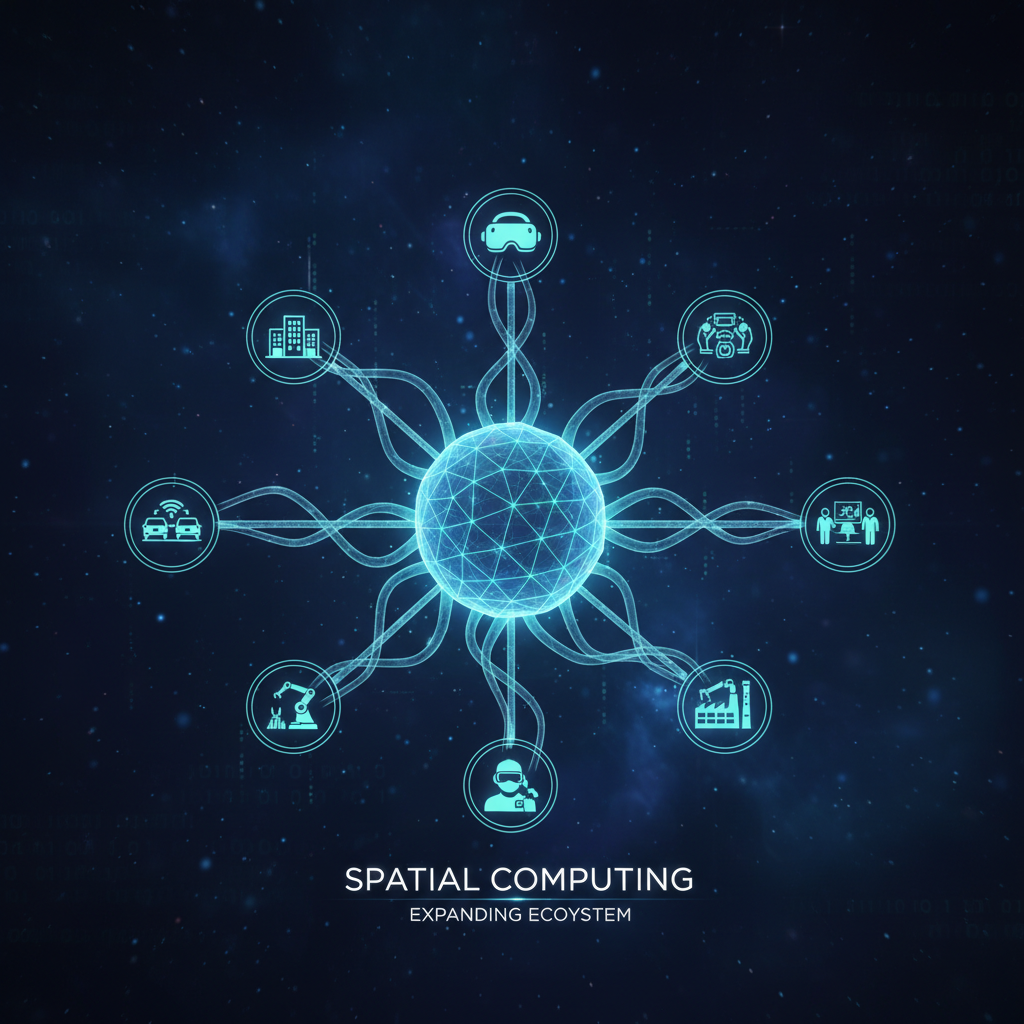
Spatial Computing: A Universe of Possibilities
Get ready to rethink your relationship with technology! Spatial computing is rapidly evolving from a niche concept into a pervasive force, blending our digital lives seamlessly with the physical world. It’s not just about screens anymore; it’s about experiences that unfold all around us. The ecosystem supporting this revolution is expanding at an incredible pace, inviting innovation from every corner.
What Exactly is Spatial Computing?
At its core, spatial computing involves technologies that understand and interact with the physical world in three dimensions. Think beyond flat screens and into environments where digital content can exist, persist, and be manipulated alongside real-world objects and spaces. This encompasses everything from Augmented Reality (AR) that overlays digital info onto your view of reality, to Virtual Reality (VR) that fully immerses you in a digital world, and Mixed Reality (MR) that intelligently merges the two.
The Engines Driving This Expansion
So, what’s fueling this exciting growth? Several key factors are converging to accelerate the spatial computing revolution:
First, we’re seeing remarkable **hardware advancements**. Devices like the Apple Vision Pro, Meta Quest series, and Magic Leap are pushing boundaries in display quality, sensor fidelity, and intuitive interaction. These sophisticated devices are becoming more powerful, comfortable, and accessible, making rich spatial experiences possible for a wider audience.
Second, **software platforms and developer tools** are maturing rapidly. Robust SDKs (Software Development Kits) from major players, alongside powerful engines like Unity and Unreal, are empowering developers to create incredibly immersive and interactive applications with greater ease and sophistication. This lower barrier to entry is sparking a wave of creativity.
Finally, improved **connectivity and processing power**, especially with the rollout of 5G and advancements in edge computing, are enabling real-time, high-fidelity spatial experiences that were previously impossible. This allows complex computations to happen instantly, whether on-device or in the cloud.
Real-World Applications Are Exploding
The beauty of spatial computing lies in its versatility. Its impact is being felt across numerous sectors:
In **enterprise and industry**, spatial computing is transforming workflows. Imagine architects walking through digital models of buildings before they’re built, surgeons rehearsing complex procedures in VR, or field technicians getting remote assistance with 3D overlays for repairs. Training, design, and remote collaboration are becoming more efficient and intuitive.
For **consumers and entertainment**, the possibilities are endless. Gaming is evolving into hyper-immersive experiences, social interactions are becoming more present and engaging, and new forms of storytelling are emerging that truly put you “inside” the narrative.
Even in **everyday life**, spatial computing is starting to weave itself in. Think about immersive learning experiences for education, enhanced navigation in complex environments, or even new ways to shop and visualize products in your own home before buying them.
Building a Collaborative Future
The “ecosystem” isn’t just about technology; it’s about people and partnerships. This expansion is fostering a vibrant community of startups, established tech giants, academic researchers, and independent creators all collaborating to define the future. Open standards, interoperability initiatives, and shared learning are crucial for ensuring that spatial computing develops in a way that benefits everyone.
We’re still in the early chapters of the spatial computing story, but the narrative is compelling. While challenges like user comfort, content creation, and ethical considerations remain, the potential for this technology to enrich our lives, transform industries, and connect us in new ways is immense. Keep an eye on this space; the world as we know it is about to get a whole lot more exciting!

Leave a Reply