
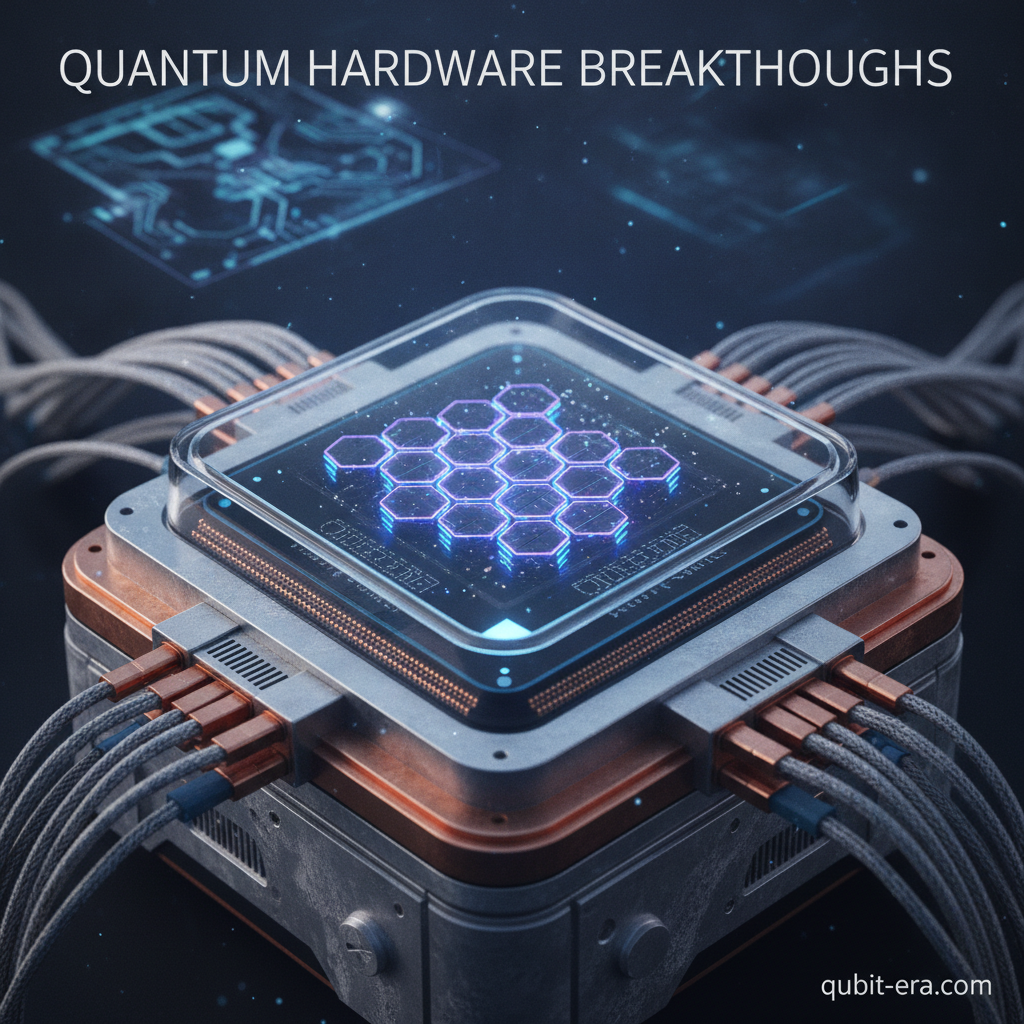
Quantum Hardware: Unlocking the Future!
Ever wondered what goes on behind the scenes to make quantum computers a reality? While the algorithms and theories are mind-bending, the physical hardware that makes it all possible is where some of the most exciting breakthroughs are happening right now! Quantum computing promises to solve problems currently intractable for even the most powerful classical supercomputers, and these promises hinge on our ability to build stable, scalable, and reliable quantum hardware. Let’s dive into the fascinating world of quantum hardware advancements!
The Quantum Leap: Why Hardware Matters
At its core, quantum computing uses the unique properties of quantum mechanics – like superposition and entanglement – to process information. The fundamental building blocks are “qubits,” which, unlike classical bits (0 or 1), can exist in multiple states simultaneously. But creating and controlling these delicate quantum states requires incredibly precise engineering in extreme conditions. The race is on to build quantum processors that can maintain these states long enough to perform complex calculations, connect many qubits together, and correct errors that inevitably occur.
Leading the Charge: Qubit Technologies
Several distinct hardware approaches are vying for supremacy, each with its own strengths and challenges:
Superconducting Qubits
These are perhaps the most well-known, used by giants like IBM and Google. They operate at temperatures colder than deep space, leveraging superconducting circuits to create and manipulate qubits. Recent breakthroughs include increasing qubit counts dramatically and demonstrating early error correction capabilities on larger arrays. The challenge remains in scaling them further while maintaining coherence.
Trapped Ions
Companies like Quantinuum (a merger of Honeywell Quantum Solutions and Cambridge Quantum) utilize trapped ions. Here, individual atoms are suspended in electromagnetic fields and manipulated with lasers. They boast very high coherence times and excellent qubit connectivity, making them strong contenders for high-fidelity operations. Recent progress has focused on improving the speed and complexity of operations, as well as developing modular architectures.
Silicon-Based Qubits
Imagine quantum chips made with familiar silicon technology! This approach, pursued by companies like Intel and startups like Diraq, uses electron spins in silicon. The appeal is the potential for mass manufacturing using existing semiconductor foundries. Breakthroughs here involve demonstrating high-fidelity operations and integrating more qubits onto a single chip, moving closer to manufacturable quantum processors.
Neutral Atoms and Photonic Qubits
Beyond these, exciting progress is also being made with neutral atoms (e.g., Atom Computing, Pasqal), which offer large arrays of highly controllable qubits, and photonic qubits (e.g., Xanadu, PsiQuantum), which use particles of light and promise robust operations at room temperature. Each method pushes the boundaries of what’s possible in different ways.
What’s New? Major Milestones Achieved
The past year has seen a flurry of activity. We’re witnessing processors with over 100, and in some cases even over 1000 qubits, being demonstrated (though not all are fully operational or error-corrected). Crucially, researchers are achieving longer “coherence times” – the duration a qubit can maintain its quantum state – and lower error rates per operation. We’re also seeing the first experimental demonstrations of “quantum error correction,” a vital step toward fault-tolerant quantum computers that can truly tackle complex problems without being overwhelmed by noise. These aren’t just incremental improvements; they’re foundational steps toward reliable, powerful machines.
Beyond the Lab: What This Means for Us
Why should we care about these hardware breakthroughs? Because a robust quantum computer has the potential to revolutionize countless fields:
- Medicine and Materials: Simulating molecules to discover new drugs or design advanced materials.
- Finance: Optimizing complex financial models and risk assessment.
- Artificial Intelligence: Enhancing machine learning algorithms for better pattern recognition and data analysis.
- Cybersecurity: Developing new cryptographic methods to protect our data.
Each hardware advancement brings us closer to these transformative applications.
The Road Ahead: A Quantum Future
While we’re still in the early stages, the rapid pace of quantum computing hardware breakthroughs is nothing short of astonishing. The journey from fragile, few-qubit systems to more stable, scalable processors is well underway. The global scientific community is tirelessly working to overcome the remaining engineering hurdles, bringing us closer to a future where quantum computers solve humanity’s most pressing challenges. It’s an exciting time to be watching this space, as each new breakthrough unlocks a piece of tomorrow’s technology today!


Leave a Reply