
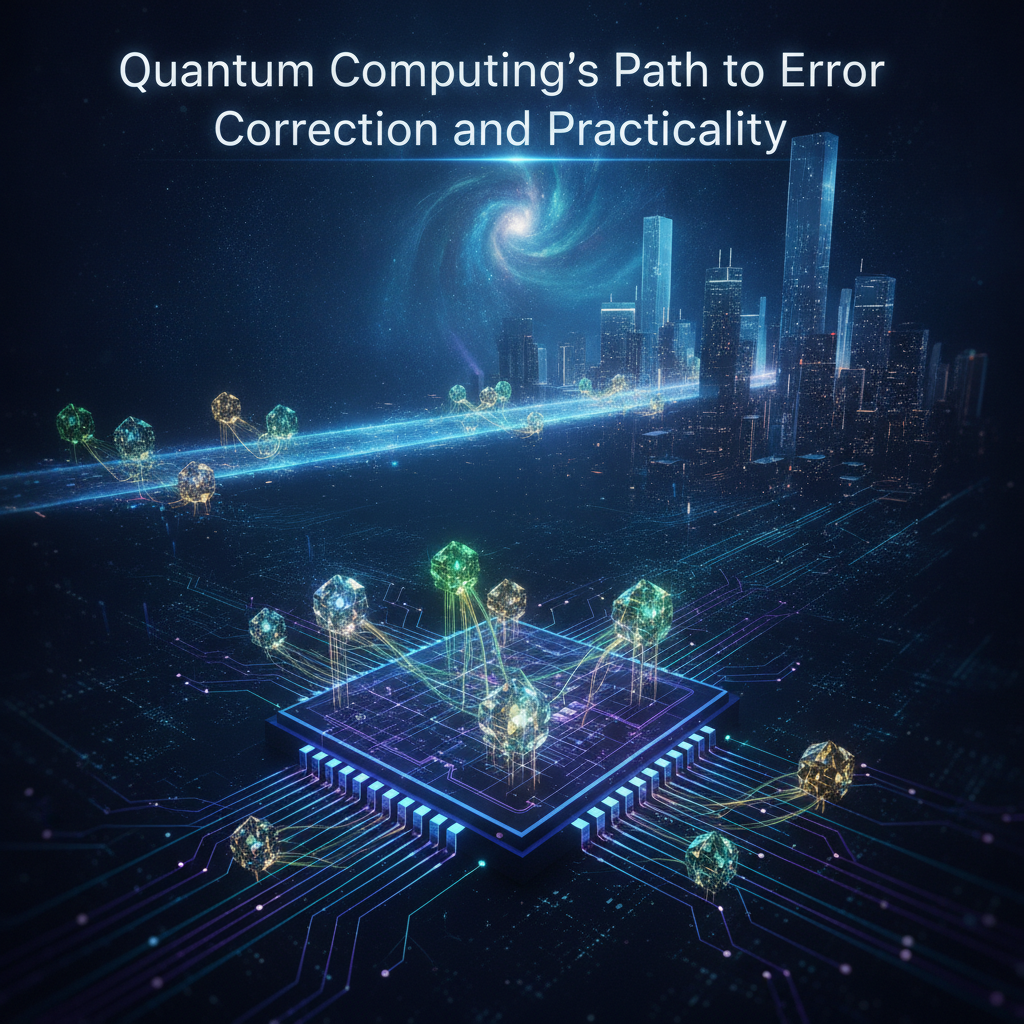
Taming the Quantum Realm: Error Correction
Quantum computing holds the promise of solving problems far beyond the reach of classical computers, from discovering new drugs to optimizing complex systems. Yet, building these revolutionary machines is an monumental task. One of the biggest hurdles isn’t just creating qubits, but making them reliable enough to actually compute. This is where quantum error correction (QEC) steps in – a crucial technology guiding quantum computing from theoretical marvel to practical reality.
The Fickle Nature of Qubits
Unlike classical bits, which are simply 0 or 1, quantum bits (qubits) can exist in superpositions of both states simultaneously. This unique property, along with entanglement, gives quantum computers their power. However, qubits are incredibly fragile. They are highly susceptible to environmental noise and interactions, a phenomenon known as decoherence. Even the slightest disturbance can cause a qubit to lose its quantum state, leading to errors in computation. Imagine trying to balance a pencil on its tip for an hour – that’s how sensitive qubits can be!
Quantum Error Correction: A Necessity
In classical computing, error correction is relatively straightforward. We can make multiple copies of a bit and use majority voting to detect and correct errors. If one bit flips, we compare it to its copies and fix it. With quantum mechanics, the “no-cloning theorem” prevents us from simply copying a qubit’s state. This means we can’t just make identical backups.
Quantum error correction employs a much more sophisticated strategy. Instead of copying a qubit, its information is encoded redundantly across multiple *entangled* physical qubits. If one of these physical qubits experiences an error, the overall logical qubit’s state can often be preserved. This distributed encoding allows for error detection and correction without directly measuring and collapsing the sensitive quantum state.
Building Reliable Systems from Unreliable Parts
The ultimate goal of QEC is to achieve “fault-tolerant quantum computing.” This means building a quantum computer that can perform long, complex calculations even if its individual components (physical qubits) are noisy and prone to errors. Think of it like a robust bridge built from many slightly imperfect girders; the overall structure remains strong because of intelligent design and redundancy. Fault tolerance is key to scaling quantum computers from a few dozen qubits to the millions that will be needed for truly transformative applications.
Challenges and the Road Ahead
While the theory behind quantum error correction is elegant, its practical implementation is incredibly challenging. Encoding one ‘logical’ qubit typically requires many ‘physical’ qubits – potentially hundreds or even thousands for a single reliable logical qubit. This overhead demands massive increases in qubit numbers and control precision. Researchers are actively exploring various QEC codes, like surface codes, and developing advanced quantum architectures to make this more efficient.
Despite these significant hurdles, progress is being made at an astonishing pace. Recent experiments have demonstrated encoding logical qubits, detecting specific errors, and even performing basic logical operations that outperform uncorrected physical qubits. These breakthroughs are vital steps towards building the larger, more stable quantum systems of the future.
Why Error Correction Matters for Practicality
Without robust quantum error correction, quantum computers would remain powerful but ultimately unreliable curiosities, limited to short computations where errors don’t accumulate too quickly. QEC is the bridge that connects today’s noisy, intermediate-scale quantum (NISQ) devices to the large-scale, fault-tolerant quantum computers that can tackle truly world-changing problems.
From developing new materials and catalysts to revolutionizing cryptography and artificial intelligence, the impact of practical quantum computing will be profound. And the path to that practicality is paved with the intricate, ingenious science of quantum error correction.

Leave a Reply