
Taming Quantum Errors: Building Reliable QCs
Quantum computing holds incredible promise, from revolutionizing medicine to discovering new materials. But there’s a big catch: quantum computers are incredibly fragile. Unlike classical computers that operate with stable bits, quantum bits (qubits) are easily disrupted by their environment, leading to errors. This fragility is arguably the biggest hurdle to unlocking their true potential, and it’s why quantum error correction (QEC) isn’t just important—it’s essential.
The Fragile Nature of Qubits
Imagine trying to perform complex calculations on a wobbly table in a room full of vibrations. That’s a bit like what current quantum computers face. Qubits leverage delicate quantum phenomena like superposition and entanglement. Any interaction with the environment – tiny fluctuations in temperature, electromagnetic fields, or even stray particles – can cause these states to collapse or decohere, introducing errors. These errors can propagate quickly, turning a potentially revolutionary computation into gibberish.
Classical computers deal with errors too, but they’re much simpler. A classical bit is either a 0 or a 1. If a bit flips, you can often detect and correct it by comparing multiple copies or using simple parity checks. Quantum errors, however, are far more complex. A qubit isn’t just 0 or 1; it can be both simultaneously (superposition) or entangled with other qubits. An error might be a “bit flip,” a “phase flip,” or a combination, and directly measuring a qubit to check for errors would destroy its quantum state.
Beyond Classical Redundancy: Quantum Error Correction
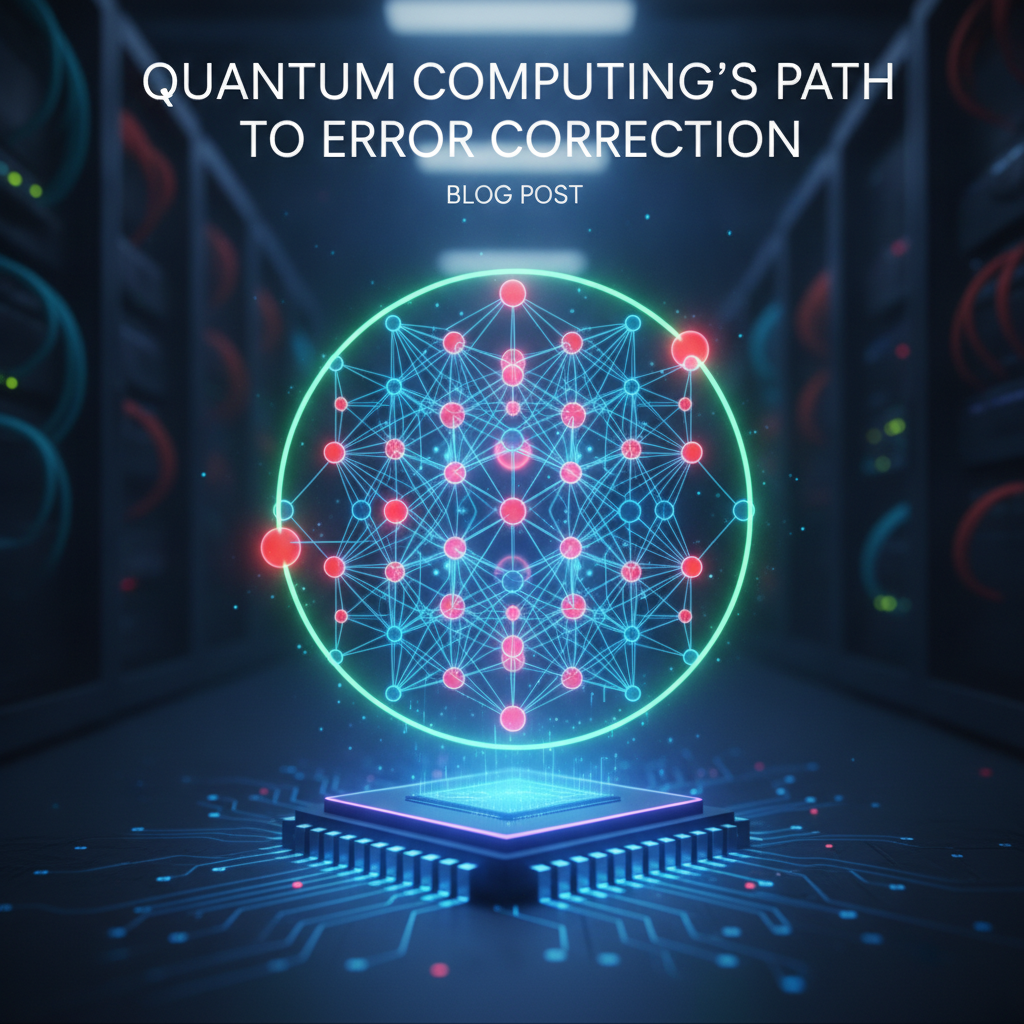
So, how do we protect something we can’t directly look at without disturbing it? Quantum error correction takes a brilliantly counter-intuitive approach. Instead of making multiple copies of a qubit (which is forbidden by the “no-cloning theorem” in quantum mechanics), QEC encodes one piece of quantum information (one “logical qubit”) across a larger number of physical qubits.
Think of it like distributing a secret message across several scrolls, where no single scroll holds the entire secret, but together they provide enough redundant information to reconstruct it even if one or two scrolls are damaged. In QEC, measurements are performed on combinations of these physical qubits (called “syndromes”) to detect where an error has occurred without revealing the underlying quantum information itself. This allows for correction, ensuring the logical qubit remains protected.
From Physical to Fault-Tolerant Qubits
The goal of QEC is to create “fault-tolerant” logical qubits. A single logical qubit might require tens, hundreds, or even thousands of physical qubits, depending on their individual error rates and the specific error correction code used (like surface codes). While this sounds like a massive overhead, it’s the pathway to scalable quantum computers. Each additional physical qubit devoted to error correction significantly reduces the effective error rate of the protected logical qubit.
Achieving truly fault-tolerant quantum computing is a monumental engineering challenge. It demands incredibly precise control over many qubits, near-perfect isolation from the environment, and the ability to perform many operations without introducing new errors.
The Road Ahead: Challenges and Breakthroughs
Current quantum hardware is in the Noisy Intermediate-Scale Quantum (NISQ) era, meaning qubits are prone to errors and the number of available qubits is limited. Implementing full-scale quantum error correction is one of the grand challenges of this field. However, significant progress is being made:
Improved Qubit Coherence: Scientists are constantly improving qubit designs and materials to make them more stable and less prone to decoherence.
Demonstrating Small Codes: Researchers have successfully demonstrated basic error correction codes on a small number of qubits, showing that the theoretical principles work in practice.
Novel Architectures: New ways of arranging and connecting qubits are being explored to facilitate error correction schemes.
The Promise of a Reliable Quantum Future
Ultimately, robust quantum error correction is the key to unlocking the full power of quantum computing. Once we can build stable, fault-tolerant logical qubits, we can move beyond current limitations and tackle the truly transformative applications:
Designing new drugs and materials with unprecedented precision.
Optimizing complex systems in finance, logistics, and AI.
Breaking currently unbreakable encryption methods.
The journey to fault-tolerant quantum computers is long and complex, but the progress in quantum error correction shows we’re on the right path. It’s a testament to human ingenuity, pushing the boundaries of physics and engineering to build the computational tools of tomorrow.
“`

Leave a Reply