
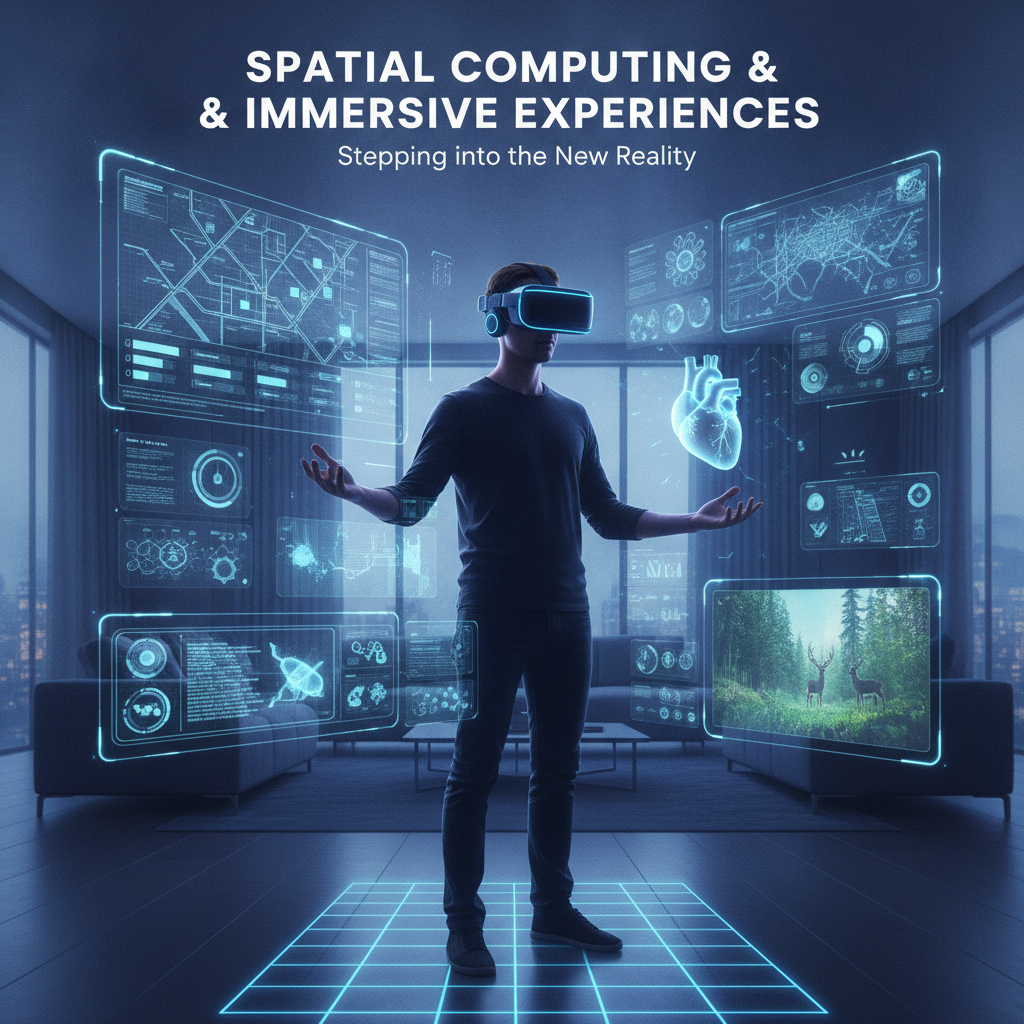
Remember when computers were just flat screens on desks? Get ready to leave those days behind, because a revolution is underway: Spatial Computing. It’s not just about wearing a headset; it’s about blending digital information seamlessly with our physical world, creating truly immersive experiences that redefine how we interact with technology.
What Exactly is Spatial Computing?
At its core, spatial computing isn’t just augmented reality (AR) or virtual reality (VR) – it’s the broader concept of technology understanding and interacting with our physical space. Think of it as giving computers ‘eyes’ and ‘brains’ to perceive, map, and interact with the 3D world around us. Instead of looking at a screen, you’re stepping into a digital environment that coexists with your real one.
The Magic Behind the Immersion
This magic is powered by a sophisticated blend of technologies. Advanced sensors scan and map our surroundings in real-time. Powerful processors and AI interpret this data, understanding objects, surfaces, and even human gestures. Then, sophisticated rendering engines overlay digital content – from interactive 3D models to holographic interfaces – directly into our field of view, creating a truly seamless blend of physical and digital.
Where Are We Seeing It? (And Where Are We Going?)
The applications of spatial computing are already vast and rapidly expanding. In healthcare, surgeons can practice complex procedures on holographic models. In design and architecture, teams can walk through virtual buildings before they’re even built. For entertainment, games become entire worlds you can physically explore. And in education, learning becomes an interactive, hands-on journey through complex concepts.
Beyond these specific use cases, spatial computing promises to make our interactions with technology far more intuitive and natural. Imagine controlling your smart home with gestures, collaborating with colleagues on a shared virtual whiteboard no matter where you are, or receiving contextual information about your surroundings just by looking at them. It’s about technology adapting to us, rather than us adapting to it.
Stepping into a New Reality
Spatial computing is more than just a technological advancement; it’s a paradigm shift. We’re moving from a world of passive consumption on flat screens to one of active engagement within immersive, intelligent environments. The journey has just begun, and the possibilities for enhanced productivity, richer entertainment, and deeper human connection are incredibly exciting. Get ready to step into a new reality!
“`

Leave a Reply