
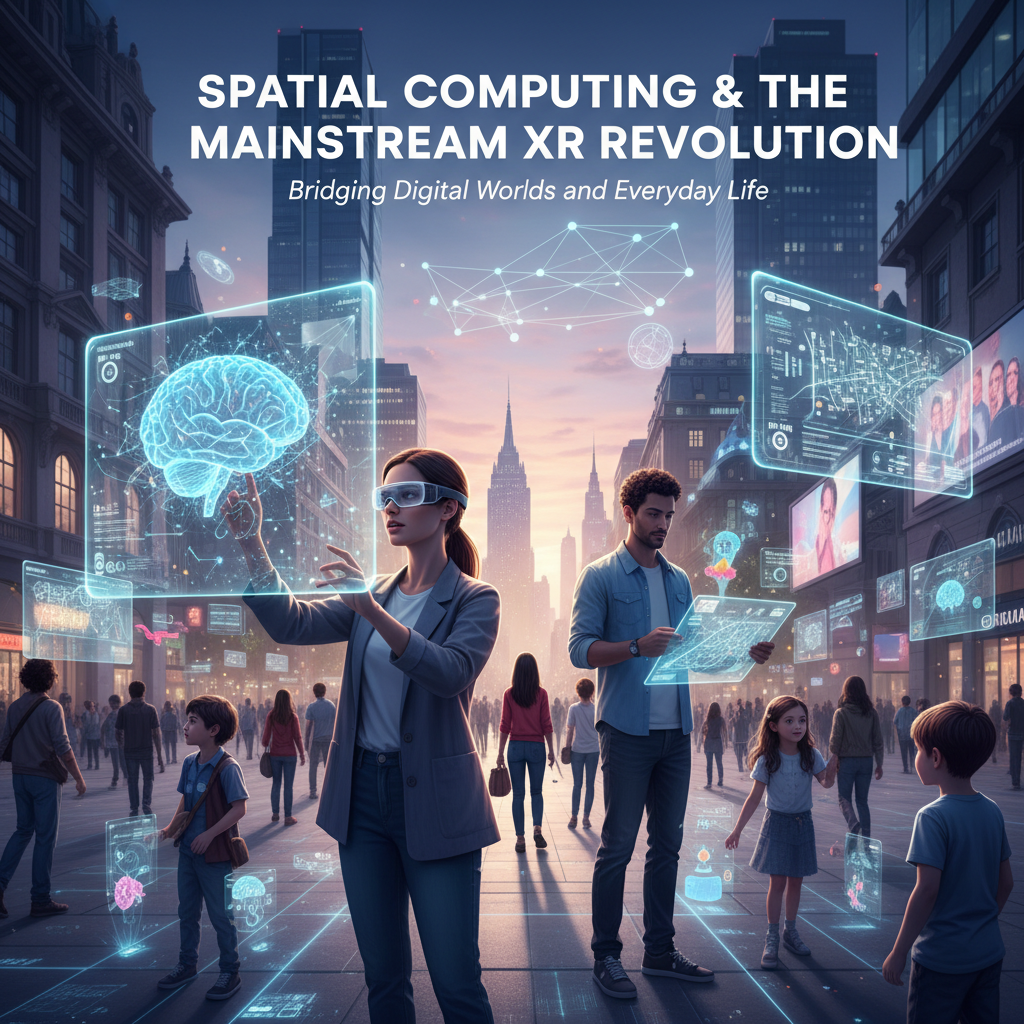
Spatial Computing: Ready for Prime Time?
Remember when smartphones felt like science fiction? Today, they’re an indispensable part of our lives. We’re on the cusp of a similar revolution, one that promises to blend our digital world seamlessly with the physical: Spatial Computing and the mainstream adoption of Extended Reality (XR). It’s an exciting future, and it might be arriving sooner than you think!
Beyond Your Screen: What Exactly is Spatial Computing?
At its heart, spatial computing isn’t just about putting on a headset; it’s about giving digital content a physical presence in your real-world environment. Imagine interacting with 3D models floating in your living room, collaborating with colleagues’ avatars around a virtual table, or navigating with augmented directions layered directly onto the street in front of you. Unlike traditional computing, which is confined to a 2D screen, spatial computing understands and interacts with the 3D space around us, making our digital experiences truly immersive and intuitive.
From Niche to Necessary: The Journey of XR
For years, XR (an umbrella term encompassing Virtual Reality, Augmented Reality, and Mixed Reality) has been an intriguing but often niche technology. Early VR headsets were bulky, expensive, and sometimes caused motion sickness. AR was mostly limited to smartphone apps that felt more like novelties than essential tools. The content ecosystem was nascent, and the “killer app” for mainstream users seemed elusive. So, what’s changing now?
Key Drivers Accelerating Mainstream Adoption
Hardware Innovations & User Experience
The biggest hurdle has always been the hardware. But we’re seeing incredible progress! Devices are becoming lighter, more powerful, and significantly more comfortable. High-resolution displays are reducing the “screen door effect,” while advanced optics and sensors are enabling more precise tracking and realistic rendering. Crucially, companies are now focusing on a more intuitive user experience, moving beyond complex controllers to natural interactions like hand gestures, eye-tracking, and voice commands. This shift from clunky gadgets to seamless interfaces is vital for mass appeal.
Content Ecosystem & Developer Tools
Hardware is just one piece of the puzzle. The real magic happens with compelling content and applications. We’re seeing a rapid expansion in this area, driven by sophisticated developer tools that make it easier to create spatial experiences. From groundbreaking games and immersive entertainment to powerful enterprise solutions for training, design, and remote collaboration, the content library is growing exponentially. As more developers enter the space, the “killer apps” for a diverse range of users will naturally emerge, much like they did for the smartphone.
Transforming Our Daily Lives
Mainstream spatial computing adoption promises to revolutionize almost every facet of our lives. Imagine enhanced learning environments where students dissect virtual frogs or explore ancient civilizations firsthand. Picture doctors performing complex surgeries with real-time holographic guidance. Envision architects walking through their designs before they’re built, or families sharing virtual experiences across continents. From shopping and social interaction to fitness and productivity, spatial computing will offer new dimensions of engagement and efficiency.
Navigating the New Reality: Challenges & Opportunities
Of course, the path to mainstream adoption isn’t without its challenges. Issues like data privacy, ethical considerations of persistent digital overlays, interoperability between different platforms, and ensuring accessibility for all users will need careful consideration. However, these challenges also present immense opportunities for innovation and collaboration. Building a responsible and inclusive spatial future is a collective endeavor.
The Future is Spatial: Are We Ready?
We are truly at an inflection point for spatial computing and XR. The technological foundations are maturing, the content ecosystem is blossoming, and the potential applications are vast and varied. While it might take a few more years for these technologies to become as ubiquitous as smartphones, the trajectory is clear. Get ready to step beyond your screen and into a digitally enhanced world – the spatial future is knocking!


Leave a Reply