
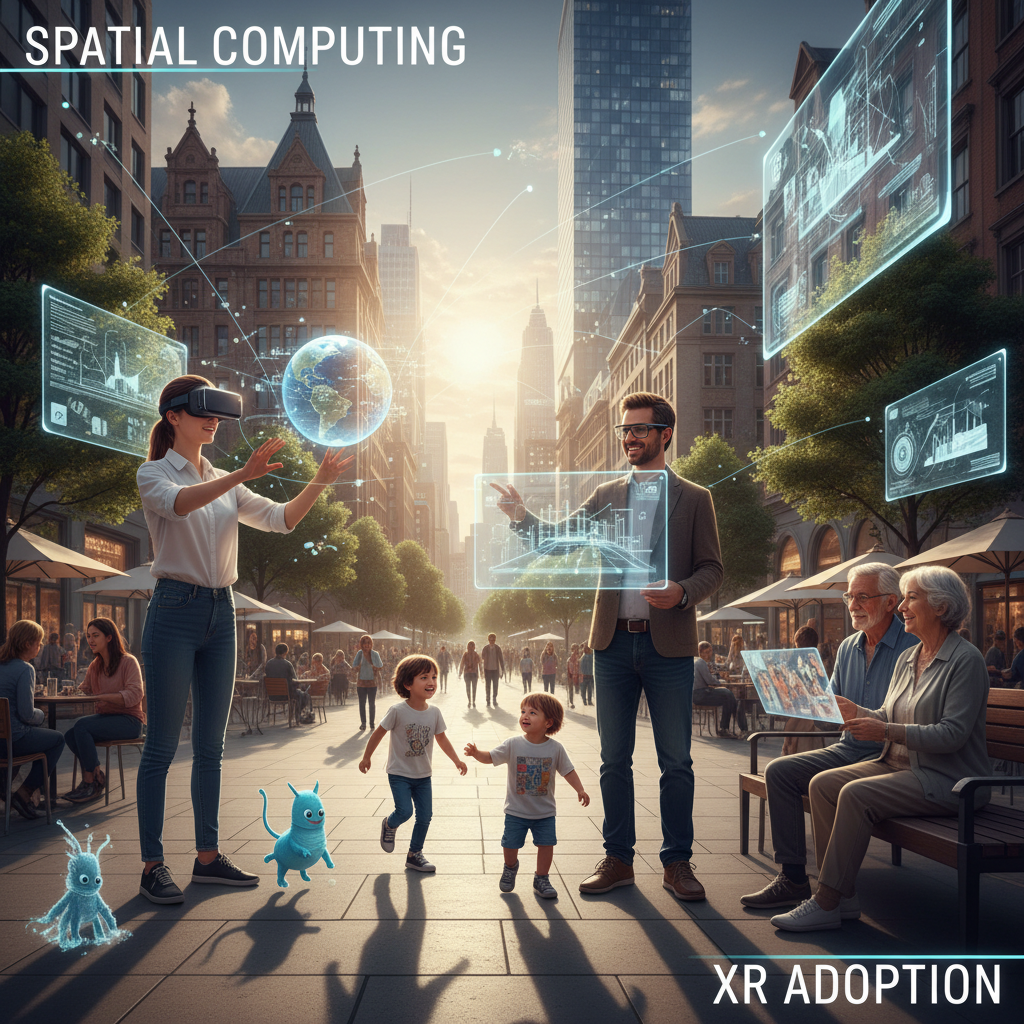
Beyond Screens: The Road to Mainstream Spatial Computing and XR Adoption
Imagine a world where your digital life isn’t confined to a flat screen, but seamlessly integrated into your physical surroundings. Welcome to the exciting frontier of Spatial Computing and Extended Reality (XR)!
What Exactly is Spatial Computing?
Spatial computing is a revolutionary paradigm shift, moving us beyond traditional 2D interfaces. Instead of interacting with apps *on* a screen, you interact with digital content *within* your physical space. Think of it as giving computers the ability to “understand” and operate within the real world, allowing digital objects to exist and interact with physical ones. This isn’t just about viewing digital content; it’s about making it spatially aware and interactive within our 3D environment.
XR: The Gateway to Spatial Experiences
Extended Reality (XR) is the umbrella term encompassing Virtual Reality (VR), Augmented Reality (AR), and Mixed Reality (MR). These technologies are our primary interfaces for experiencing spatial computing. VR fully immerses you in a digital world, AR overlays digital information onto your real world view, and MR blends the two, allowing digital and physical objects to interact realistically. While XR has seen incredible advancements, its mainstream adoption is the key to unlocking the full potential of spatial computing.
The Current Landscape: Niche vs. Mainstream
Today, XR has found strong footholds in specific areas. VR shines in gaming, professional training, and immersive entertainment. AR is increasingly integrated into our smartphones for filters, navigation, and shopping experiences. However, the vision of ubiquitous XR devices replacing traditional screens in daily life for the average person is still on the horizon. High costs, bulky hardware, limited content ecosystems, and comfort issues have kept it somewhat niche.
Paving the Way: Drivers for Mainstream Adoption
What will it take for spatial computing and XR to become as common as smartphones? Several factors are converging:
- Improved Hardware: Lighter, more comfortable headsets with higher resolution, wider fields of view, and longer battery life are crucial. Think stylish glasses rather than bulky goggles.
- Accessible Content & Applications: A “killer app” beyond gaming that provides tangible, everyday value will be a game-changer. Productivity tools, social platforms, and educational experiences that genuinely enhance our lives are vital.
- Seamless User Experience: Intuitive interactions, robust tracking, and minimal latency are essential to prevent user fatigue and motion sickness.
- Affordability: As with any new technology, price drops driven by economies of scale will make devices accessible to a broader audience.
- Interoperability & Standards: Open standards will allow content and applications to flow seamlessly across different devices and platforms, much like the web today.
Beyond Entertainment: Practical Applications for Everyone
While gaming and entertainment often capture the headlines, the real power of spatial computing for mainstream adoption lies in its practical applications:
- Work & Productivity: Imagine collaborative virtual workspaces where colleagues from around the globe can interact with 3D models and data as if they were in the same room.
- Education: Immersive learning experiences that allow students to explore historical sites, dissect virtual organs, or visualize complex scientific concepts in 3D.
- Healthcare: Surgeons training with realistic haptic feedback, remote diagnostics with AR overlays, and therapeutic VR environments for mental health.
- Social Connection: More immersive social interactions that transcend geographical boundaries, allowing people to feel truly present with loved ones or new acquaintances.
- Retail & Design: Virtually trying on clothes, placing furniture in your living room before buying, or collaborating on architectural designs in real-time 3D.
The Road Ahead: Challenges and Excitement
While the future is bright, challenges remain. Privacy concerns regarding spatial data, the need for robust ethical frameworks, and ensuring equitable access are important conversations we must have. However, the innovation pipeline is strong, with major tech companies investing heavily in the space. We’re seeing a rapid evolution from rudimentary devices to sophisticated platforms.
Embracing the Spatial Future
Spatial computing and mainstream XR adoption aren’t just about new gadgets; they represent a fundamental shift in how we interact with information, each other, and our world. It promises a future where technology is less of a barrier and more of an intuitive extension of our natural environment. Get ready to step beyond the screen – the spatial era is rapidly approaching!
“`



Leave a Reply