
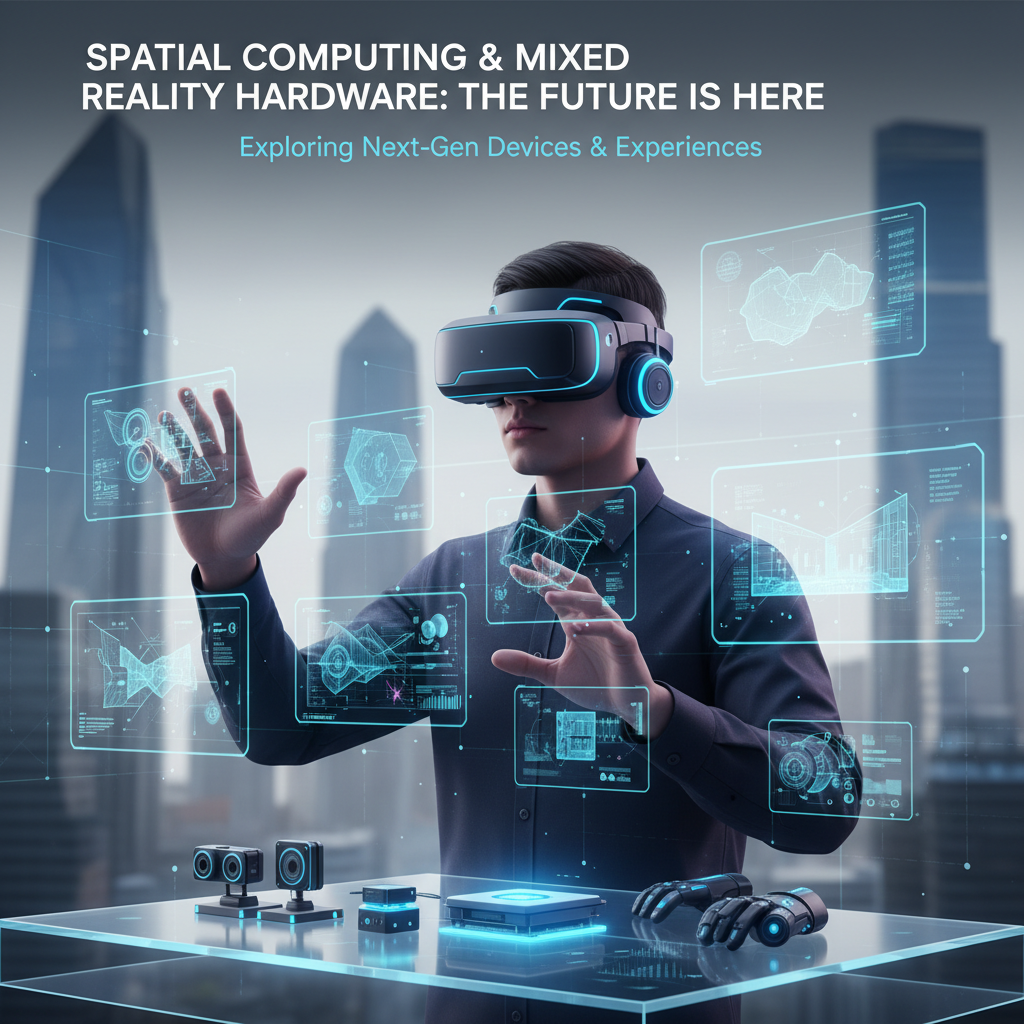
Unpacking the Future: MR Hardware & Spatial Computing
Ever wondered how the digital world is starting to blend seamlessly with our physical one? It’s not just magic – it’s the incredible engineering behind Spatial Computing and Mixed Reality (MR) hardware. Let’s dive into the fascinating tech making it all possible!
What is Spatial Computing, Anyway?
Spatial computing is a paradigm shift where computers understand and interact with the physical world, placing digital content directly within our real-world environment. Think of it as your computer gaining awareness of its surroundings, allowing you to interact with information and applications not just on a screen, but *within* your space. And at the heart of this revolution lies powerful, sophisticated hardware.
The Essential Ingredients: Key Hardware Components
To create these immersive experiences, MR devices are packed with cutting-edge technology. Each component plays a vital role in blurring the lines between the physical and digital.
Crystal-Clear Displays: Your Window to Another World. These aren’t just any screens. MR headsets require high-resolution, high-refresh-rate displays with wide fields of view to convince your brain that digital objects are truly present. Innovations like micro-OLEDs and pancake optics are crucial for vivid imagery and a compact form factor. Through these displays, digital information is overlaid onto your view of the real world, whether it’s a floating 3D model or an interactive menu.
Sensors & Tracking: Knowing Where You Are and What You’re Doing. This is where the “spatial” part truly comes alive. A suite of cameras (RGB, depth, infrared), LiDAR scanners, and Inertial Measurement Units (IMUs – accelerometers, gyroscopes) work in concert. They constantly scan your environment, mapping the room, tracking your head and hand movements, and understanding spatial anchors. This precise tracking allows digital content to stay fixed in place relative to the real world, even as you move around.
Processing Power: The Brain of the Operation. All this data – from scanning the environment to rendering complex 3D graphics – requires immense computational power. MR devices feature powerful custom chips, often akin to those found in smartphones but optimized for spatial tasks. These System-on-a-Chip (SoC) designs, like Apple’s R1 or Qualcomm’s Snapdragon XR series, handle real-time sensor fusion, AI-driven scene understanding, and graphic rendering, often requiring sophisticated active cooling solutions.
Input & Interaction: How You Talk to the Digital World. Gone are the days of just a mouse and keyboard. MR hardware embraces natural interaction methods. Hand tracking allows you to manipulate virtual objects with your bare hands, eye tracking lets you select items just by looking, and voice commands offer another intuitive way to control your experience. Some devices also include physical controllers for more precise interactions, especially in gaming or professional applications.
Today’s Trailblazers: A Glimpse at Current Hardware
The MR hardware landscape is rapidly evolving, with several key players pushing the boundaries. Devices like the Apple Vision Pro showcase high-resolution passthrough video, advanced eye, and hand tracking, and a powerful custom chip for seamless spatial computing. The Meta Quest series, while primarily VR, increasingly integrates mixed reality capabilities through color passthrough cameras, offering a more accessible entry point. Microsoft’s HoloLens continues to be a leader in the enterprise sector, providing robust mixed reality solutions for industrial and medical applications. Each device offers a unique take on how we interact with and perceive digital information in our physical space.
The Road Ahead: Challenges and Exciting Possibilities
While current MR hardware is incredibly impressive, there are still exciting frontiers to explore. Challenges include reducing device bulk and weight, extending battery life, increasing the field of view, and making these powerful devices more affordable for mainstream adoption. The future promises even lighter, more comfortable designs, enhanced processing efficiency, and tighter integration with Artificial Intelligence for even smarter spatial understanding. Imagine devices that can predict your needs or seamlessly integrate with smart home technologies based on your presence and gaze.
Stepping into Tomorrow, Today
Spatial computing and mixed reality hardware aren’t just futuristic concepts; they are here, evolving rapidly, and beginning to redefine how we work, play, and connect with information. It’s an exciting time to witness the birth of a new computing era, built on the incredible ingenuity of these devices that allow us to literally step into tomorrow, today. Keep an eye on this space – the innovation is just getting started!
“`


Leave a Reply