
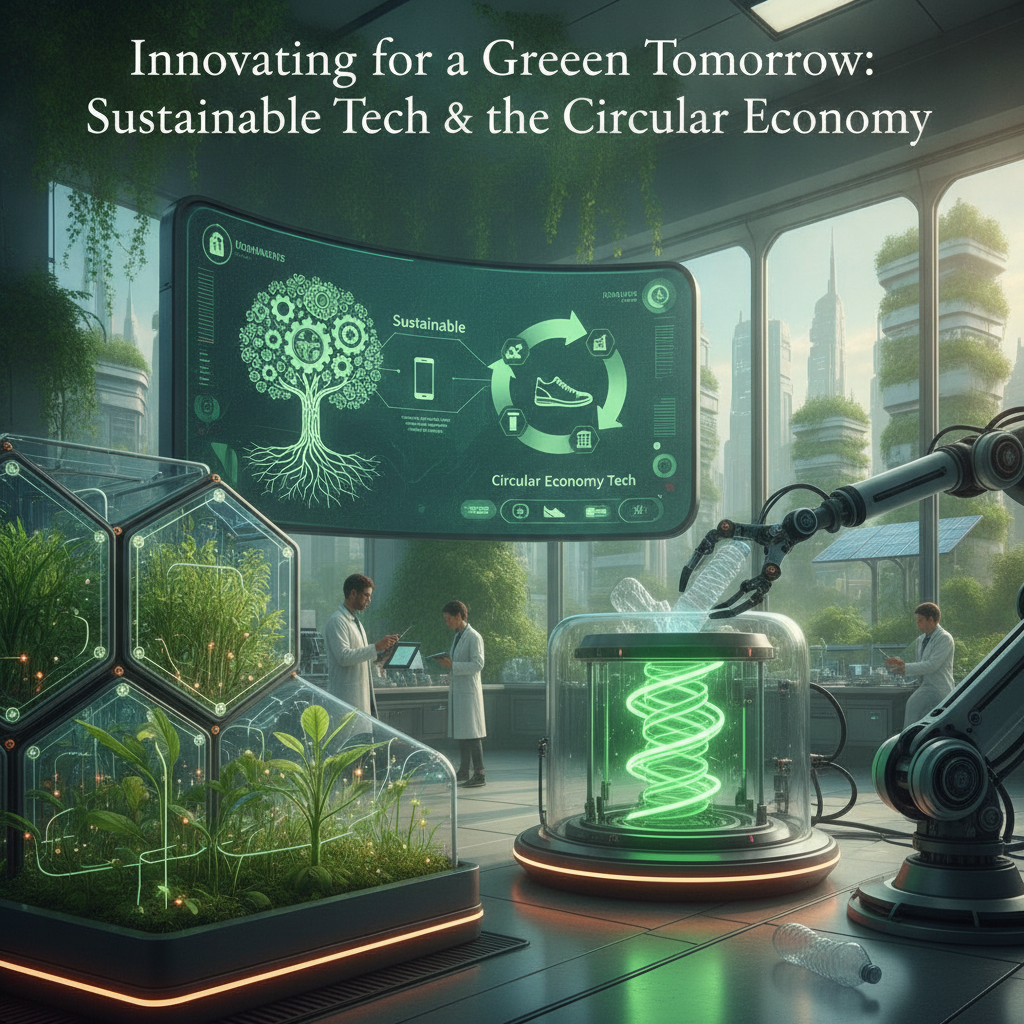
Innovating for a Circular Future: Sustainable Tech
The way we produce and consume is at a crossroads. For decades, a linear “take-make-dispose” model has dominated, leading to mounting waste, resource depletion, and environmental strain. But what if we could design out waste, keep materials in use, and even regenerate natural systems? Enter the exciting world of Sustainable Materials and Circular Economy Tech – a powerful combination shaping a greener future!
What Are Sustainable Materials?
At its heart, sustainability in materials means drastically reducing their environmental footprint throughout their entire lifecycle. This isn’t just about recycling; it’s about thoughtful design from the ground up. Think beyond traditional plastics and metals to innovations like:
- Bio-based materials: Plastics and composites derived from plants, algae, or fungi, offering biodegradable or compostable alternatives.
- Recycled content materials: High-performance products made from post-consumer or post-industrial waste, giving old materials new life.
- Responsibly sourced materials: Wood, minerals, and other resources extracted with minimal environmental and social impact.
- Waste-derived materials: Turning industrial by-products or even agricultural waste into valuable building blocks.
These materials are designed to be durable, repairable, and ultimately, to cycle back into the economy rather than ending up in a landfill.
Embracing the Circular Economy with Tech
A circular economy is an economic model built on three core principles: design out waste and pollution, keep products and materials in use, and regenerate natural systems. Technology is the indispensable engine driving this transformation, making it scalable and efficient.
Tech Driving the Transformation
Here’s how cutting-edge technology is making the circular economy a reality:
1. AI & IoT for Smarter Resource Management
Artificial Intelligence (AI) and the Internet of Things (IoT) are revolutionizing how we track and manage resources. IoT sensors can monitor material flows in supply chains, track product usage to optimize maintenance, and even identify when a product is ready for repair or recycling. AI algorithms can then analyze this data to predict demand, optimize sorting processes, and streamline reverse logistics, ensuring materials stay in circulation for longer.
2. Blockchain for Transparency and Traceability
Imagine knowing the exact origin, composition, and environmental impact of every component in a product. Blockchain technology offers this level of transparency. By creating an immutable, decentralized ledger, blockchain can track materials from their source through manufacturing, use, and end-of-life, verifying sustainability claims and enabling more efficient recovery and recycling.
3. Advanced Recycling Technologies
Beyond traditional mechanical recycling, new technologies are unlocking possibilities for materials previously deemed unrecyclable. Chemical recycling breaks down complex plastics into their basic monomers, allowing them to be rebuilt into virgin-quality plastic. Biological recycling uses enzymes or microbes to decompose materials. These innovations are critical for closing material loops that mechanical processes can’t handle.
4. Digital Twins & Lifecycle Assessment (LCA) Software
Designing for circularity starts before a product is even made. Digital twin technology creates a virtual replica of a product, allowing designers to simulate its entire lifecycle – from material sourcing to potential end-of-life scenarios. Paired with advanced LCA software, this helps optimize designs for durability, repairability, and recyclability right from the drawing board, minimizing environmental impact proactively.
5. Robotics and Automation for Disassembly and Sorting
Efficiently disassembling complex products or sorting mixed waste streams manually is often challenging and costly. Robotic systems, powered by AI, are becoming adept at identifying and separating different materials with incredible precision and speed. This automation is crucial for extracting valuable resources from discarded items, boosting recycling rates and recovering higher quality secondary materials.
The Future is Circular
The synergy between sustainable materials and circular economy tech isn’t just an environmental aspiration; it’s a powerful economic opportunity. It fosters innovation, creates new jobs, and builds resilient supply chains less dependent on finite virgin resources. As consumers and businesses, supporting these advancements and embracing circular practices is a vital step towards a more sustainable and prosperous future for all.
“`



Leave a Reply