Unlocking Creativity: Advanced Generative AI & Multimodal Models
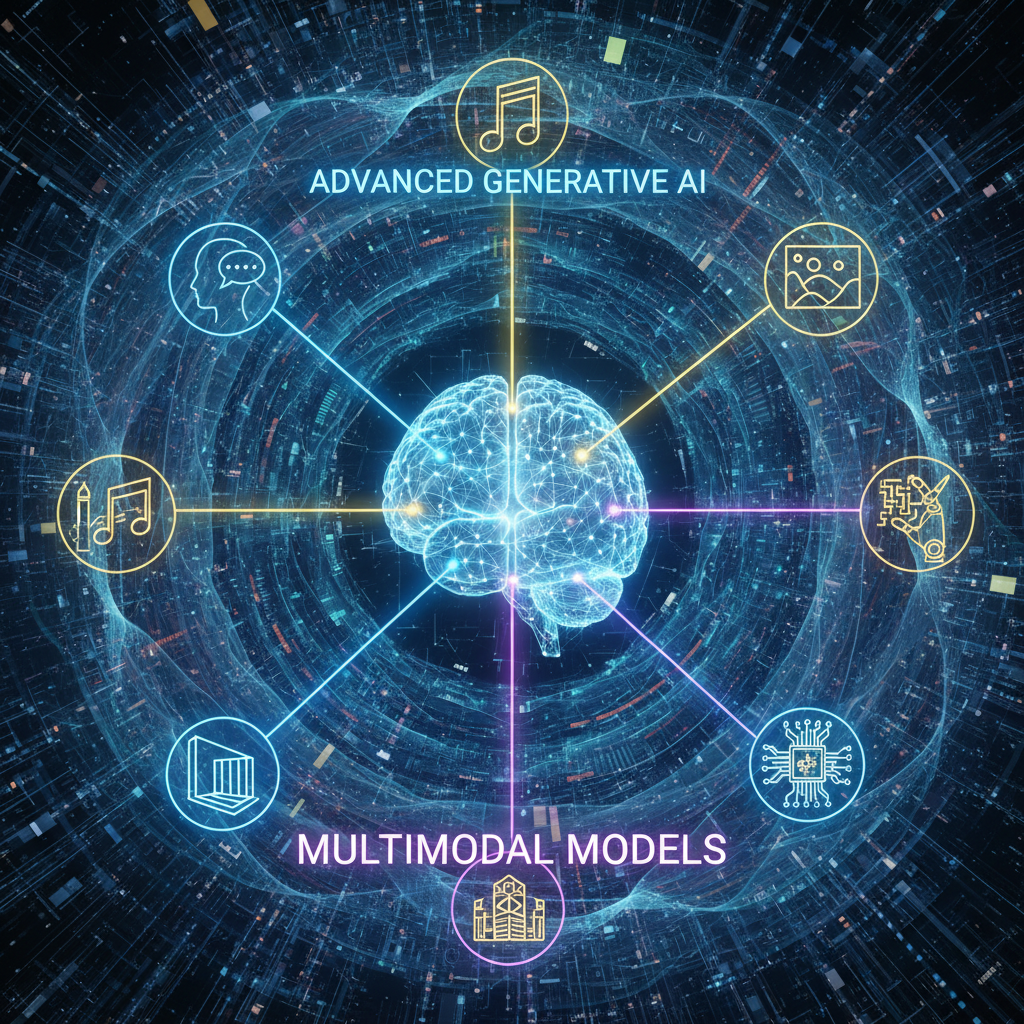
Welcome to the cutting edge of artificial intelligence! If you’ve been following the world of AI, you’ve undoubtedly encountered generative models. But what happens when we push these capabilities further, integrating multiple forms of information? That’s where Advanced Generative AI and Multimodal Models truly shine, ushering in an era of unprecedented creativity and functionality.
Beyond the Basics: What is Advanced Generative AI?
Advanced Generative AI refers to the evolution of models that can create new, original, and realistic content across various domains. Unlike earlier models that might generate simple text or images, today’s advanced systems leverage deeper architectures like sophisticated transformer networks and diffusion models. These allow them to learn complex patterns from massive datasets, enabling them to produce remarkably coherent narratives, intricate artworks, compelling music, and even functional code – often indistinguishable from human-created content.
The “advanced” aspect also comes from their ability to understand context better, follow nuanced instructions, and exhibit a form of creativity previously thought exclusive to humans. They are not merely regurgitating data; they are synthesizing new information based on the learned underlying distributions.
The Power of Perception: Understanding Multimodal Models
Imagine an AI that doesn’t just read a sentence but also sees an image, hears a sound, and understands how they all relate. That’s the essence of a Multimodal Model. These groundbreaking systems are designed to process, interpret, and generate information from multiple data types simultaneously – combining text, images, audio, video, and more.
For example, models like OpenAI’s GPT-4 (with vision capabilities) can not only answer questions about text but also describe images, infer context from visuals, and even perform complex reasoning tasks by integrating information from both modalities. This ability to cross-reference and synthesize different forms of input leads to a richer, more human-like understanding of the world, and consequently, more sophisticated and relevant outputs.
Transforming Industries: Key Applications and Impact
The implications of advanced generative AI and multimodal models are vast and revolutionary. They are already beginning to reshape numerous sectors:
Content Creation: From generating marketing copy and blog posts to drafting film scripts, composing music, and creating digital art, these models empower creators to accelerate their work and explore new artistic frontiers.
Design & Prototyping: Architects can generate design options, product designers can visualize concepts, and engineers can simulate complex systems with greater speed and efficiency.
Education & Research: Personalized learning experiences, automated research summaries, and even the generation of synthetic data for scientific experiments are becoming realities.
Accessibility: Multimodal models can translate sign language to text, describe visual content for the visually impaired, and enhance communication for diverse user groups.
Healthcare: Assisting in drug discovery, generating personalized treatment plans, and analyzing medical images with greater precision.
These models are not just tools; they are powerful collaborators, augmenting human capabilities and opening doors to innovations we’ve only just begun to imagine.
Looking Ahead: Challenges and Future Directions
While the potential is immense, advanced generative AI and multimodal models also present significant challenges. Ethical considerations surrounding bias in data, the potential for misuse (e.g., deepfakes), copyright issues, and the sheer computational resources required are all areas of active research and debate.
The future, however, looks incredibly bright. We can expect even more sophisticated models capable of deeper reasoning, real-time multimodal interaction, and perhaps even a form of common-sense understanding. The synergy between different modalities will only strengthen, leading to AI systems that perceive and interact with our world in increasingly nuanced and intelligent ways, truly blurring the lines between digital and physical creativity.
The journey with Advanced Generative AI and Multimodal Models is just beginning. It’s a thrilling time to witness and be a part of this technological revolution that promises to redefine how we create, communicate, and innovate. What possibilities do you envision with these powerful tools?
“`
Leave a Reply