
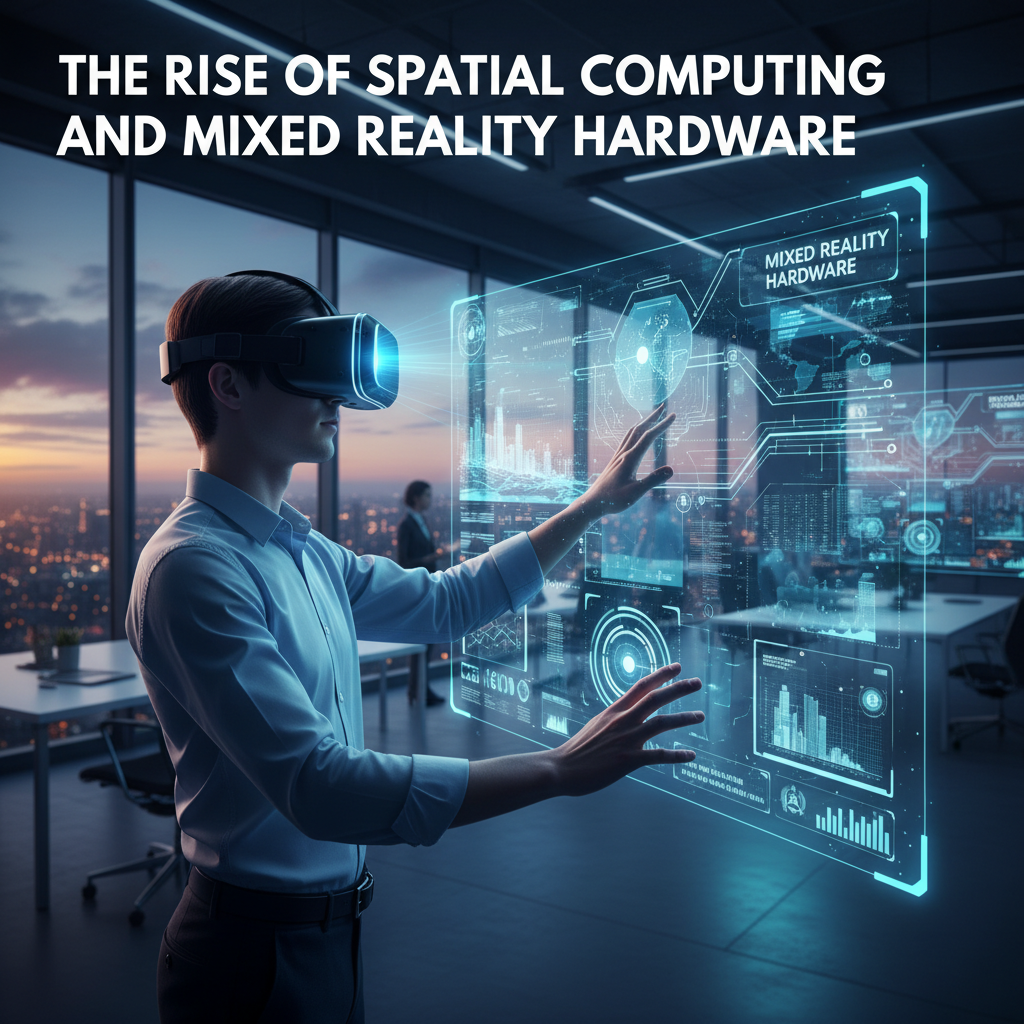
Stepping into Tomorrow: Spatial Computing & MR
Remember when flip phones were cutting edge? It feels like just yesterday! Now, we’re on the cusp of another monumental shift in how we interact with technology. Welcome to the era of Spatial Computing and Mixed Reality (MR) hardware, where our digital lives are no longer confined to flat screens but blend seamlessly with our physical world.
What Exactly is Spatial Computing?
Imagine your computer programs, apps, and data aren’t just on your desktop, but exist all around you, anchored in real space. That’s the essence of spatial computing. It’s an evolution from traditional computing, allowing us to interact with digital content as if it were part of our environment. Think of it as a canvas that extends beyond your monitor, using the real world as its backdrop.
Decoding Mixed Reality (MR)
You’ve probably heard of Virtual Reality (VR) and Augmented Reality (AR). Mixed Reality (MR) is the exciting sweet spot in between. While VR fully immerses you in a digital world, and AR overlays digital information onto your real view, MR takes it a step further. It allows digital objects to interact with your physical environment in a realistic way – a virtual ball could bounce off your real table, or a digital assistant could stand in your living room and respond to its layout. It’s about truly blending the two realities.
The Hardware Leading the Charge
The vision of spatial computing and MR wouldn’t be possible without groundbreaking hardware. Devices like the Apple Vision Pro are bringing high-fidelity spatial experiences to the consumer market, boasting incredible displays and intuitive interaction methods. On the enterprise side, we’ve seen pioneers like the Microsoft HoloLens demonstrate powerful capabilities for training, design, and remote assistance. And let’s not forget the continuous advancements in the Meta Quest series, pushing the boundaries of accessible VR and MR experiences for gaming and social interaction.
These devices are packed with sophisticated sensors, cameras, and processors that map your environment, track your movements, and render stunning digital content with remarkable precision. They are literally our windows into this new spatial dimension.
Transforming Our World: Applications and Impact
The potential applications of spatial computing and MR are truly vast:
- Work & Productivity: Imagine collaborating on a 3D model with colleagues across the globe, all appearing as if they’re in the same room, manipulating the model with gestures. Or having multiple virtual monitors floating around you in your real office.
- Entertainment & Gaming: Beyond immersive gaming, think of interactive storytelling where the characters appear to be in your living room, reacting to your presence.
- Education & Training: Surgeons can practice complex procedures on realistic digital organs, engineers can design and test prototypes virtually, and students can explore historical sites as if they were there.
- Design & Creativity: Architects can walk through their building designs before they’re built, and artists can sculpt in 3D space with their hands.
This isn’t just about cool gadgets; it’s about fundamentally changing how we learn, work, play, and connect.
Challenges and the Road Ahead
While the excitement is palpable, there are still hurdles to overcome. Cost, battery life, form factor (making devices lighter and more comfortable), and the development of compelling content are all areas that need continued innovation. However, the trajectory is clear: as these technologies mature, they will become as ubiquitous and indispensable as smartphones are today.
We are truly at the dawn of a new computing paradigm. Spatial computing and mixed reality hardware aren’t just gadgets; they’re the keys to unlocking a future where our digital and physical worlds merge into a single, seamless, and infinitely interactive experience. Get ready to step in!

Leave a Reply