Unlocking Creativity: Advanced Multimodal AI
The Next Frontier in AI
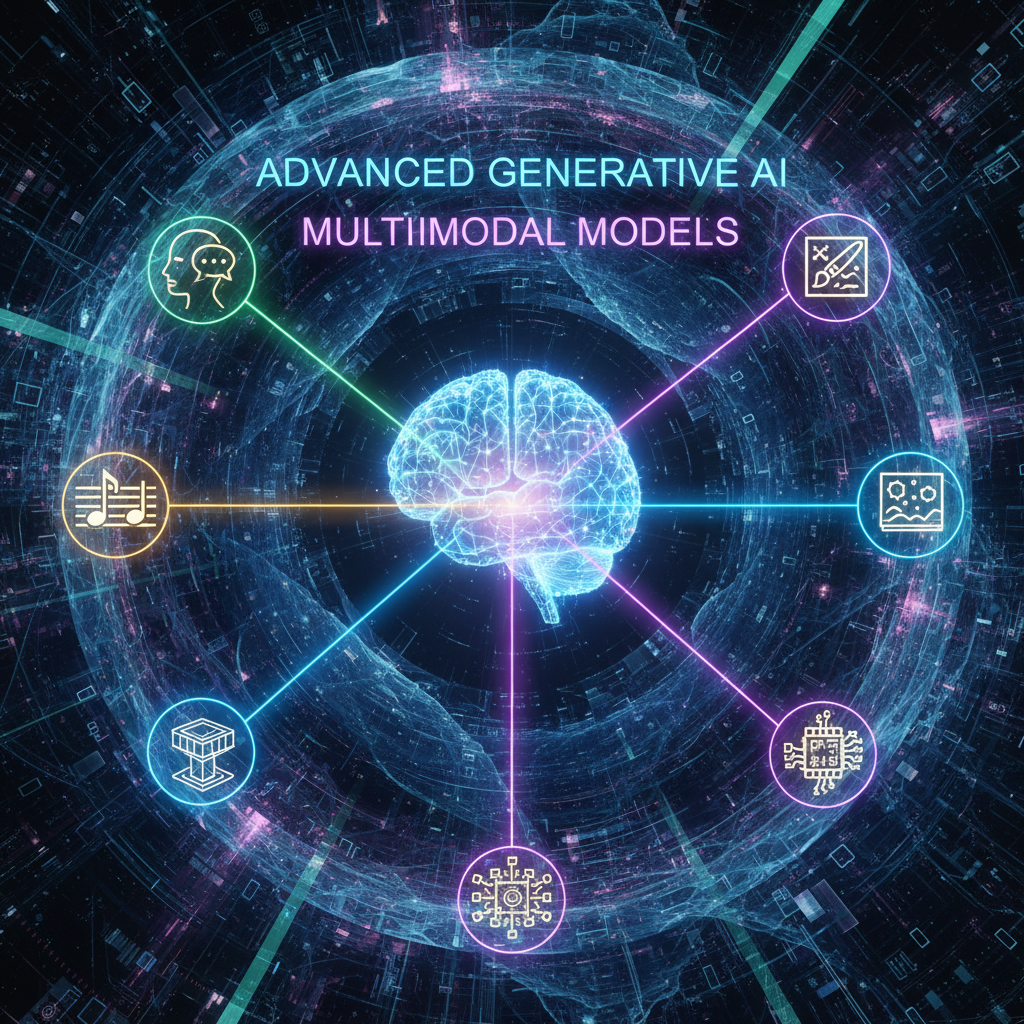
Artificial Intelligence has been on a remarkable journey, from rule-based systems to deep learning models that can master complex tasks. Today, we stand at the cusp of an even more exciting era: Advanced Generative AI and Multimodal Models. These innovations are not just refining existing capabilities; they’re fundamentally changing how we interact with technology and unleash creativity, pushing the boundaries of what machines can perceive and produce.
What is Advanced Generative AI?
Generative AI, in its essence, refers to models capable of generating new, original content rather than just analyzing or classifying existing data. Think beyond predictive text – we’re talking about AI that can compose music, write compelling stories, design intricate images, or even create entire virtual worlds. Advanced generative models, often powered by sophisticated architectures like Diffusion Models and Transformer networks, learn complex patterns from vast datasets to produce outputs that are remarkably coherent, creative, and often indistinguishable from human-made content.
The Power of Multimodal Models
While powerful on their own, generative AI truly shines when it becomes “multimodal.” A multimodal model is an AI system that can process, understand, and generate information across multiple types of data or “modalities.” This means it can integrate and reason with text, images, audio, video, and even 3D data simultaneously. Instead of just understanding a written description, a multimodal AI can process the description, analyze an accompanying image, and even listen to a related audio clip to build a richer, more human-like understanding of context.
How They Work Together
The magic happens when advanced generative AI meets multimodal capabilities. These models are designed to learn intricate relationships between different modalities. For instance, you could provide a text description and ask the AI to generate a photorealistic image that matches it perfectly, or feed it an image and request a detailed narrative. They can generate a video from a text prompt, or even create music that perfectly complements a scene. By bridging the gaps between diverse data types, multimodal generative models enable unprecedented levels of creative control and synthesis, leading to outputs that are richer and more contextually aware.
Real-World Applications and Impact
The implications of advanced generative AI and multimodal models are vast and transformative:
Content Creation: Artists, designers, writers, and musicians can leverage these tools to generate drafts, explore new styles, or even create entire pieces of art, music, or literature from simple prompts.
Design and Prototyping: Architects and product designers can rapidly generate multiple design iterations based on sketches, text descriptions, and material preferences.
Education and Accessibility: Multimodal AI can create interactive learning experiences, generate descriptive audio for visually impaired users from images, or translate complex concepts across different media types.
Human-Computer Interaction: Imagine interacting with AI through natural language, images, and gestures simultaneously, leading to more intuitive and effective communication.
Challenges and the Road Ahead
While the potential is immense, there are also significant challenges. Ethical considerations surrounding bias in training data, the potential for misuse (e.g., deepfakes), intellectual property rights, and the sheer computational resources required are all critical areas of ongoing research and discussion. However, as researchers continue to innovate, we can anticipate models that are even more sophisticated, efficient, and capable of understanding and generating an even wider array of complex, diverse, and personalized content, pushing humanity’s creative boundaries.
Join the Multimodal Revolution
Advanced Generative AI and Multimodal Models are not just buzzwords; they represent a fundamental shift in our technological landscape. They are empowering creators, driving innovation, and offering us new ways to understand and interact with information. Keeping an eye on these developments means staying ahead in a rapidly evolving world, where the only limit is our imagination.
Leave a Reply