
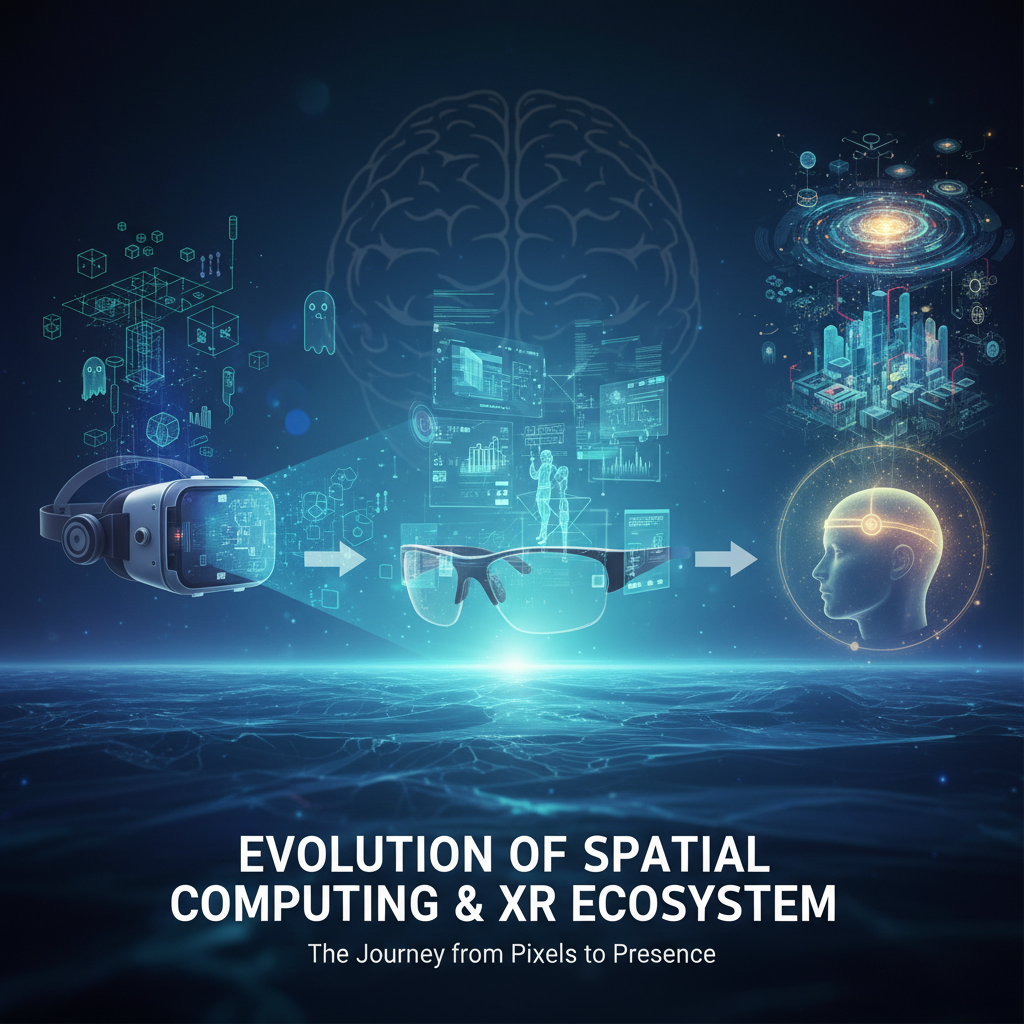
The XR Evolution: From Pixels to Presence
Hello, fellow tech enthusiasts!
Remember when “virtual reality” was a futuristic concept confined to sci-fi movies? Or when augmented reality was just a quirky filter on your phone? Well, hold onto your hats, because the world of Spatial Computing and XR (Extended Reality) has evolved at a breathtaking pace, transforming from niche curiosities into a burgeoning ecosystem poised to redefine how we interact with digital information and the physical world.
Early Seeds: The Dawn of Digital Worlds
The journey of spatial computing isn’t new; its roots stretch back decades. Think of Ivan Sutherland’s “Sword of Damocles” in the 1960s, a pioneering head-mounted display that offered a glimpse into overlaying digital graphics onto the real world. Or Morton Heilig’s Sensorama, an immersive experience machine from the ’50s. These were the audacious, early attempts to break the two-dimensional screen barrier, laying the groundwork for what was to come.
For a long time, XR remained largely in labs or high-cost industrial applications, often hindered by technological limitations like processing power, display quality, and tracking accuracy. But the vision was clear: to create more natural, intuitive ways to interact with data and environments.
The XR Awakening: A New Era of Immersion
The 2010s marked a pivotal shift. The rise of powerful mobile processors, miniaturized sensors, and high-resolution displays democratized the technology. Companies like Oculus (later Facebook, now Meta) ignited a consumer VR revolution, bringing relatively affordable, immersive headsets to the masses. Suddenly, people could step into virtual worlds from their living rooms.
Simultaneously, augmented reality found a home in our pockets. Smartphone AR apps, powered by platforms like Apple’s ARKit and Google’s ARCore, allowed millions to experience digital objects seamlessly integrated into their real surroundings. Microsoft’s HoloLens demonstrated the immense potential of mixed reality for enterprise, showcasing how 3D holograms could assist workers in complex tasks.
The Ecosystem Blooms: Beyond the Headset
Today, the XR ecosystem is far more than just headsets and smart devices. It’s a complex web of interconnected technologies and disciplines:
- Hardware Innovation: Lighter, more powerful, and increasingly standalone devices (e.g., Meta Quest series, Apple Vision Pro, Magic Leap) are constantly pushing boundaries.
- Software and Platforms: Robust development tools (Unity, Unreal Engine), cloud-based rendering, and spatial operating systems are making creation and deployment easier.
- Content and Applications: From gaming and entertainment to remote collaboration, training simulations, healthcare, and retail, XR applications are diversifying rapidly.
- Enabling Technologies: AI and machine learning enhance realism and interaction; 5G reduces latency for cloud-rendered experiences; haptic feedback adds a sense of touch; and advanced tracking systems provide unparalleled precision.
This convergence means XR is no longer just about seeing digital content; it’s about experiencing and interacting with it in a truly spatial way.
What’s Next? The Spatial Future is Here
Looking ahead, the evolution of spatial computing promises an even more integrated and pervasive future. We’re moving towards a world where digital information is contextual, persistent, and seamlessly blended with our physical reality, accessible through various form factors – from smart glasses to embedded sensors.
Imagine collaborating with colleagues as holograms across continents, doctors performing intricate surgeries with AI-assisted AR overlays, or simply navigating your city with persistent digital information layered over your view. The potential is immense, albeit with ongoing challenges around usability, content creation, privacy, and accessibility.
Join the Journey!
The journey from early experiments to a sophisticated spatial computing and XR ecosystem has been incredible, and we’re truly just scratching the surface. It’s a field brimming with innovation, creativity, and the promise of new ways to learn, work, play, and connect.
What excites you most about the future of XR? Share your thoughts in the comments below!
“`



Leave a Reply