

Quantum Leaps: Progress & Real-World Impact
Quantum computing, once a distant dream, is rapidly evolving from theoretical marvel to tangible technology. This field promises to revolutionize industries by solving problems intractable for even the most powerful classical supercomputers. Let’s dive into the exciting progress being made and explore the practical applications that are on the horizon, shaping a future powered by quantum.
Recent Strides in Quantum Hardware
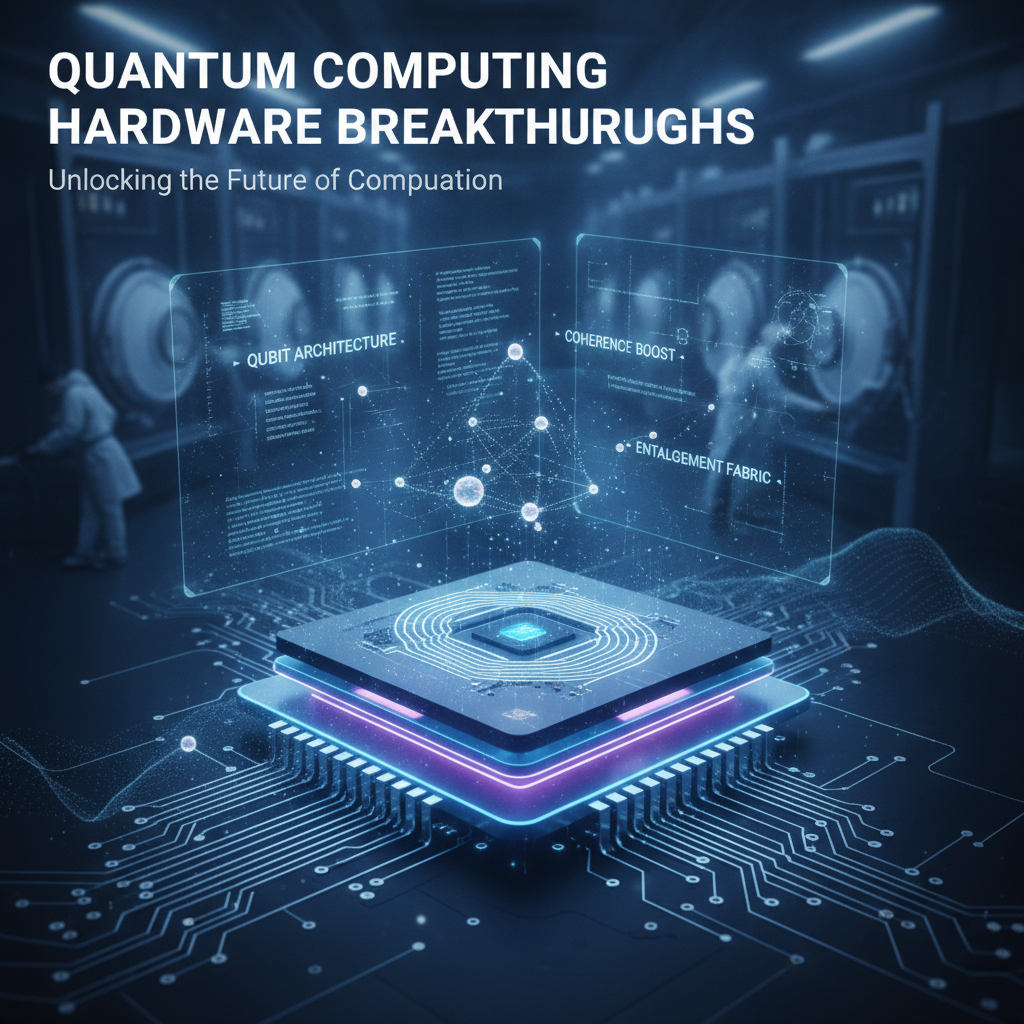
The past few years have seen remarkable advancements in quantum hardware. We’re witnessing a steady increase in qubit counts, with major players like IBM, Google, and others pushing boundaries. Beyond raw numbers, significant progress is being made in qubit quality, coherence times, and error correction techniques – crucial steps toward building fault-tolerant quantum computers. These improvements are allowing researchers to run more complex algorithms and gain deeper insights, moving us closer to commercially viable quantum solutions.
Revolutionary Practical Applications
The potential applications of quantum computing span across numerous sectors, promising breakthroughs that were previously unimaginable. Here are some of the most anticipated:
Materials Science & Drug Discovery
One of the most profound impacts of quantum computing will be in simulating molecules and materials at an unprecedented level of detail. This capability could dramatically accelerate the discovery of new drugs, design of more efficient catalysts, and creation of novel materials with bespoke properties (e.g., superconductors, highly efficient batteries). Imagine developing life-saving medicines or sustainable energy solutions in a fraction of the time currently required!
Financial Modeling & Optimization
The financial sector stands to gain immensely from quantum computing’s ability to tackle complex optimization problems. Quantum algorithms could enhance portfolio optimization, fraud detection, risk analysis, and even accelerate high-frequency trading strategies. By processing vast datasets with unparalleled speed, quantum computers could provide financial institutions with a significant competitive edge and more robust risk management tools.
Logistics & Artificial Intelligence
Optimization is at the heart of many real-world challenges, from supply chain logistics to traffic management. Quantum computing offers a pathway to solve these complex combinatorial problems far more efficiently, leading to reduced costs, increased efficiency, and a smaller environmental footprint. Furthermore, quantum machine learning algorithms hold the promise of accelerating AI development, enabling faster training of models and unlocking new possibilities in data analysis and pattern recognition.
The Road Ahead: Challenges and Promise
While the progress is thrilling, it’s important to acknowledge that challenges remain. Scaling quantum computers, maintaining qubit stability, and developing robust error correction protocols are active areas of research. However, the collaborative efforts across academia, industry, and governments are pushing these boundaries daily. We’re in an era of “noisy intermediate-scale quantum” (NISQ) devices, where practical applications are just beginning to emerge, setting the stage for even more powerful machines in the future.
Conclusion: A Quantum Future Awaits
Quantum computing is no longer science fiction; it’s a rapidly advancing field with the potential to reshape our world. From accelerating scientific discovery to optimizing global logistics, the practical applications are vast and transformative. As researchers continue to make incredible strides, we’re all witnessing the dawn of a new computational era. Keep an eye on this space – the quantum revolution is just getting started!
“`


Leave a Reply