
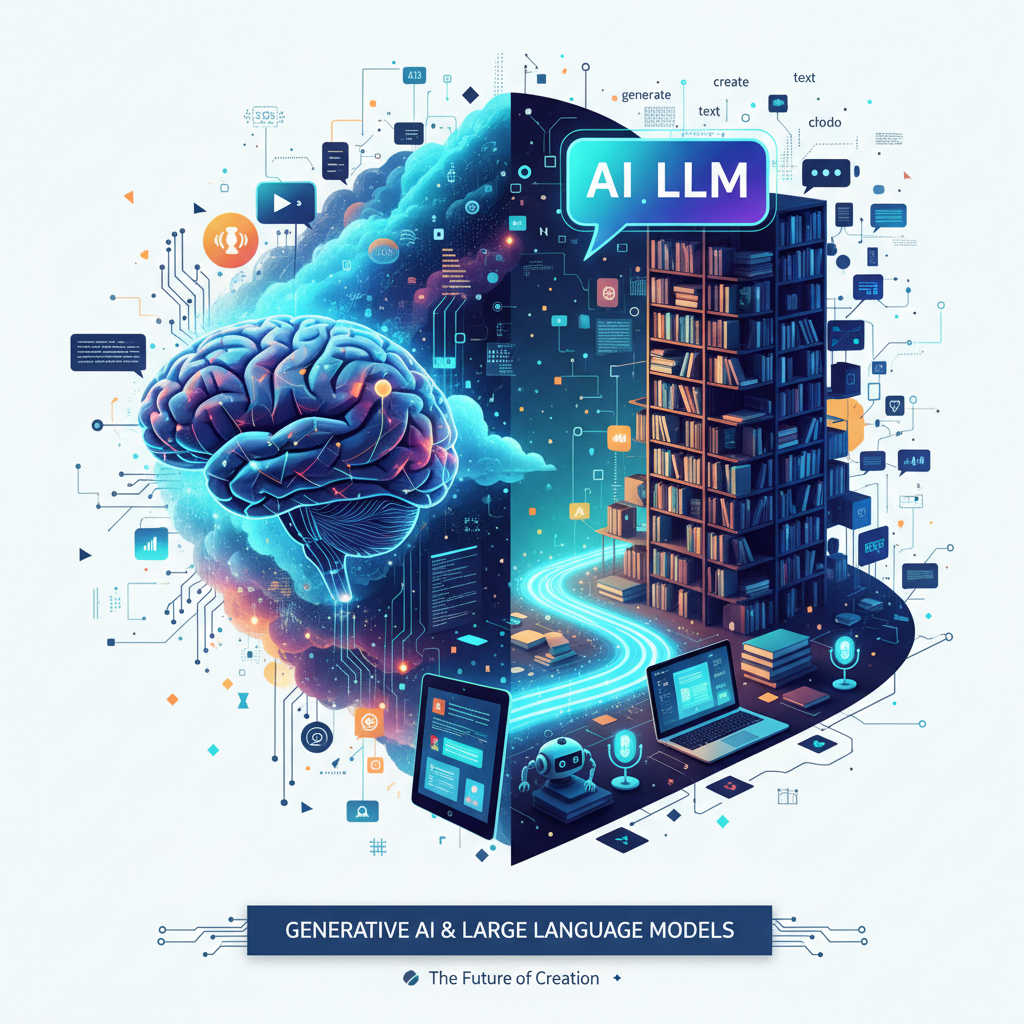
Ever feel like you can’t keep up with the latest tech buzzwords? You’re not alone! Among the most talked-about topics currently are Generative AI and Large Language Models (LLMs). They’re reshaping industries, sparking creativity, and even helping with our daily tasks. But what exactly are they, and why are they so significant? Let’s break it down in a friendly way!
What Exactly is Generative AI?
At its core, Generative AI refers to artificial intelligence systems capable of producing new and original content. Unlike traditional AI, which might analyze data or make predictions based on existing patterns, generative AI doesn’t just process information; it creates it. Think of it like a digital artist, writer, or composer that can produce something entirely novel, whether it’s an image from a text description, a unique piece of music, or even a brand new story.
The “generative” part means it learns from vast amounts of existing data and then generates data with similar characteristics. It’s not copying; it’s learning the underlying patterns and structures to create something fresh.
Enter the Large Language Models (LLMs)
Large Language Models, or LLMs, are a prominent and incredibly powerful type of Generative AI, specifically designed to understand, interpret, and generate human-like text. The “large” in their name refers to two main things:
- The sheer volume of data they’re trained on: Billions of words from books, articles, websites, and more.
- The number of parameters (connections) in their neural network: Often in the hundreds of billions, allowing them to grasp complex linguistic nuances.
These models learn grammar, facts, reasoning, and even a bit of common sense from this massive dataset. They can then take a prompt from you and generate coherent, contextually relevant, and often surprisingly human-like responses.
How Do They Work Their Magic?
Without getting too technical, both Generative AI and LLMs work using complex artificial neural networks. These networks are trained on enormous datasets, allowing them to identify intricate patterns and relationships. When given a prompt or input, the model uses these learned patterns to predict the most probable sequence of data (whether it’s pixels for an image, words for text, or notes for music) that would logically follow, creating something new in the process.
Beyond the Hype: Real-World Applications
The applications for Generative AI and LLMs are rapidly expanding across nearly every sector:
- Content Creation: Drafting emails, writing blog posts, generating marketing copy, summarizing lengthy documents.
- Coding & Development: Assisting developers by generating code snippets, debugging, and explaining complex functions.
- Art & Design: Creating stunning digital artwork, designing logos, or even generating architectural renderings from simple descriptions.
- Customer Service: Powering advanced chatbots that can handle complex queries and provide human-like support.
- Research & Education: Helping researchers synthesize information, assisting students with learning, and generating personalized educational content.
Opportunities & Challenges Ahead
The rise of Generative AI and LLMs presents incredible opportunities for increased productivity, enhanced creativity, and solving complex problems in novel ways. They can automate mundane tasks, freeing up human potential for more strategic and innovative work.
However, they also come with important considerations. Issues like data privacy, potential biases inherited from training data, the need for factual accuracy verification, and ethical deployment are crucial discussions we must continue to have as these technologies evolve. Understanding these challenges is key to harnessing their power responsibly.
The Road Ahead
Generative AI and Large Language Models are not just fleeting trends; they represent a significant leap forward in artificial intelligence. As they continue to develop, becoming even more sophisticated and integrated into our lives, they promise to unlock new levels of innovation and transform how we interact with technology and the world around us. So, next time you hear about them, you’ll know you’re looking at the future, already in motion!
“`



Leave a Reply