
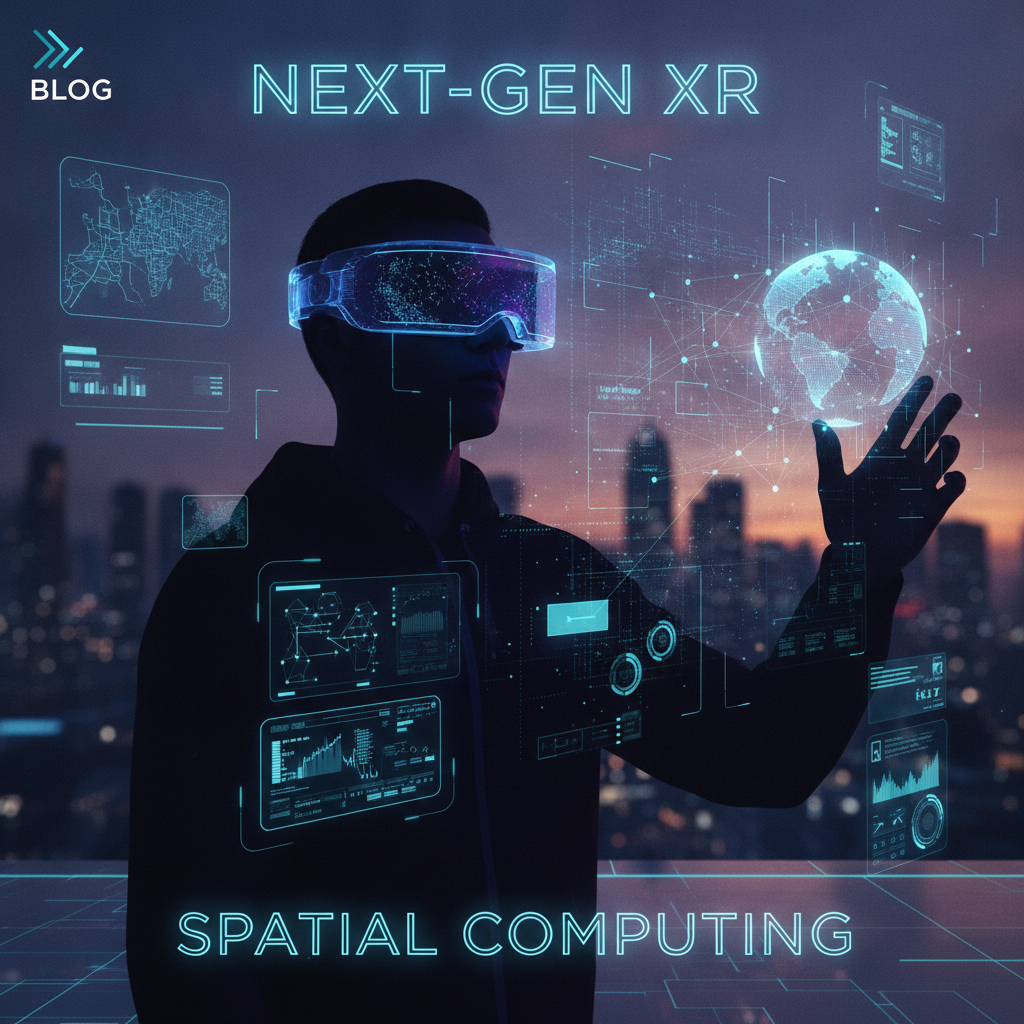
Get ready to redefine how you interact with the digital world! Extended Reality (XR) headsets are evolving at breakneck speed, ushering in an era of ‘Spatial Computing’ that promises to blend our physical and digital realities like never before. It’s not just about gaming anymore; it’s about a fundamental shift in how we work, learn, and connect.
What Exactly Are Next-Gen XR Headsets?
Forget bulky, clunky devices of the past. The latest generation of XR headsets — encompassing Virtual Reality (VR), Augmented Reality (AR), and Mixed Reality (MR) — are sleeker, more powerful, and incredibly immersive. We’re talking about crystal-clear displays, wider fields of view, precise eye and hand tracking, and advanced passthrough capabilities that seamlessly merge digital information with your real-world surroundings.
These next-gen devices prioritize comfort and portability. Think lightweight designs with integrated processing power, making them truly standalone and versatile tools for both professional and personal use. They’re designed to be worn for extended periods, making immersive experiences a practical part of our daily lives.
Decoding Spatial Computing
If XR headsets are the ‘eyes’ to this new world, then Spatial Computing is the ‘brain’ that understands and interacts with it. At its core, Spatial Computing allows digital content to understand and react to the physical space around it. Imagine placing a virtual 3D model on your real-world desk, walking around it, and having it stay exactly where you left it, even when you leave the room and come back.
It’s about creating persistent, context-aware digital experiences that aren’t confined to a flat screen, but exist within your environment, accessible and interactive from multiple devices. This technology understands depth, obstacles, and the user’s presence, creating a truly intuitive and natural interaction model.
The Game-Changing Applications
The potential impact of this convergence is staggering across various sectors:
Enterprise & Productivity:
Remote collaboration with digital twins, interactive training simulations, 3D design and prototyping in a shared virtual space, and performing complex tasks with real-time AR guidance.
Education & Learning:
Immersive lessons where students can explore ancient Rome, dissect a virtual frog, or visit distant planets, fostering deeper understanding and engagement.
Healthcare & Wellness:
Surgical planning, therapeutic treatments, medical training simulations, and even mental wellness applications leveraging immersive environments.
Entertainment & Social:
Truly immersive gaming, virtual concerts, and connecting with friends and family in shared digital spaces that feel incredibly real and present.
Everyday Life:
Navigating with AR overlays, smart home control through spatial interfaces, and personalized digital assistants that understand and interact with your physical environment.
The Road Ahead: Challenges and Excitement
While the technology is rapidly advancing, the journey is just beginning. Challenges like widespread adoption, creating compelling content, ensuring data privacy and security, and the standardization of spatial interfaces are still being addressed by innovators worldwide. However, the vision is clear: a future where our digital lives are seamlessly integrated into our physical world, enhancing our capabilities and enriching our experiences in ways we’re only just beginning to imagine.
The coming years promise to be a fascinating era for technological evolution. Get ready to step into a new dimension of interaction, where the lines between the real and the digital continue to beautifully blur. The future of computing is spatial, and it’s arriving sooner than you think!
“`



Leave a Reply