
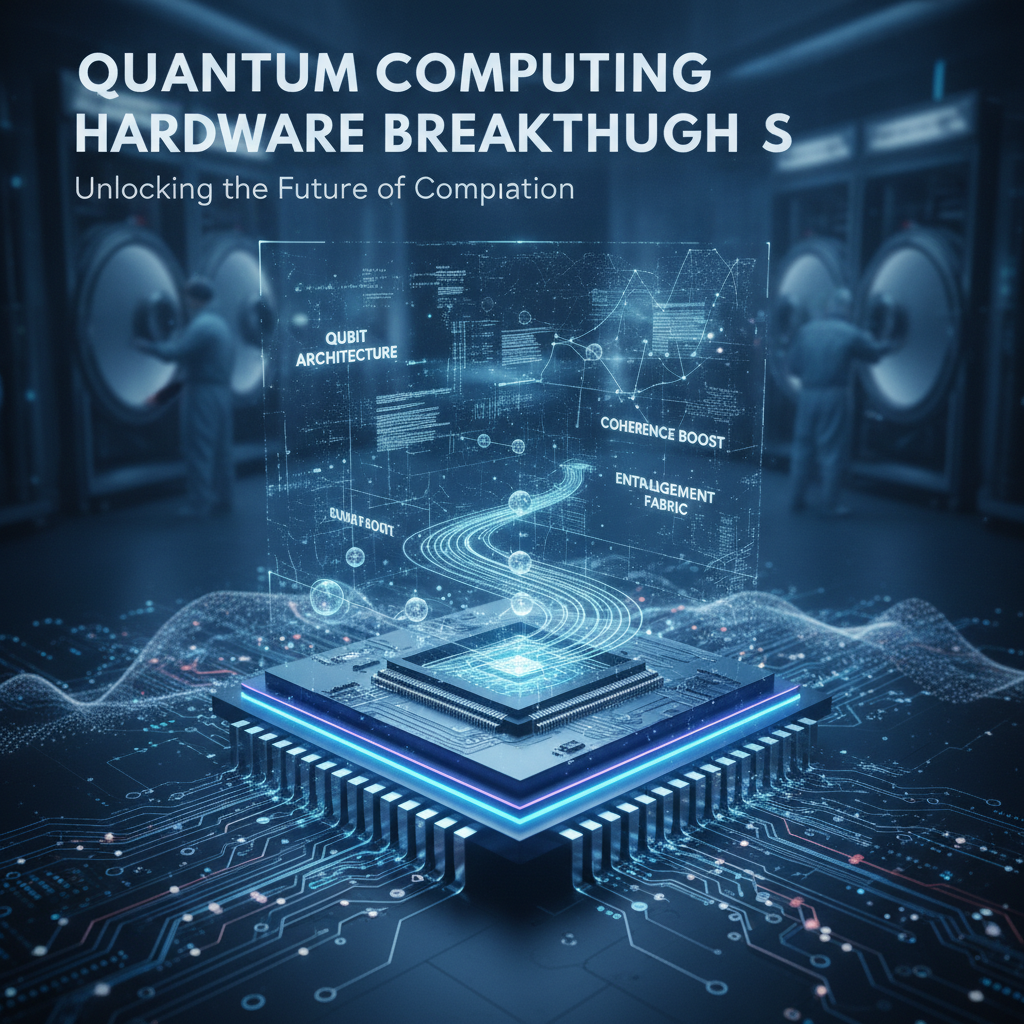
Quantum Hardware Hits New Milestones: Powering the Future
Quantum computing isn’t just a futuristic dream; it’s rapidly becoming a tangible reality, largely thanks to incredible breakthroughs in its underlying hardware. While the theoretical potential of quantum algorithms is vast, translating that into practical applications hinges entirely on building robust, reliable, and scalable quantum processors. And excitingly, the pace of innovation here is breathtaking!
The Core of Quantum Power: Qubit Technologies
At the heart of any quantum computer are qubits, the quantum equivalent of classical bits. Unlike classical bits that are either 0 or 1, qubits can exist in a superposition of both states simultaneously, allowing for exponentially more complex calculations. Different technologies are vying for dominance in creating these delicate quantum building blocks, each with unique strengths and challenges.
Superconducting qubits, often seen in devices from IBM and Google, use tiny circuits chilled to near absolute zero. Trapped ions, favored by companies like IonQ, suspend individual atoms with electromagnetic fields. Silicon-based qubits, optical qubits, and topological qubits are also showing immense promise, pushing the boundaries of what’s possible in varying environments.
Recent Leaps: Qubit Counts, Coherence, and Error Rates
The past few years have witnessed significant strides. We’re seeing a steady increase in the number of qubits integrated into single processors, moving from a handful to dozens, and even over a hundred in some experimental setups. This ‘scaling up’ is critical for tackling more complex problems.
Equally important are improvements in ‘coherence time’ – how long a qubit can maintain its quantum state before external interference causes it to lose its quantum information. Longer coherence times mean more stable operations and more complex computations. Alongside this, error rates are decreasing, making quantum calculations more reliable and bringing us closer to practical error correction.
The Road Ahead: Scaling and Integration
While current processors are impressive, building fault-tolerant quantum computers will require thousands, even millions, of high-quality qubits. This presents immense engineering challenges in terms of fabrication, control, and interconnectivity. Researchers are actively exploring novel architectures and chip designs to overcome these hurdles, including modular approaches that could link smaller quantum processors together.
The integration of classical control electronics with quantum processors is another key area of innovation. Miniaturizing the complex control systems needed to manipulate qubits, especially those requiring extreme cold, is vital for creating practical and accessible quantum systems.
Why Does This Matter? The Impact on Our Future
These hardware breakthroughs are not just scientific curiosities; they are foundational to unlocking quantum computing’s transformative potential. Imagine accelerating drug discovery, designing new materials with unprecedented properties, optimizing complex logistical systems, or breaking currently unbreakable encryption methods. Each hardware improvement brings these applications closer to reality.
The field of quantum computing hardware is incredibly dynamic, with new records and advancements announced regularly. While there’s still a journey ahead, the rapid progress we’re witnessing fills us with optimism. The future powered by quantum technology is not just on the horizon; it’s being built, qubit by qubit, right now. Stay tuned for more exciting updates!


Leave a Reply