
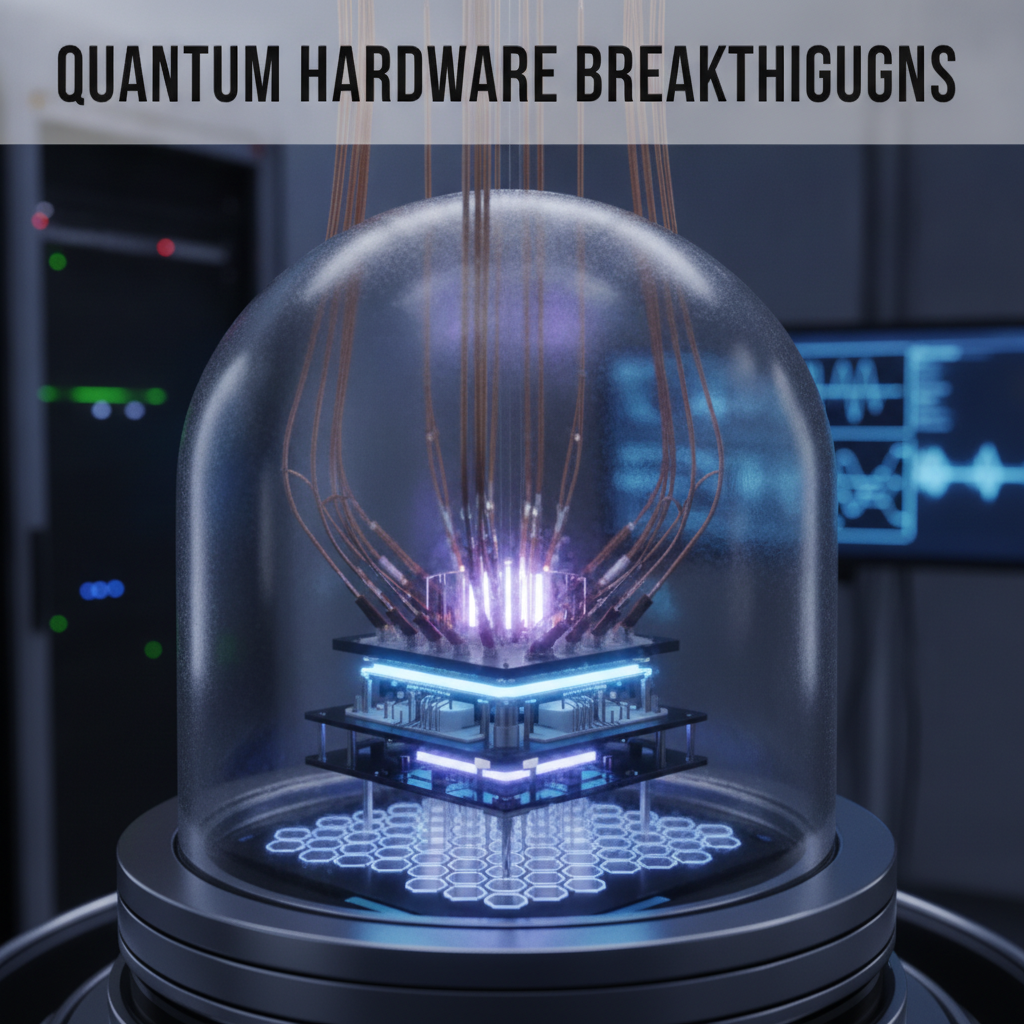
Quantum Leaps: The Race in Hardware Progress
Ever wondered what it takes to build a machine that harnesses the bizarre rules of quantum mechanics? The world of quantum computing isn’t just about groundbreaking algorithms; it’s crucially about the incredible engineering challenge of building the actual quantum hardware. Let’s dive into the fascinating progress being made!
The Building Blocks of Quantum Computers
At the heart of any quantum computer are qubits – the quantum equivalent of classical bits. Unlike classical bits that can only be 0 or 1, qubits can be 0, 1, or both simultaneously (a state called superposition), and they can also be entangled. This unique behavior promises exponential power for certain computational tasks. But making these tiny, delicate quantum systems stable and controllable is an immense task.
The quest for a truly powerful quantum computer hinges on pushing the boundaries of physics and engineering. Researchers worldwide are striving to increase qubit counts, improve their coherence times (how long they maintain their quantum state), and reduce error rates. It’s a multidisciplinary marathon!
Leading the Charge: Different Qubit Technologies
There isn’t just one way to build a qubit, and various technologies are competing and collaborating to achieve breakthroughs. Each has its own strengths and challenges:
- Superconducting Qubits: Often used by companies like IBM and Google, these rely on supercooled circuits that exhibit quantum properties. They are highly scalable but require extreme cryogenic temperatures, just a hair above absolute zero.
- Trapped Ions: Companies like IonQ use lasers to trap and manipulate individual atoms (ions) that serve as qubits. They boast very high fidelity (low error rates) and good coherence times but can be tricky to scale up to many qubits.
- Photonics: This approach uses particles of light (photons) as qubits. They are robust against environmental noise and can operate at room temperature, making them promising for future quantum networks, though building complex gates can be challenging.
- Silicon Spin Qubits: Leveraging existing semiconductor manufacturing techniques, these qubits use the spin of electrons in silicon. They hold promise for scalability and integration with classical electronics but are still in earlier stages of development.
Milestones and Momentum: Recent Achievements
The pace of innovation in quantum hardware is breathtaking. Just a few years ago, quantum computers with dozens of qubits were a distant dream. Now, we’re seeing:
- Processors with over 100 qubits becoming increasingly common, with some reaching into the hundreds, demonstrating the potential for much larger systems.
- Significant improvements in qubit coherence times, allowing for more complex computations before quantum states decohere.
- Steady progress in reducing error rates, a critical step towards fault-tolerant quantum computing, where errors can be detected and corrected.
- The development of modular architectures, enabling the connection of smaller quantum processing units to create larger, more powerful systems.
These aren’t just incremental steps; they represent fundamental advances in our ability to control and protect quantum information, pushing us closer to solving real-world problems.
The Road Ahead: Challenges and Innovations
Despite the incredible progress, significant hurdles remain. Scaling up to thousands or even millions of qubits (necessary for truly powerful, error-corrected quantum computers) requires overcoming immense engineering challenges. Keeping qubits stable and isolated while simultaneously allowing them to interact and perform computations is a delicate balance.
Innovations in cryogenics, quantum interconnects, and control electronics are vital. Researchers are also exploring novel materials and designs to make qubits more robust and easier to manufacture. The journey is complex, but the dedication of scientists and engineers is truly inspiring.
A Future Shaped by Quantum Hardware
The advancements in quantum computing hardware are not just technical marvels; they are the foundation upon which the quantum future will be built. From discovering new drugs and materials to optimizing complex logistics and breaking modern encryption, the potential applications are vast and transformative.
While a universally accessible, fault-tolerant quantum computer is still some years away, the rapid progress in hardware brings us closer every day. It’s an incredibly exciting time to watch this field evolve, and we can all look forward to the “quantum leaps” yet to come!
“`


Leave a Reply