
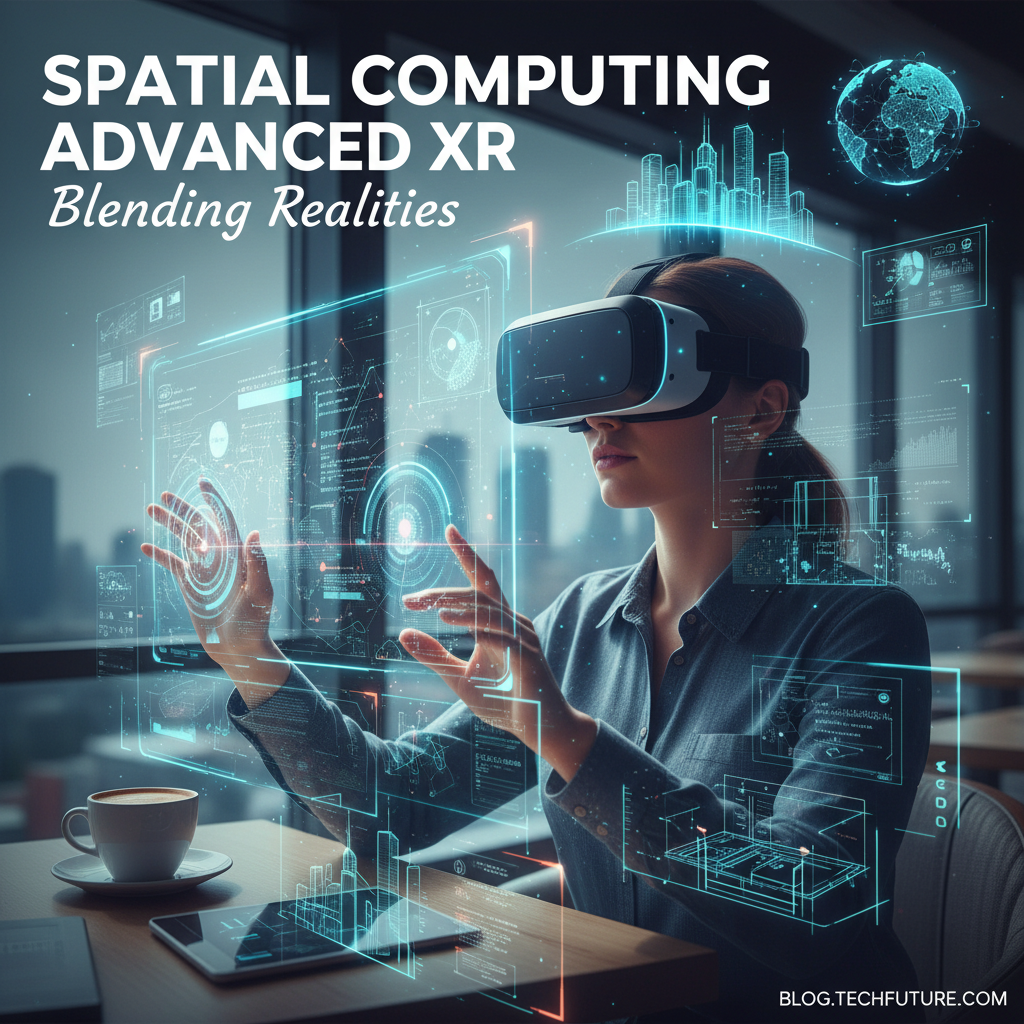
Step into the Future: Spatial Computing & Advanced XR
Imagine a world where digital content isn’t confined to your screens but seamlessly integrates with your physical environment. Welcome to the captivating realm of Spatial Computing and Advanced XR (Extended Reality)! These cutting-edge technologies are not just buzzwords; they represent a fundamental shift in how we interact with information and the world around us.
What is Spatial Computing?
At its core, Spatial Computing is about enabling computers to understand and interact with the real world in three dimensions. It’s the magic that allows digital objects to “know” where they are in your living room, understand the layout of a factory floor, or even react to the real-time movements of people. Think beyond simple AR overlays; Spatial Computing creates a persistent, interactive digital layer that is anchored to our physical reality. This means digital information isn’t just displayed; it becomes part of our space, ready to be manipulated, collaborated on, and experienced as if it were truly there.
The Evolution of Advanced XR
XR is an umbrella term encompassing Virtual Reality (VR), Augmented Reality (AR), and Mixed Reality (MR). Advanced XR takes these concepts to an unprecedented level. We’re moving past bulky headsets and limited experiences towards more intelligent, intuitive, and immersive interactions. This evolution is powered by breakthroughs in everything from high-resolution displays and sophisticated sensor fusion to powerful on-device AI and responsive haptics. Advanced XR aims to blur the lines so effectively that the digital and physical become indistinguishable, offering truly presence-rich experiences that adapt to our context and intent.
Real-World Applications & Impact
The potential applications of Spatial Computing and Advanced XR are vast and transformative.
- Healthcare: From detailed surgical planning and remote assistance for doctors to immersive training simulations for medical students.
- Education: Bringing historical events to life, conducting virtual lab experiments, or exploring complex anatomical models in 3D.
- Industry & Design: Engineers can collaborate on 3D models in shared virtual spaces, factory workers can get augmented instructions overlaid on machinery, and architects can walk through digital twins of buildings before they’re even built.
- Entertainment & Social: Creating hyper-realistic gaming worlds, interactive storytelling experiences, and new ways to connect with friends and family across distances.
These technologies promise to make work more efficient, learning more engaging, and entertainment more immersive than ever before.
Challenges and the Road Ahead
While the future looks bright, several challenges lie ahead. These include optimizing computational power for truly seamless experiences, improving user comfort and ergonomics of devices, addressing data privacy concerns in spatially aware environments, and fostering widespread content creation tools. However, with continuous innovation from leading tech companies and a growing ecosystem of developers, the trajectory is clear: Spatial Computing and Advanced XR are poised to redefine our digital and physical lives in profound ways.
We are truly on the cusp of a new era, where our environments become interactive canvases and digital information is seamlessly woven into the fabric of our reality. Get ready to experience the world in a whole new dimension!
“`



Leave a Reply