
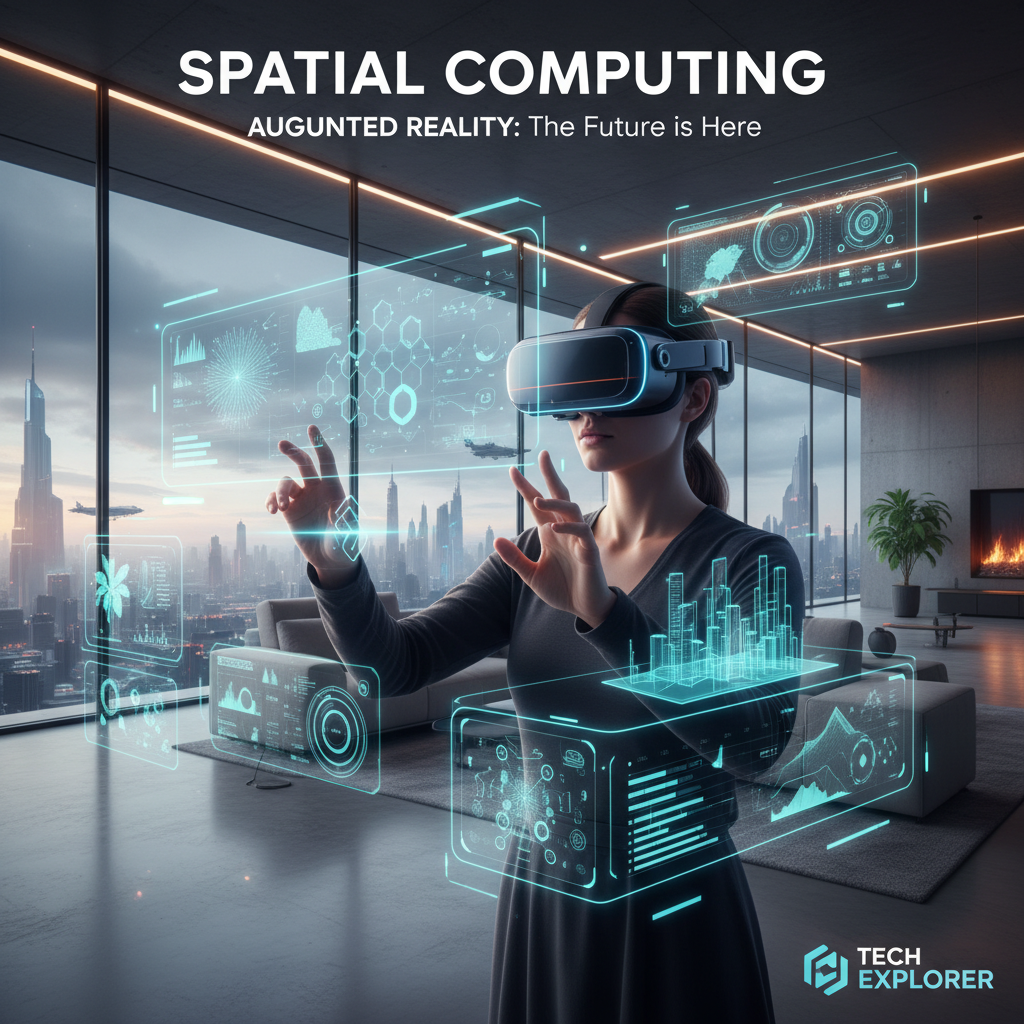
Stepping into the Spatial Future with Augmented Reality
Ever feel like the digital world is a separate entity from our physical one? What if they could seamlessly merge, creating an interactive environment where information and experiences are layered directly onto our reality? Welcome to the exciting frontier of Spatial Computing, where Augmented Reality (AR) acts as our window into this transformative world.
What Exactly is Spatial Computing?
Spatial computing is a paradigm shift where computers understand and interact with the real world, much like humans do. It’s about technologies that can “see” and “understand” the three-dimensional space around them – its objects, geometry, and environment. Think of it as giving computers a spatial awareness, allowing them to track your movements, map a room, and place digital content within that physical context persistently.
This isn’t just about displaying information; it’s about making digital objects aware of their physical surroundings, allowing them to cast shadows, bounce off real walls, and even react to real-world physics. It bridges the gap between our physical existence and the vast digital realm.
Augmented Reality: Your Gateway to the Spatial Web
While spatial computing is the underlying framework, Augmented Reality (AR) is often the most visible and accessible interface for experiencing it. AR devices, whether it’s your smartphone, a tablet, or dedicated AR glasses, overlay digital information onto your view of the real world. This isn’t virtual reality, which fully immerses you in a digital world; AR enhances and augments your actual environment.
Through AR, the abstract data and digital creations of spatial computing become tangible. Imagine seeing a virtual furniture piece in your living room before buying it, following navigation arrows projected onto the street, or collaborating with colleagues on a 3D model that appears to float in your shared office space. AR makes spatial computing actionable and personal.
Transforming Industries and Daily Life
The implications of combining spatial computing with AR are profound and extend across nearly every sector:
- Education: Students can dissect virtual organs in biology class, explore ancient ruins from their classroom, or visualize complex scientific concepts in 3D.
- Healthcare: Surgeons can overlay patient data directly onto their field of view during operations, and medical students can practice procedures on highly realistic digital models.
- Manufacturing & Design: Engineers can prototype and visualize designs in real-world scale, spotting flaws and making adjustments instantly without physical mock-ups.
- Retail: Customers can “try on” clothes, “place” furniture, or “see” how a new appliance fits into their home before making a purchase.
- Entertainment: Gaming evolves as digital characters interact with your physical environment, and live events become more immersive with overlaid graphics and information.
The Road Ahead: Challenges and Promise
While the vision is captivating, bringing spatial computing and AR to their full potential still involves overcoming hurdles. These include improving hardware (lighter, more powerful AR glasses), enhancing real-time spatial mapping capabilities, ensuring privacy and data security, and developing intuitive user interfaces. However, the rapid pace of innovation suggests these challenges are being tackled with enthusiasm.
The future of computing isn’t confined to a screen; it’s interwoven with our physical world. Spatial computing, powered by advancements in Augmented Reality, promises a future where technology enhances our perception, interaction, and understanding of the world around us in ways we’re only just beginning to imagine. Get ready to experience your world anew!



Leave a Reply