
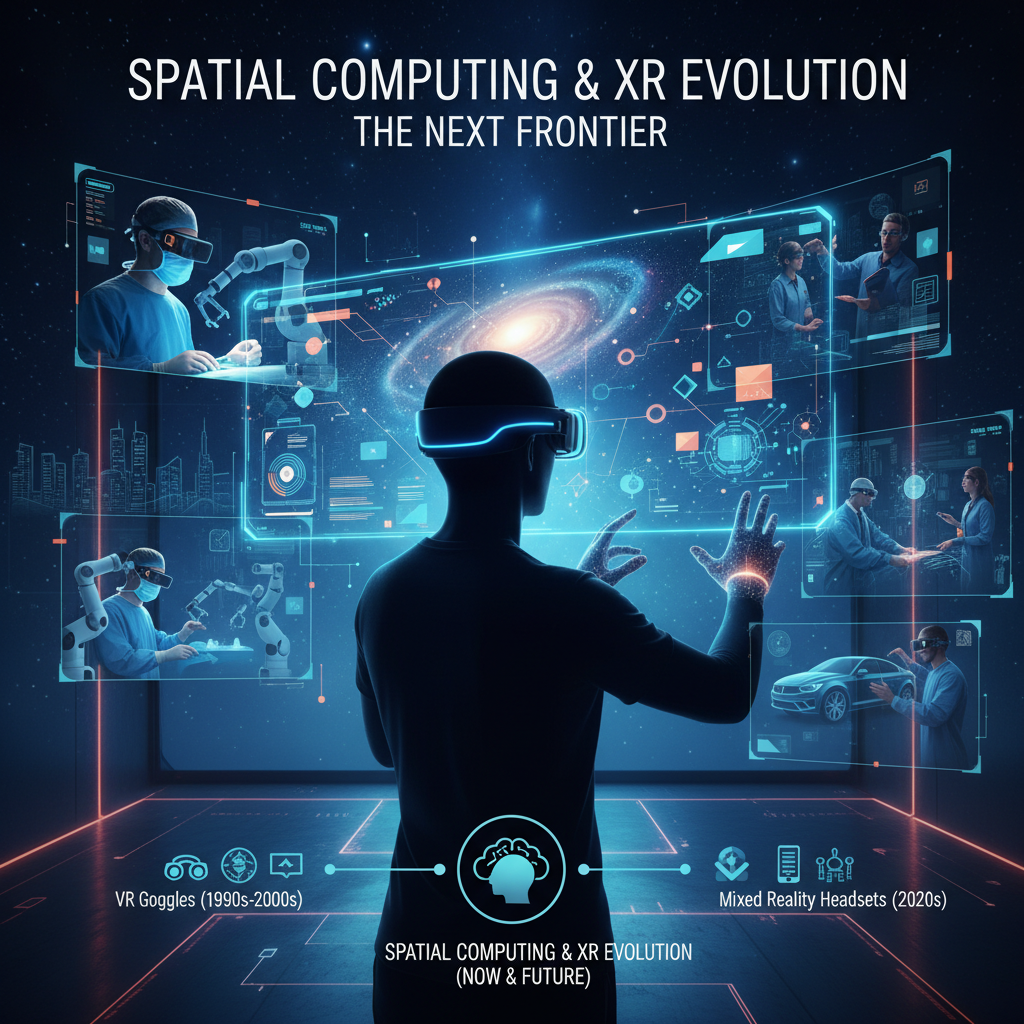
XR & Spatial Computing: The Next Digital Frontier
The digital world is no longer confined to flat screens. We’re on the cusp of a revolutionary shift, moving from traditional 2D interfaces to immersive, 3D environments that blend seamlessly with our physical reality. This evolution is powered by the convergence of Spatial Computing and Extended Reality (XR), promising to redefine how we interact with technology, information, and each other.
What is Spatial Computing?
At its heart, spatial computing is about enabling computers to understand and interact with the physical world in three dimensions. It allows digital content to exist and persist in real-world spaces, responding to environmental cues and user movements. Imagine a digital blueprint floating accurately over a construction site, or a virtual object remaining anchored to your coffee table even when you walk away and return. It’s about blending bits with atoms, making technology truly location-aware and context-sensitive.
The XR Spectrum: AR, VR, and MR
Extended Reality (XR) is an umbrella term encompassing several immersive technologies that merge the real and virtual worlds:
- Virtual Reality (VR): Fully immerses users in a simulated environment, often blocking out the real world entirely. Think VR headsets for gaming or intensive training simulations.
- Augmented Reality (AR): Overlays digital information onto the real world, enhancing what we see. Smartphone AR apps or smart glasses showing directions are prime examples.
- Mixed Reality (MR): Blends real and virtual worlds to create new environments and visualizations where physical and digital objects coexist and interact in real-time. This is where spatial computing truly shines, allowing digital holograms to react to real-world surfaces.
Key Drivers of Evolution
The rapid progress we’re seeing in XR and spatial computing is fueled by several accelerating factors:
Hardware Advancements: More powerful, compact, and affordable headsets and devices are hitting the market, offering higher resolutions, wider fields of view, and improved tracking capabilities. These devices are becoming more comfortable and accessible to a broader audience.
Software & Platforms: Robust development tools, SDKs, and specialized platforms are making it easier for creators and developers to build rich, interactive spatial experiences. The ecosystem is maturing rapidly, fostering innovation.
AI Integration: Artificial intelligence is crucial for real-time environment understanding, object recognition, natural language processing, and intuitive user interfaces. AI makes spatial experiences smarter and more seamless.
Enterprise Adoption: Businesses are investing heavily in XR for practical applications like remote assistance, product design, immersive training, and collaborative workspaces. This enterprise adoption proves the tangible value of these technologies beyond consumer entertainment.
Impact Across Industries
The transformative potential of XR and spatial computing is vast and touches nearly every sector:
- Healthcare: Surgeons can practice complex procedures, and medical students can explore human anatomy in interactive 3D. Telemedicine can also be enhanced with remote diagnostic tools.
- Manufacturing & Design: Engineers can visualize prototypes in real-time, collaborate on designs with colleagues across continents, and guide assembly workers with AR overlays for enhanced precision.
- Education: Immersive lessons can transport students to historical events, intricate biological systems, or even distant planets, making learning highly engaging and memorable.
- Entertainment & Gaming: Experiences are becoming incredibly immersive, blurring the lines between player and world, offering new forms of storytelling and interaction.
- Remote Work & Collaboration: Virtual meeting spaces offer a sense of presence and interactivity that traditional video calls simply can’t match, fostering deeper connection and productivity among distributed teams.
Challenges and the Road Ahead
While the future is bright, the path isn’t without hurdles. Challenges include the high cost of advanced hardware, the need for more compelling and diverse content, ensuring user comfort and safety, and addressing critical privacy concerns related to constant environmental scanning. Building a truly inclusive and accessible spatial internet will also require significant effort.
However, with continued innovation, standardization, and a strong focus on user experience and ethical development, these technologies are poised to become as ubiquitous and transformative as smartphones are today.
Stepping into the Future
Spatial computing and XR are not just about gadgets; they represent a fundamental shift in how we perceive and interact with information and our environment. As these technologies mature, they will unlock unprecedented opportunities, making our digital and physical worlds truly one. Get ready to step into a future where technology doesn’t just show you the world, it lets you live inside it.
“`



Leave a Reply