
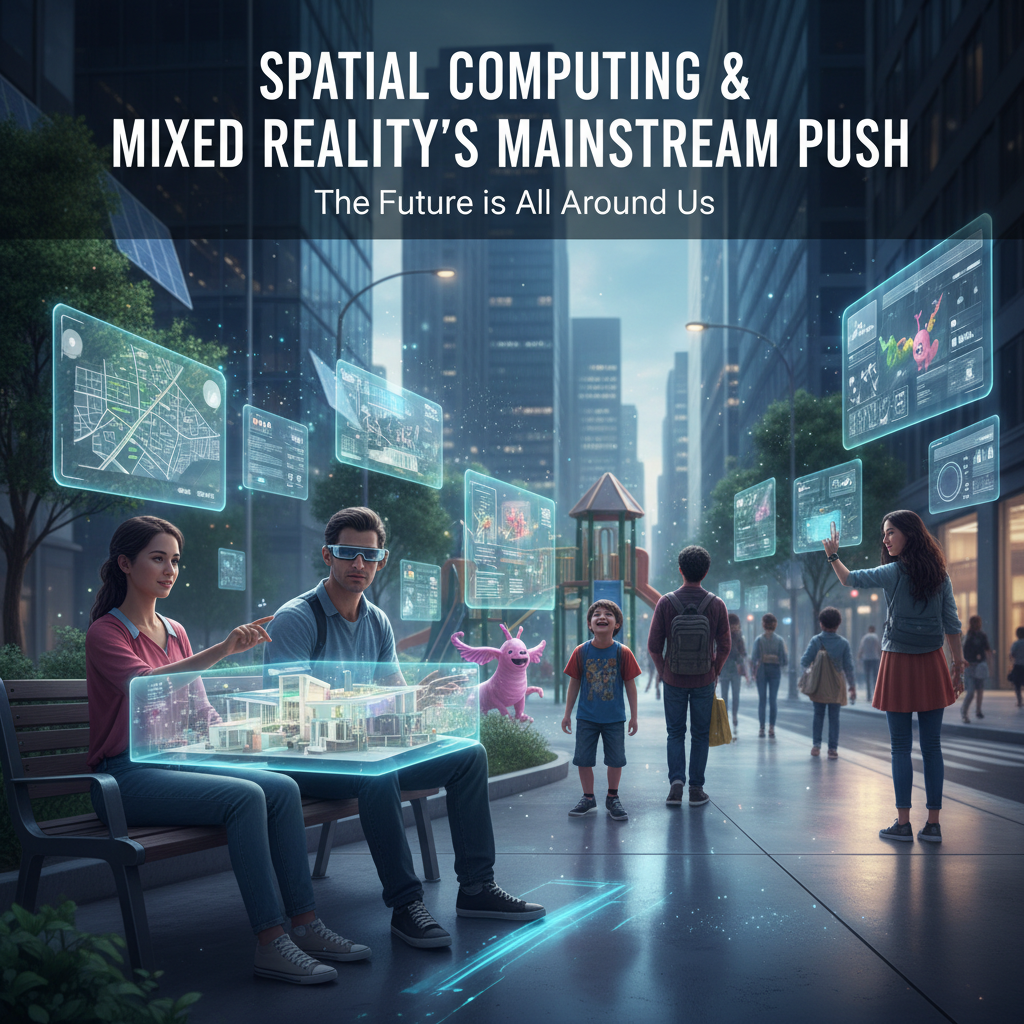
MR & Spatial: Ready for the Mainstream?
Remember when smartphones felt like magic? Get ready for the next wave of innovation that’s set to redefine how we interact with technology and the world around us: Spatial Computing and Mixed Reality (MR). It’s no longer just a futuristic concept; these incredible technologies are making a serious push towards becoming a staple in our daily lives.
What Exactly Are We Talking About?
At its heart, Spatial Computing is about enabling computers to understand and interact with the physical world, creating digital experiences that are aware of their environment. Think about your phone knowing if you’re inside or out, or where objects are around you. Mixed Reality (MR) takes this a step further, blending digital content seamlessly with our real-world view. It’s not just virtual reality (fully immersive digital worlds) or augmented reality (digital overlays on the real world); MR allows digital objects to interact with and be anchored to physical spaces, creating truly integrated experiences.
The Perfect Storm: Why Now?
Several factors are converging to fuel this mainstream push. Hardware has become significantly more powerful, smaller, and more comfortable. Devices like the Meta Quest lineup and Apple Vision Pro are showcasing the potential of robust, standalone MR experiences. Software platforms are maturing, making it easier for developers to create compelling applications. Furthermore, advancements in AI and computer vision are allowing devices to better “understand” our environment, making spatial interactions more intuitive and reliable.
Beyond the Hype: Real-World Applications
While gaming and entertainment often grab the headlines, the true power of spatial computing and MR lies in their practical applications. Imagine surgeons practicing complex procedures in a holographic operating room, architects visualizing their designs at full scale on-site, or remote teams collaborating on 3D models as if they were in the same room. From enhanced education and training to industrial design and healthcare, these technologies promise to revolutionize how we work, learn, and communicate, making our interactions with digital information far more intuitive and immersive.
Challenges on the Road Ahead
Of course, the path to mainstream adoption isn’t without its hurdles. Cost remains a significant factor for many high-end devices. The “killer app” that makes MR indispensable for everyone is still evolving. User comfort, battery life, and the social acceptance of wearing head-mounted displays in public are also important considerations. However, with continuous innovation and increasing investment, these challenges are being addressed piece by piece.
Get Ready for a Spatial Future
The journey of Spatial Computing and Mixed Reality from science fiction to everyday reality is well underway. While it might take some time for these devices to be as ubiquitous as smartphones, the foundational technologies are rapidly advancing, and the potential impact is immense. Keep an eye out – the way we experience the digital world is about to get a whole lot more spatial, and we think you’re going to love it!
Leave a Reply