
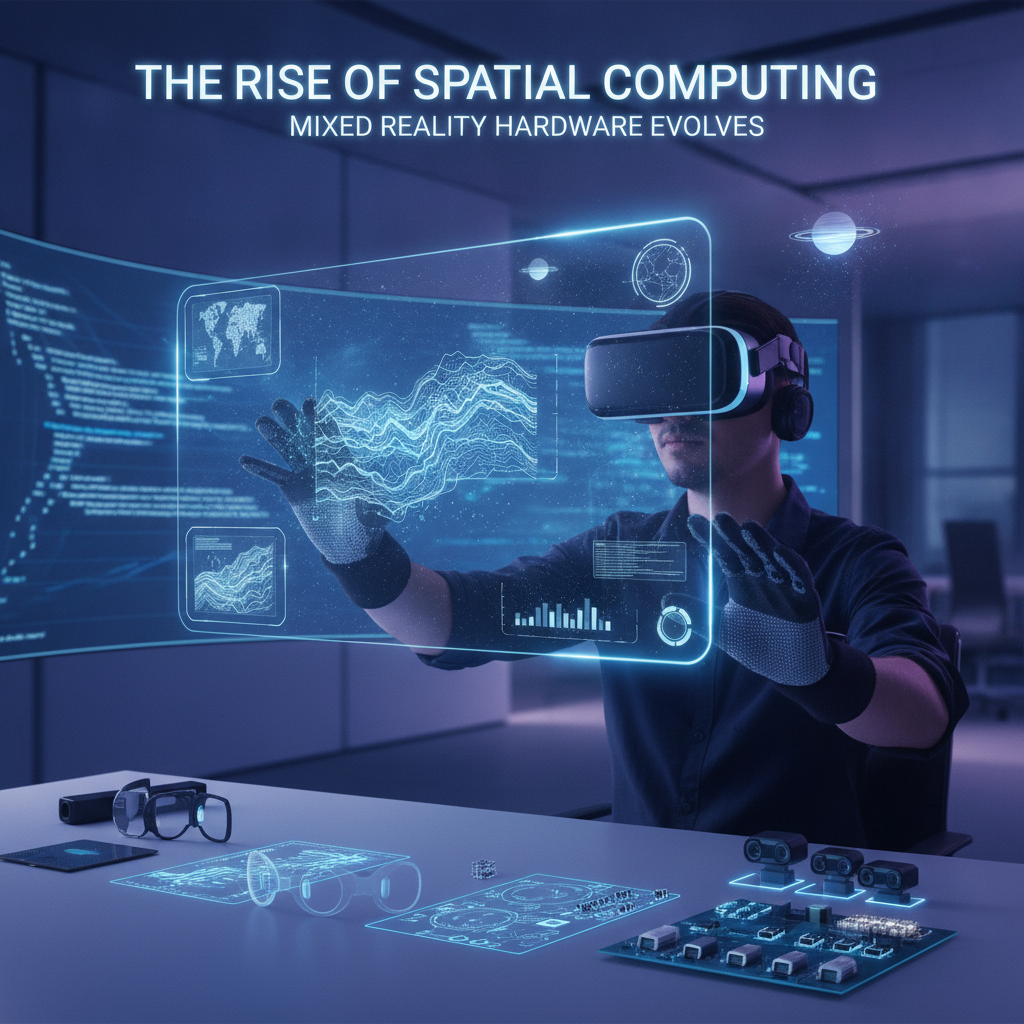
Beyond Screens: Entering the Spatial Computing Era
Remember when smartphones felt like magic? Get ready for the next technological leap. We’re on the cusp of a revolution set to fundamentally change how we interact with technology and the world around us: the rise of spatial computing and mixed reality hardware.
What Exactly is Spatial Computing?
At its core, spatial computing isn’t just about putting a screen in front of your eyes. It’s about empowering computers to understand and interact with our three-dimensional physical environment, blending digital information seamlessly into our real world. Think of it as moving beyond a flat, 2D interface on a phone or monitor, into an immersive, interactive 3D space.
This technology allows digital content – apps, information, objects – to coexist and interact intelligently within your physical surroundings. It’s about context, understanding where you are, what you’re looking at, and then overlaying relevant digital layers. Mixed Reality (MR) is a key component, sitting on a spectrum between augmented reality (AR) and virtual reality (VR), offering the best of both worlds by enabling digital objects to interact convincingly with the real world.
The Hardware Driving the Revolution
While the concepts of AR and VR have been around for decades, recent advancements in hardware are finally bringing spatial computing into the mainstream. Devices like Apple’s Vision Pro, Meta’s Quest headsets, and Microsoft’s HoloLens are leading the charge. These aren’t just fancy displays; they are sophisticated spatial computers packed with:
- High-Resolution Displays: Offering incredibly crisp visuals that make digital content look realistic.
- Advanced Sensors: Tracking eye movements, hand gestures, and environmental mapping to understand your surroundings and intentions.
- Powerful Processors: Capable of rendering complex 3D environments and running sophisticated AI algorithms in real-time.
- Ergonomic Designs: Though still evolving, designs are becoming more comfortable and intuitive, aiming for future all-day wearability.
Impact Across Industries: Beyond Gaming
While gaming and entertainment are often the first things that come to mind, spatial computing’s potential reaches far beyond. Its transformative power is set to redefine numerous sectors:
- Enterprise & Productivity: Imagine architects walking through virtual blueprints on a construction site, or engineers collaborating on 3D models from different continents. Desk-based computing could be replaced by infinitely customizable virtual workspaces.
- Healthcare: Surgeons practicing complex procedures in a virtual environment, or doctors visualizing patient data directly overlaid on the body during examinations.
- Education: Students taking virtual field trips to ancient Rome or dissecting a virtual frog with interactive 3D models, making learning more immersive and engaging.
- Retail: Trying on clothes virtually, or visualizing furniture in your home before you buy it, leading to more informed purchasing decisions.
Challenges and the Road Ahead
Despite the incredible promise, spatial computing faces several hurdles. The current hardware can be expensive, somewhat bulky, and battery life is still a significant limitation. There are also important questions around user adoption, privacy, and the ethical implications of a digitally augmented world.
However, the pace of innovation is accelerating. We can expect devices to become smaller, lighter, more powerful, and significantly more affordable. As developers begin to unlock the true potential of these platforms, we’ll see a surge in compelling applications that move beyond novelty to essential tools that enhance our daily lives.
Conclusion: A New Era of Interaction
Spatial computing isn’t just another tech trend; it’s a fundamental shift in how we will compute, create, and connect. It’s about blending our digital and physical lives in a way that feels natural, intuitive, and ultimately, more human. We are standing at the dawn of a new era, where our screens will no longer be boundaries, but windows into an infinitely expansive, interactive digital world seamlessly integrated with our own. Are you ready to step in?
“`

Leave a Reply