
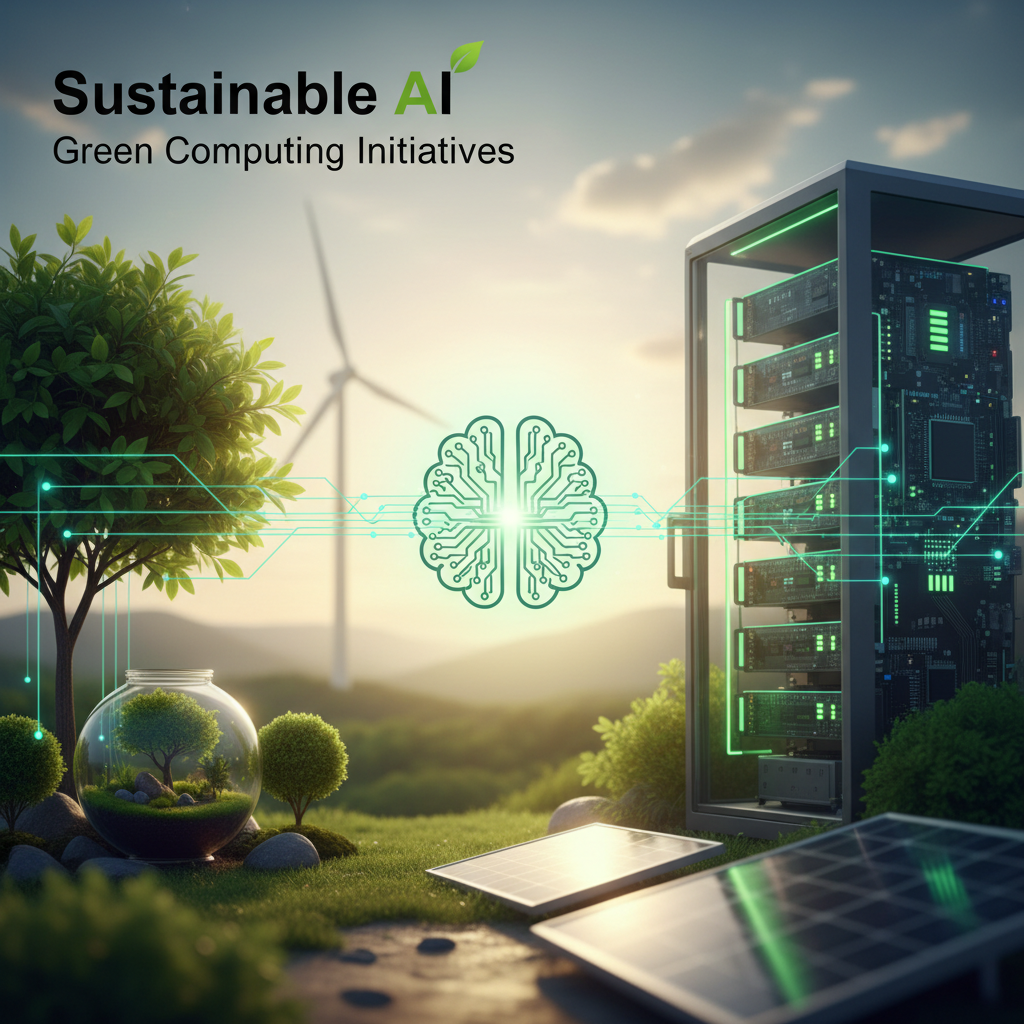
AI’s Green Leap: Sustainable Tech for Tomorrow
Artificial Intelligence (AI) is transforming our world at an unprecedented pace, from enhancing medical diagnostics to revolutionizing our daily routines. While the potential benefits are vast, the energy consumption required to train and run complex AI models is also rapidly increasing, raising crucial questions about its environmental impact. This is where the vital concepts of Sustainable AI and Green Computing come into play.
What is Sustainable AI?
Sustainable AI isn’t just a buzzword; it’s a commitment to developing and deploying AI systems in an environmentally responsible and resource-efficient manner. It encompasses the entire lifecycle of an AI model, from data collection and model training to deployment and maintenance. The goal is to minimize energy consumption, reduce carbon emissions, and optimize hardware usage without compromising performance or innovation.
This includes focusing on more efficient algorithms, reducing the size and complexity of models where possible, and optimizing data processing to lessen computational demands. It’s about ‘doing more with less’ in the AI world, ensuring that our technological progress doesn’t come at an unsustainable environmental cost.
The Power of Green Computing in AI
Green Computing forms the foundational backbone for achieving Sustainable AI. It’s a broad practice that involves the environmentally responsible use of computers and related resources. For AI, this translates into several key areas:
Energy-Efficient Hardware: Utilizing specialized, low-power processors and hardware optimized for AI workloads, such as energy-efficient GPUs and custom AI accelerators.
Optimized Data Centers: Deploying AI infrastructure in data centers that use renewable energy sources, employ advanced cooling techniques (like liquid cooling), and are designed for maximum energy efficiency.
Extended Lifespan: Designing hardware and software with longevity in mind, reducing the frequency of upgrades and e-waste.
By integrating green computing principles, we can significantly mitigate the carbon footprint associated with intensive AI operations, making AI development not just powerful, but also planet-friendly.
Pioneering Green AI Initiatives
The good news is that many organizations and researchers are already making strides in this area. We’re seeing innovative initiatives emerge globally:
Algorithmic Efficiency: Developing ‘lighter’ AI models that achieve similar results with fewer parameters and less computational power. Techniques like model pruning and knowledge distillation are gaining traction.
Renewable Energy Integration: Major cloud providers and tech giants are committing to powering their data centers entirely with renewable energy sources like solar and wind.
Carbon Footprint Tracking: Tools are being developed to measure and report the energy consumption and carbon emissions of AI models during their training phase, enabling developers to make more informed, sustainable choices.
Hardware Innovations: Research into neuromorphic computing and analog AI chips aims to mimic the brain’s energy efficiency, promising significant power reductions compared to traditional digital processors.
These efforts highlight a growing awareness and commitment within the tech community to address the environmental challenges posed by AI’s rapid growth.
Why Sustainable AI Matters for All of Us
Embracing Sustainable AI and Green Computing isn’t just an ethical choice for tech companies; it offers profound benefits for everyone:
Environmental Preservation: Directly contributes to reducing global carbon emissions and mitigating climate change.
Economic Efficiency: Lower energy consumption translates to reduced operational costs for AI infrastructure, making advanced AI more accessible and affordable.
Enhanced Reputation: Companies prioritizing sustainability build trust and appeal to a growing segment of environmentally conscious consumers and investors.
Long-Term Viability: Ensures that AI’s development is sustainable for the long haul, preventing resource depletion and ensuring its benefits can be realized for generations to come.
As AI continues to evolve, integrating sustainability into its core development is not merely an option, but a necessity. By championing Green Computing and fostering Sustainable AI practices, we can harness the incredible power of artificial intelligence to build a smarter, more efficient, and undeniably greener future for all.



Leave a Reply